|
|
Room C Fill of Floor at (T/13,14-13/17,19) No information. |
| Identified as pyre by SIR.
In room E. Burnt "pocket" found while digging red earth that contained late Hellenistic pottery, including a fragment of Pergamene (discarded). No pit was discerned, but concentration ... 3rd quarter 4th c. B.C. |
| Sacrificial Pyre = Pit in floor (identified as pyre by SIR); with the characteristic small plates and saucers. "Saucer Grave" at 12/ΚΑ.
Dimensions: 2m (length)x 0.70 (width).
North of north wall of building ... First half 4th c. B.C. |
| Hellenistic Pyre below packed clay floors of Room 2; west of Late Roman wall extension, below tile platform terracotta drain installation, bordered on the north by bedding foundation stones of crosswall ... Ca. 300 B.C. |
Tile-lined Well in Room 2 of Street Stoa (5/8-13/13), ca. 0.64m in diameter. Tiles set in pairs for each circuit, tops carefully lettered for placement, one hand-hole per tile. Actual well earlier (?) ... 21-26 June 1972 |
Cistern in Room 12, House C=House N.
Simple flask-shaped chamber with draw shaft, in House M, Room 1; no tunnels. Excavated as single fill, but later analysis of material suggested two fills. Coins:
24 ... 4th. c. B.C. |
| Handler ... Found in an area of disturbed fill north of a floor surface in Room 4 of the Classical Commercial Building. The floor surface (n. 3 on the west side of Room 4) was preserved at 52.503-52.544 masl., and ... 2nd half 4th c. B.C. |
Grave in south peristyle of Hephaisteion. Grave LXIV in notebook.
No mention of bones. Coins:
13 March 1939 #21-#23
14 March 1939 #7 Neg. KK 395 ... 13-15 March 1939 |
Tiled well, ca. 30m south of the Tholos. Associated with Building D. Hellenistic Group A with Late Roman fill in upper 3.00m. Objects A 245 and P 4597 are from fill on floor around well-head, contemporary ... 325-260 B.C. |
Coins:
26 May 1936 #2-#3
Fragments of "A" ware and of micaceous water jars; no basket-handled water jars; and a lead seal with the name and portrait of Hadrian ... Late 2nd.-early 3rd. c. A.D. |
No period of use. Below the upper (Early Roman) dump extending down to ca. 6.10m. was a dumped fill of broken pottery in great quantity, including a high proportion of red-figured fragments. Masses of ... Ca. 430-400 B.C.
Late 1st c. B.C.-mid 1st c. A.D. |
| Well in Room 6 of Street Stoa U/2,U/3-13/15.
Associated with the building lying under the Roman Street Stoa. Its fills divided into 5 separate layers, with the bulk of finds belonging to Layer 1, the ... 14 June-21 August 1973 |
| Disturbed pyre in NE stoa area.
In western room of westernmost shop building. A patch of ash i or at the level of layer 2 (lot Ι 189d), partially destroyed by modern wall. Pottery from layer 2 dates ... 400-350? |
| North of House G (RSY=Pyre 13).
Concentration of artifacts, small pieces of bone, and burnt material in stratum, no pit discerned. The pyre is cut by the trench of a wall of a Roman house to north. It ... 290-250 B.C. |
Fillings in a well on south slope of Kolonos Agoraios. The shaft reached a depth of 20.28m., but produced no use filling. The lower part, from water level at 12.60m. to bottom, provided only mud and gravel ... Ca. 425-400 B.C. |
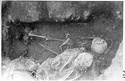
| Laura Gawlinski ... Burial of a woman (young adult female ca. 18-20); precise dating difficult due to disturbance by later features, but the amount of Neolithic and Geometric pottery extracted from the trench is significant ... Prehistoric |
| Laura Gawlinski ... Well in courtyard of Early Building I, adjacent to wall of Room B. Tile lined; upper course in situ, lower two collapsed probably in antiquity. Letters inscribed on rims (eta, phi, omicron, theta). Medium ... First quarter of the 4th c. B.C. |
| Margaret Crosby ... Grave 1 (Grave XXVI: EG) Urn cremation (trench-and-hole), adult male?
[JP]
Boots or Booties Grave. Near the west branch of the Great Drain, about 100m to the southwest of the Agora horos inscription ... Early Geometric I |
Well at 63/ΙΒ (in House H, Room 15). Upper fill mixed Hellenistic to 2nd c. or later. Probably thrown in in Early Roman times when House H was built. Contained many figurines; probably part of Koukla factory ... 12 August 1947 |
| Anne McCabe ... Enchytrismos burial of an infant in Byzantine Room C, L/15-2/13, at 52.915m. Although disturbed by roots, the skeleton (AA 373) was articulated and lay parallel to Wall 1, with head at the NW and feet ... 14-15 June 2007 |
| Cistern on lower north slope of Areopagus.
Latest of thirteen amphora handles dated ca.199; twelve legible coins, the latest dating ca. 196-190. Three intrusive pieces:two semiglazed fragments and piece ... 260-190 B.C. |
| Laura Gawlinski ... Fill excavated south and west of Early Building Ii, Room E latrine, with a high concentration of votive material, such as pyre saucers, miniature loom weights, and ribbon handled plates. Some traces of ... 400-350 B.C. |
| Pyre in House C, Room 12 (RSY=Pyre 9) in the industrial area west of the Areopagus.
Notebook refers to House N.
Beside west wall of room 12. Pottery, burnt bone, and cinders in a roughly round pit; disturbed ... Ca. 250 B.C. |
| Marcie Handler ... This pyre was found in the fill under Pyre J 2:23. Unfortunately, no floor surface was found between the two pyres. There were no complete vessels in this pyre. The sherds of the pyre vessels were mixed ... 275-250 B.C. |
| Rodney S. Young ... Grave 4 in notebook. Amphora, no other pots but carbonized remains of food offerings. Over urn two stone slabs, on top, mass of small stones containing Late Geometric sherd ... Late Geometric |
Soft Trench behind Stoa Stylobate, opposite Piers 21 and 22, along W face of Shop front wall. Herulian destruction debris at the north end of the Stoa of Attalos. Coins:
20 February 1954 #1-#2
22 February ... Late 3rd c. A.D ... Crosby, Agora X, pp. 119-120, no. ... Crosby, Agora X, pp. 121-122, no. ... Crosby, Agora X, p. 118, no. |
| Geometric Burial. Burial B in notebook.
Overlay E 14:13. Skeleton lay on smoothed bedrock, head southward, arms folded on chest, hands below chin. Legs, cut off by later disturbance, probably bent, with ... Late Geometric |
Well dug through cistern at 64/Γ. Seems to have been stratified; four fills recorded but here treated as one as divisions are rather "arbitrary".
Agora V, p. 126: Constructed in late 1st c.; use filling ... 3rd c. A.D. POU (before 267 A.D.) |
Grave in south peristyle of Hephaisteion. Grave LXI in notebook.
No mention of bones. Coins:
11 March 1939 #12-#14
13 March 1939 #4
14 March 1939 #2-#4 Neg. KK 393 ... 11-13 March 1939
18 March 1939 |
Dumped filling of 6th c. A.D. Coins:
3 May 1939 #1-2 (red earth above well)
9 June 1939 #1
10 June 1939 #1
12 June 1939 #1-#5
13 June 1939 #1
19 June 1939 #1-#2, #3 (Dump)
7 May 1940 #1
9 May 1940 #1
27 ... Early 1st-5th c. A.D. POU |
| Dumped filling mostly of 3rd c. A.D., but dumped as late as 5th century. Nbp. 143: The fill in this cistern was of three kinds: to within .60m. of the floor plain broken bedrock with no sherds; then a ... 10-17 February 1937 |
Hellenistic fill, north of Temple of Ares, on either side of wall running east-west over 50/ΙΓ. Mostly coarse pottery including many stamped amphora handles.
Cf. also nb. P XII, pp. 2297-2298. Coins:
13 ... 275-200 B.C. |
| Rodney S. Young ... Grave 13 in notebook.
Two skeletons of small children lay in a pithos which had been put on its side; its mouth was stopped by a stone slab.
Most offerings were inside the pithos, but two kantharoi and ... Late Geometric |
Part of the cistern system 44/ΙΓ - 46/ΙΑ - 42/Θ.
Objects with context as "cistern 44ΙΓ, mouth of 46/ΙΑ" are listed with D 12:2.
The following objects are from "earth", i.e. no context layer:
SS 5334, ... Late Hellenistic-Early Roman |
Irregular depression in bedrock (ca. 7x5m), ca. 2m deep; area south of E-W Late Roman wall. Dumped filling apparently intended to level off the area. Coins:
11 March 1952 #10
12 March 1952 #1-#5
13 March ... Ca. 400-325 B.C. |
Two chambers connected by a tunnel, all filled at the same time, but with slight Hellenistic disturbance. Chamber A, to west at 14/ΛΗ, B to east at 14-15/ΛΒ on grid for section RR.
Cistern system ca. 20.00m ... Ca. 325-275 B.C. |
Accumulated debris on the west side of the market square.
Related layers added 1999/2000 (JWH), e.g. "Gravelly layer above burning", "Clearing Classical floor", "Lowest level above bedrock", "Below burning", ... First half of 5th c. A.D. |
| Evelyn Lord Smithson ... Grave 3: (Grave XXVII: EG). Urn cremation (trench-and-hole), adult male. Carbonized figs and grapes included in inventoried objects (no number). [JP]
"Craftsman-Warrior" tomb: combination of weapons and ... Early Geometric I |
Sand fill N of Base A.
... Because of the uncertainty of ground level contemporary with Base A and of the possibility of missing a continuous strosis or disturbance in this soft sandy fill, I have kept ... Last quarter 2nd-first quareter 3rd c. A.D. |
Cistern at 9/Β (10/Β on plan), at the NW foot of the Areopagus, some 200m to the west of the Coroplast's Dump. It had evidently belonged to one of the small houses in that thickly populated residential ... Second half 4th c. B.C. |
| An extensive cistern system on the lower north slope of the Areopagus, south chamber with blind tunnel extending further south (south tunnel); north chamber; drawshaft further north, extends to north tunnel ... Ca. 320-240 B.C. |
Cistern-shaft at the southeast foot of Kolonos Agoraios.
Nbp. 2369: Two chamber cisterns, 88/ΛΔ and 100/ΚΘ, united by a long straight passage running almost due N-S. A draw shaft at 95/ΚΘ is set just ... Upper fill, Late Roman with some Hellenistic.
Middle fill, Sullan debris to last quarter of 1st c. B.C.
Lower fill, 4th-3rd c. B.C.=POU and abandonment |
Cistern with two tunnels, the one entering its neck cut off by an early Roman well, the other, at the bottom not excavated.
Chamber conical in shape, with a depressed draw basin in the center of the floor ... Early Roman-3rd c. B.C. |
| Rubbish Dump in mouth of abandoned well in Tholos Trench F, Kitchen. Filled with ash, charcoal, broken pottery, roof tiles.
Also from Trench L.
13 March 2014 by Ann Steiner
The deposit has four components ... Ca. 425-400 B.C. |
|
|