|
|
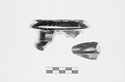
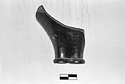
Shoulder fragment.
From a sizable jug decorated with three rows of large projections. Blister ware; light red clay with white bits, smooth orange surfacing.
Cf., from Corinth, C-34-1023: loc. cit., fig ... Ca. 425 B.C. (?) |
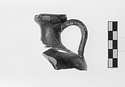
Small squat jug with melon ribs. Blister ware; red clay, gray at the surfaces.
Similar but the ribbing more careful: from Corinth, C-34-1028: Hesperia, VI, 1937, p. 288, fig. 23, 138 ... Context ca. 430-410 B.C. |
Shoulder and wall fragment.
From a sizable jug; broad melon ribs on the shoulder. Blister ware; clay red, surfaces gray to orange.
For the shape and the ribbing see especially from Corinth, C-34-1024: ... Context ca. 470-425 B.C. |
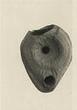
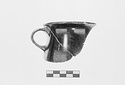
Half of mouth, end of spout, and handle missing.
Heavy, widely flaring foot; curved resting surface; pointed underside.
Two grooves on upper body. Incurved rim nearly flat on top, with groove at edge ... 150-100 |
Floor fragment with start of stem. Part of surface pitted. Max. dim. 0.082. H. A. Thompson, Hesperia 23, 1954, pl. 15:d.
I, symposiast (head, shoulders, upper part of left arm, both legs from the knee ... Ca. 500 B.C. |
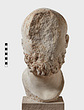
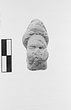
| The face, except for corner of left eye, and the left cheek, is missing; otherwise intact. The neck ends in a carefully cut tenon.
The head is that of a man with a thick curly beard and short curly hair ... Period of Hadrian ... Agora I, no. 23, pp. 33-34, pl. 12. |
Triton?
Head, left arm, right forearm, left wing, most of right wing, lower back, spout, and chalice missing.
Well-muscled male torso with wings growing from shoulders.
On preserved section of right ... 200-175 |
Plakettenvase: Crete Or Alexandria.
Broken all around.
Fragment of wall of large closed vessel, probably amphora or hydria; traces of ribbing at left and right edges of fragment. Nike with left leg forward ... 310-275 |
Equal sides. Stamp on top: bucranium (?). Same as PNW 87.
Glaze: red black to within 0.01 from bottom.
Clay: buff, slight mica. Assembly Place - filling of Period III ... 1930 |
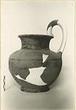
Mended with small missing pieces restored in plaster and painted. Lower part of body, all of foot missing. Thin glaze, reddish in places, abraded in others. P.H. 0.23; max. diam. 0.235; diam. of mouth ... Ca. 480-470 B.C ... Lang, Graffiti in the Athenian Agora (Agora Picture Book 14), rev. ed., Princeton 1988, p. 30, fig. 29; K. ... Rotroff, Birds of the Athenian Agora (Agora Picture Book 22), Princeton 1985, p. 23, fig. 43; G. Koch-Harnach, Erotische Symbole: Lotusblüte und gemeinsame Mantel auf antiken Vasen, Berlin 1989, p. 167, fig. 34; M. Kilmer, Greek Erotica on Attic Red-Figure Vases, London 1993, cat. no. |
Krater: Asia Minor?
Two nonjoining sections: one wall fragment (b: P 3229 b) and part of wall and rim (a: P 3229 a+ P 20593).
Upper body of calyx krater with widely flaring, molded, overhanging rim ... Context of 150 to early 1st century |
| Handle broken away.
On rim, herringbone (?), nearly effaced.
On discus, rosette.
Double (?) nozzle groove at sides; no air hole.
On bottom, double circular groove with double grooves towards nozzle, and ... 29 January 1932 |
| Round-mouthed, semi-glazed.
Glazed red, dilute wash on body much worn.
Cf. Agora XII, no. 150. Well beneath Stoa gutter. Leica PD 2630-66 ... May-June 1954 ... Agora XII, no. 150 ... Hesperia 55 (1986), pp. 33, 34, no. 74, fig. 23. |
| Intact.
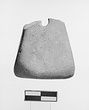
Dark stone pestle, cubical with rounded edges.
ADDENDA Another similar pestle in box no. 167. Well A (Double Well by East entrance of Square Building), box 13. 2387 Leica ... 26 April 1951 |
| Uncleaned. Small pit, over bedrock, west of wall C. 2262 Leica, 80-30-34 ... 28 June 1978 |
| Less than one-half of rim and upper body and one handle preserved. Plain out-turned rim, vertical strap handle attached below rim.
Very shiny black glaze.
Cf. Agora XII, no. 223. Catalogued 22 August ... 27 June-5 August 1972 ... Very shiny black glaze.
Cf. Agora XII, no. 223 ... 84-23-21, 87-21-32a, 87-26-34 (35), 85-34-14 |
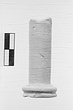
| One end broken away.
A plain shaft with a simple "cap" or "base" in two degrees at one end.
Traces of white on surface.
Pinkish to buff clay. Well.
350-320 B.C. 449 Leica, 81-34-34 ... 11-17 May 1938 |
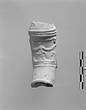
| In relief, around the top of the object, three draped women dancing hand in hand.
Traces of red and yellow paint.
Pale yellow clay.
Perhaps intended to be applied to a larger figure. Agora sample no. 393, ... 2 March 1934 |
| Solid hub. Imbedded in surface, strosis 4. 3090 Leica ... 3 May 1954 |
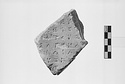
| Inscribed fragment.
Broken on all sides and at back.
Cut at top and bottom for reuse.
Recessed fillet at right, broadening toward top.
Pentelic marble. Found in modern fill, beneath lime-slaking pit. 34 ... 20 July 1969 |
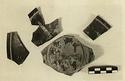
| Four non-joining fragments. Low ring foot; groove around center of floor which is decorated with double cross in thin clay paint. Incised band around inside of rim; on body sheaves and dots in thin clay ... 22 May-6 June 1935 |
| a) Preserves less than one-half of rim and upper body, with trace of lower body.
b) Preserves part of handle attachment.
Convex lower body, low concave upper body. Hollow moulded rim. Handle attached ... 27 June-5 August 1972 ... Handle attached to lower body.
Cf. Agora XII, no. 652 (ca. 380 B.C.) ... 84-21-25, 85-34-0, 85-34-11, 87-23-19, 87-36-6(7), 87-39-3 |
| Broken away below the shoulder. The flaring mouth is drawn to a blunt beak.
Dull but firm black glaze. Cistern. Leica, 90-12-17, 90-34-34, 4-322 ... 1932 |
| Bearded head with puffed out cheeks and high headdress. Cistern. Leica, XXXIV-49, L-7, 81-34-23 ... April 1938 |
| Mended from three pieces; small bits missing from one side. Ring foot; the sides flare to a plain edge, beneath which are attached two close horizontal handles.
Red clay with a buff slip outside and a ... 8 May 1934 |
| Inscribed fragment.
Small fragment, broken on all sides and behind.
Seven lines of the inscription preserved; stoichedon.
Space between lines, five including: 0.059m.
Space between letters, five including: ... 22 May 1940 |
| Inscribed base.
The block has clearly been re-used for there are two square dowel holes on the inscribed face. The right face has a recessed panel but no letters visible; a place where they might be expected ... 2nd.-1st. centuries B.C ... Hesperia 23 (1954), p. 253, no. 34, pl. 54 ... Agora XVIII, no. X724. |
| Base and small part of bottom only.
Flaring rim foot.
Clear yellowish-green glass. Well, fill 4 b. Container 33 or 34.
50-early 2nd c. A.D. 1523-1529 Leica PD 2515-3 ... 14 April 1938 |
| Handle missing. Flat base; plump body; wide mouth.
Covered with flaky brown glaze. Well below Stoa gutter. 3780 Leica, 82-545 PD 2630-68 ... 29 May 1954 |
| Preserved is the forehead with part of the nose and eyes, and a sock of bushy hair.
Traces of white, and of red on eye. Roman Bath: red fill in compartment under Hypocaust Room. 6342, 6454 Leica, 80-37-23, ... 13 October 1947 |
| Inscribed fragment of columnar grave monument.
Broken at top, bottom and back.
Three lines of the inscription preserved.
Hymettian marble. Found in late fill. Leica ... 3 June 1963 |
| Most of the shoulder, with the opening for a small neck, and part of the side wall preserved; mended from many pieces. Five fragments do not join. Three rows of dents around the shoulder.
Light red clay ... 29 March 1934 |
| Torus ring base with reserved resting surface. Reserved underside with two concentric glazed circles.
Metallic black glaze. Catalogued 3 August 1979. Filling of Square Building, main mass, piers 16-17E ... 25 April 1952 |
| Mold for plaque with horse and chariot.
Part of one hind leg, and of the chariot wheel preserved. Below the rim of the mould.
Very coarse red clay with large bits; buff slip. Trench 2, filling. Leica ... 25 April 1934 |
Fragment of the foot. Letter scratched before firing, on the unglazed surface. Complete.
Clay: fine reddish; black glaze on outside except narrow band on vertical face. Shape cf. Olynthus 306 Assembly ... Early 4th century. |
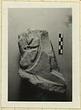
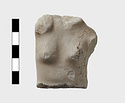
| Broken off at neck, and both shoulders and waist.
Nude or half-draped Aphrodite, of type S 2367, arranging hair, with right arm raised, left arm pressed against left breast.
Inferior work. Left breast ... 13 July 1978 |
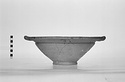
| Fragmentary; profile complete; plastered. Deep bowl; ring foot; flaring wall; everted rim and overhanging lip grooved on top and outer edges; two horizontal handles applied flush to lip.
Hard, coarse, ... May 1950 |
| Top half missing. Lower edge lacking a large chip.
Pyramidal with graffito.
Picked with a single hole. Graffito (H) scratched on bottom. Upper part glazed.
Attic clay. Inventoried 23 August 1985. Pit ... 27 June-5 August 1972 |
| Oval setting from bezel.
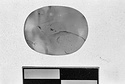
Flat on bottom, convex on top, carefully polished but undecorated.
Almost colorless, slightly veined. In earth around burial in trench 18 (grave 23). Leica, 79-12-11, 79-12-12, ... 7 June 1963 |
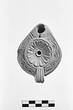
| Wave pattern on rim.
On discus, rosette, around central filling hole.
Handle solid, triple grooved. Nozzle with stamped circles inside.
On base, double concentric grooves; signed.
Unglazed.
Red clay ... 17 June 1931 |
|
|