|
|
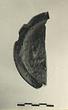
Part of soft clay bowl with reddish brown slip. Inscribed inside. Spelling NEOKΛOΣ. Oscar Broneer, Nb. No. 4. 179 88-401 ... 31 May 1937 |
Clay fine, buff, soft. Head missing. Traces of white slip. Pin hole beneath on level bottom. Not carefully modeled.
Almost identical with Agora T IIII which is from Late 5th century context. From the ... Probably late fifth century B.C. |
Rim chipped.
Flaring foot, convex to outside; grooved resting surface; nippled underside at slight angle to inner face of foot. Reserved band at junction of foot and body. Four closely grouped palmettes ... 325-300 |
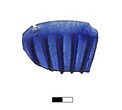
| Only a fragment from the rim and side wall remain.
The outside of the moulded wall is heavily ribbed up to a plain band which encircles the top.
Deep blue glass. Agora sample no. 281. Well on slopes of ... 3 May 1934 |
| Mended from many fragments; more than half preserved. Central knob handle.
Clay micaceous, red, much blackened inside. Remains of slip. Unglazed.
Cf. Agora XXXIII, no. 732. Pithos. Leica ... 28 April 1932 |
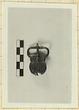
| A small buckle with a loop and a solid surface with two loops for attachment behind, and a tongue. Grave 10, by the heart. 80 Leica, XLIII-100, LVII-93, 83-321, 83-641 ... 2 May 1934 |
Most of handle and parts of foot, underside, and body restored.
Low foot; flat resting surface; flat underside with some string marks still visible. Straight lower body, convex shoulder. Tapering neck ... 150-110? (Roman context) |
| Rising shape.
Typical clay.
Neat impression. Finished Μενεκράτους Leica ... 29 February 1932 |
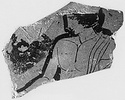
Wall fragment. Max. dim. 0.032. Matheson, Polygnotos, p. 418, cat. no. KL 64.
Warrior (most of head with pilos and left shoulder) to left, the shaft of a spear belonging to his opponent crossing his face ... Ca. 440-430 B.C. |
Stamped Plate.
Center of floor preserved.
Convex underside, with trace of groove around edge. At center of floor, six-petaled rosette within hexagon with concave sides, all within circular field. Reddish ... Late Hellenistic? (Roman context) |
Mended and complete. Glaze abraded on one handle. H. 0.065; diam. at rim 0.19; diam. of tondo 0.106; diam. of foot 0.08. Themelis, Agora: Guide, fig. opp. p. 62; M. Lang, Socrates in the Agora (Agora Picture ... Ca. 500 B.C ... Themelis, Agora: Guide, fig. opp. p. 62; M. Lang, Socrates in the Agora (Agora Picture Book 17), Princeton 1978, fig. 11; S. Roberts, Hesperia 55, 1986, p. 16, cat. no. 22, p. 17, fig. 9, pl. 4 (outside).
|
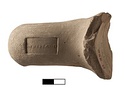
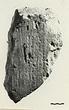
| Inscribed fragment.
Inscribed face, back and bottom preserved.
Damaged along left and right sides; minor fractures.
Five lines of the inscription preserved.
Hymettian marble. Found in wall of the modern ... 22 March 1938 |
Shoulder fragment with part of ring at junction with neck. Max. dim. 0.095.
Woman (head with hair tied up with fillets) to left before a loutrophoros-hydria (mouth, start of vertical handle, top of neck) ... Ca. 450 B.C. |
| Two joining fragments give left half of body with trace of nozzle and start of handle rising from rim.
Flat rim; low disk foot. Glazed inside.
Worn reddish-brown glaze.
Red clay.
Type 8 of Agora collection ... 7 July 1959 |
| Broken all around. Ring foot with reserved resting surface. Underside reserved with three circles and dot. Part of graffito on underside.
Black glaze. Attic clay. Pit. 965 Leica ... 27 June-5 August 1972 |
| Broken on three sides and back. Front and top resting surface preserved.
Characteristic chisel work of Temple of Athena at Sounion.
Streaky gray and white Agrilezza marble. Lot 653/4. 33 Leica ... 5 May 1971 |
| The fragment is from near the edge of the lid; the vertical flange which fitted into the box, and the projecting horizontal flange, have broken away but can be traced. The surface of the fragment is very ... 10 March 1932 |
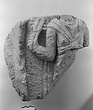
| The head is missing, the lower part of the left arm, and all the body below the waist. Part of the left side of the stone is preserved.
Pentelic marble. Surface fill. Leica, 79-8-4(3), 79-8-6(5) ... 3 March 1933 |
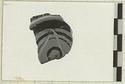
Fragment of side and lug of BF column krater. Figure (charioteer?) with staff or [?] in hand, faces left. Oscar Broneer Nb. No. 2 168 ... 19 Oct 1933 |
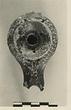
| Vertical strap handle and end of nozzle missing.
Raised edge around small sunken center; three small holes and central filling hole inside it. On upper body, horizontal band of scale pattern, dots above ... 25 February 1936 |
|
|