|
|
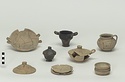
| Pyre in Room 8 of Roman House H. Concentration of artifacts, bone, and flecks of carbon in stratum, no pit discerned. the pyre lay within a red fill apparently contemporary with it, but with some later ... 300-290 B.C. |
Roman use fill in lowest 6.70m; Byz upper fill (dump). Notebook lists eight fills; subdivisions based on shelf groupings.
Subdivisions:
.1=Dumped fills 1-2, Byzantine
.2=Fill 3 (baskets 18-37)
.3=Fill ... 50-150 A.D. to Early Byz. |
Well (stone-curbed shaft) near middle of Tholos which served the prior building.
Period of Use dated to ca. 500-480(?) B.C., Upper fill dated to ca. 480-470 B.C. or soon after in Agora XXX (a gradual ... Ca. 500-480 B.C. |
A well on the NW slope of the Areopagus; unfinished well-shaft dug to a depth of only 3.05m., and refilled with broken pottery and other debris. The shaft clearly was begun with the intention of digging ... Ca. 520-480 B.C. |
|
|