|
|
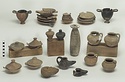
| Grave V, under room 18 in House 3, plus burned deposit at 94/IΘ. Identified as sacrificial pyre by SIR on Agoraios Kolonos:
In southeast corner of house 3. 35 artifacts, bone and charred material in pit, ... Ca. 300-275 B.C. |
Grave in north peristyle of Hephaisteion. Grave LXII in notebook.
No mention of bones. Pottery discarded. Coins:
11 March 1939 #15
14 March 1939 #5 Neg. KK 385 ... 18 March 1939 |
Bottle-shaped cistern with dumped fillings on NW slopes of Areopagus; appears not to have been finished in antiquity: the walls and floor show no traces of stucco.
Lower filling, ca. 375-340 B.C.
Upper ... Ca. 375-275 B.C. |
| This filling is the largest deposit of its time found in the Agora. It may be compared with H 6:5 and with N 7:3.
Dug in soft bedrock to a depth of 11.40m; footholds cut on opposite sides of the shaft ... Ca. 490-450 B.C. |
Investigations within the Stoa of Zeus, the north part, various levels.
Notebook references: Stoa Trench E Layers IV and V, Stoa Pits A, B and C, and Layers I and II of area between back wall and retaining ... 5th c. B.C. |
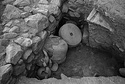
| James Artz Pirisino Daniele Kylindreas Miltiades ... Excavation in Room 3 of ΒΘ West revealed 5 ceramic vessels in a row against the eastern face of Wall 12. 3 complete vessels (ΒΘ 122, 124, and 125) were catalogued, along with the base of a plain glazed ... 9th-11th c. A.D ... Excavation in Room 3 of ΒΘ West revealed 5 ceramic vessels in a row against the eastern face of Wall 12. 3 complete vessels (ΒΘ 122, 124, and 125) were catalogued, along with the base of a plain glazed flat-bottomed basin (ΒΘ 121). ... Other joining fragments include significant portions of course water jars and amphorae, and a large pithos lid with decorative grooves (west:2012:f:42).
The fill in Room 3 was uniform in consistency, and no floor levels were found. ... Joanita Vroom and the Agora staff, all fill from the pithos was saved, but not given an Agora Sample number. |
Cistern at 70/ΚΕ and channels. Part of same system as D 17:3 and D 17:5. It was set against a corner of the lowest foundation block. Thus one is forced to assume that enough of the wall remained at least ... Ca. 200-150 B.C. |
|
|