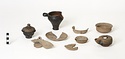
[Agora Deposit] D 11:6: Hole ("Cistern") B

Pocket of soft fill in bedrock at corner of Late Roman house, with a hoard of lead tokens. No pottery catalogued. Herulian debris: cf. D 10:1, D 11:7 Coins: 25 May 1935 #8 Estimated Grid No pottery catalogued ... 25 May 1935

icon

[Agora Deposit] D 7:11: Grave in West Peristyle of Hephaisteion (Grave XXXIX)

Grave in west peristyle of Hephaisteion. Grave XXXIX in notebook. No mention of bones. Coins: 7 March 1939 #12-#13 8 March 1939 #4-#5 10 March 1939 #3-#9 Neg. KK 367 ... 7-10 March 1939

[Agora Deposit] G 11:2: Well in Cistern to West of Tholos

May be of Hellenistic origin when cistern system went out of use. For a general note on the cistern see Nb. ΟΕ III, pp. 246 ff. Objects from B 586 various depths (no subdivision): S 2324-S 2330, P 34894, ... Late 2nd-early 6th c. A.D.

[Agora Deposit] G 11:3: Well

Well (stone-curbed shaft) near middle of Tholos which served the prior building. Period of Use dated to ca. 500-480(?) B.C., Upper fill dated to ca. 480-470 B.C. or soon after in Agora XXX (a gradual ... Ca. 500-480 B.C.

[Agora Deposit] C 18:11: Early Drain Channel Pit

Ostrakon deposit, sand fill in a shallow channel in bedrock at the bottom of the Great Drain in the valley between the Areopagus and the Hill of Nymphs. This group of ostraka may well come from a single ... Ca. 490-480 B.C.

icon

[Agora Deposit] J 1:8: Pyre J 1:8

Marcie Handler ... The Pyre was revealed in a layer of 4th c. fill in the north end of Room 6, just south of Wall 8. Room 6 is defined by the street wall (Wall A) on the west, Wall 7 on the east, Wall 9 on the south (preserved ... 4th c. B.C.

[Agora Deposit] H-I 7-8:1: "Burnt Layer"

Accumulated debris on the west side of the market square. Related layers added 1999/2000 (JWH), e.g. "Gravelly layer above burning", "Clearing Classical floor", "Lowest level above bedrock", "Below burning", ... First half of 5th c. A.D.

[Agora Deposit] C 10:3: Well

Well with 4th. c. fill, no well deposit at the bottom. Coins: 2 April 1936 #1 3 April 1936 #8-#19 4 April 1936 #11 8 April 1936 #3-#4 22 May 1936 #5 25 May 1936 #2 27 May 1936 #2 28 May 1936 #2-#5 29 May ... Second half A.D. 4th. c.

[Agora Deposit] M 20:1.1: Top + Intermediate fills

Top fill to 1.00m. = dump of late Hellenistic ware mixed with some Roman of 2nd c. to early 3rd. c. Intermediate fill 1.20-2.00m. = dump with tiles and stucco, almost no sherds. Coins: 6 February 1937 ... 2nd-3rd c. A.D.

[Agora Deposit] M 23:1: Cistern in NW Corner of Byzantine Building

Chamber of water system with one blind tunnel and two cisterns connected by tunnel. Pottery consistent throughout, late Hellenistic. Late 2nd c. B.C. Ten stamped amphora handles. Most of bowls long-petal ... 100-75 B.C.

[Agora Deposit] N 20:4: Mask Cistern

Dumped fillings thrown in during second quarter of 1st c. B.C. containing mostly debris resulting from Sulla's sack in 86 B.C. Agora XXIX, p. 464: Four fills distinguished during excavations ... but seemingly ... Late 2nd c. and early 1st c. B.C. POU; 110-75 B.C ... B.C. containing mostly debris resulting from Sulla's sack in 86 B.C. Agora XXIX, p. 464: Four fills distinguished during excavations ... but seemingly with no chronological differentiation (p. 580). ... Coins: 7 March 1938 #16-#17 8 March 1938 #23-#25 9 March 1938 #8 10 March 1938 #6-#17 11 March 1938 #3-#12 12 March 1938 #14-#29 14 March 1938 #7-#14 15 March 1938 #10-#11 10 May 1938 #1-#10

[Agora Deposit] P 15:3: Sand Fill North of Base A

Sand fill N of Base A. ... Because of the uncertainty of ground level contemporary with Base A and of the possibility of missing a continuous strosis or disturbance in this soft sandy fill, I have kept ... Last quarter 2nd-first quareter 3rd c. A.D.

[Agora Deposit] N 20:7: Cistern at 67/ΙΗ

At 67/ΙΗ, at the northeast slope of the Areopagus. Cistern with drawshaft, 4.60m deep. The drawshaft had been cleared to bottom in the eighteenth or nineteenth century, and some of the fill in the main ... Most second half of 3rd c. B.C.

[Agora Deposit] F 16:1: Demeter Cistern

Cistern at 9/Β (10/Β on plan), at the NW foot of the Areopagus, some 200m to the west of the Coroplast's Dump. It had evidently belonged to one of the small houses in that thickly populated residential ... Second half 4th c. B.C.

icon

[Agora Deposit] J 2:9: Pyre

Excavation of this pit began in 1995, tentatively identified as a pyre. This proved to be so with continued excavation in 1996. The deposits J 2:8 and J 2:9 were combined to become J 2:9. Miniature vessels ... Ca. 300 B.C.

icon

[Agora Deposit] B 19:5: Pyre in House N, Room 2, Layer 5

Pyre in House N, room 2, layer 5 (RSY=Pyre 8). Near northern corner of room 6. Artifacts, bone, burnt logs, and cinders in square pit dug from level of layer 5, through layers 5 and 6; thin clay floor ... 325-300 B.C.

[Agora Deposit] E 14:3: Drawshaft, "Kybele Cistern"

Cistern-shaft at the southeast foot of Kolonos Agoraios. Nbp. 2369: Two chamber cisterns, 88/ΛΔ and 100/ΚΘ, united by a long straight passage running almost due N-S. A draw shaft at 95/ΚΘ is set just ... Upper fill, Late Roman with some Hellenistic. Middle fill, Sullan debris to last quarter of 1st c. B.C. Lower fill, 4th-3rd c. B.C.=POU and abandonment

[Agora Deposit] E 14:1: Cistern

Cistern at the southeast foot of Kolonos Agoraios. Nbp. 2369: Two chamber cisterns, 88/ΛΔ and 100/ΚΘ, united by a long straight passage running almost due N-S. A draw shaft at 95/ΚΘ is set just off the ... Use filling of late 4th-early 3rd c. B.C. Accumulative fillings of late 3rd-early 2nd and late 1st c. B.C. Upper dumped filling of 3rd c. A.D.

icon

[Agora Deposit] U 13:1: Well in Room 6 of Street Stoa U/2,U/3-13/15

Well in Room 6 of Street Stoa U/2,U/3-13/15. Associated with the building lying under the Roman Street Stoa. Its fills divided into 5 separate layers, with the bulk of finds belonging to Layer 1, the ... 14 June-21 August 1973