|
|
One fragment of "A" ware; no "D" ware or gouged ware; several basket-handled water jars and two amphorae ... 2nd. c. A.D ... One fragment of "A" ware; no "D" ware or gouged ware; several basket-handled water jars and two amphorae. |
Cistern to N of well in Room 9 of South Stoa I.
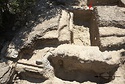
The well apparently cut through some cistern or early cavity which the builders of the well filled with whole amphorae and stones. We did not remove all ... 7 July 1967 ... The well apparently cut through some cistern or early cavity which the builders of the well filled with whole amphorae and stones. We did not remove all the amphorae (nbp 7247). |
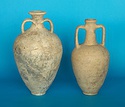
| Marcie Handler ... A deposit of six amphorae and one micaceous water jar was excavated between 20 June and 6 July 2005 in the area north of Wall K. The neck and one handle of one of the amphorae (BZ 1213) had been poking ... Ca. 1st c. A.D ... A deposit of six amphorae and one micaceous water jar was excavated between 20 June and 6 July 2005 in the area north of Wall K. The neck and one handle of one of the amphorae (BZ 1213) had been poking out of the surrounding fill since the end of the 2001 season. ... Along with the one whole amphora (BZ 1213), two mended amphorae (BZ 1262 & 1263) and the micaceous water jar (BZ 1264), there were also in-situ fragments of three other amphorae, but the necks, handles, and/or bases of these amphorae were missing and the vessels were therefore not mended (the fragments of these three amphorae can be found in the pottery tins).
|
Tins 8-12.
27 lamp fragments, a "D" ware plate and an early (?) gouged jug, micaceous water jars and amphorae. Some joins were noted between fills III and IV, but in general the fills are distinct ... Mid-3rd. c. A.D ... gouged jug, micaceous water jars and amphorae. Some joins were noted between fills III and IV, but in general the fills are distinct. |
Tins 6-7.
The mending of pottery revealed a break at about 19.60, although the nature of the pottery seems about the same: "A" and "D" ware, gouged ware, flaring-mouthed jars, micaceous water jars and ... Late 3rd.-early 4th. c. A.D ... The mending of pottery revealed a break at about 19.60, although the nature of the pottery seems about the same: "A" and "D" ware, gouged ware, flaring-mouthed jars, micaceous water jars and various large amphorae. |
A large chamber cistern filled in the second c. BC when a well (C 9:16) was dug through its floor. Well tiles were run up from the floor of the cistern to just below its neck; a double layer of complete ... Late 2nd c. B.C ... Well tiles were run up from the floor of the cistern to just below its neck; a double layer of complete wine amphorae was packed over the floor around the well tiles to hold them in place. |
A tiled well with POU from 9.30-10.80m. and dumped fill above 9.30m. The dumped fill differs from lower fill only in the less frequent appearance of fragments of micaceous water jars and the occurrence ... 3rd c. A.D. with destruction at 267 A.D ... The dumped fill differs from lower fill only in the less frequent appearance of fragments of micaceous water jars and the occurrence of Roman D ware plate fragments and of large brick red amphorae with fluted handles.
|
| Laura Gawlinski ... Ovoid pit cut into bedrock or sterile fill just north of preserved floor surfaces in the so-called Strategeion. Length (west-east) 2.6m; widens at 1.25m from the east scarp so that at west pit is 0.75m ... 4th B.C ... Although marble chips were found scattered throughout fill of amphorae pit, these pits were distinct: Find Γ 2854, Amphora, was uncovered beneath hard fill that made up the northeast bottom edge of the marble chip pit. Some material belonging to the amphorae pit was removed with Lot Γ 383, including an inscribed amphora fragment (Find Γ 3887).
... Therefore, it seems that both whole and fragmentary amphorae were dumped here.
|
North of Eleusinion: Loose fill in pit outside Roman Building. 14 inventoried items, 22 objects, 325 sherds.
Objects : terracottas; handmade object; large figurine; lamps.
Early ware : Gray Minyan; Mycenaean; ... 6th c. B.C. and earlier ... Household : plain and banded: amphorae; lekane; unglazed. |
Well in Coletti Garden.
Diameter 1m. There were no traces of hand holes in its walls. At 5.2m depth below datum on the S-E side of the shaft, a small underground stream emptied into the well. The stratigraphy ... Ca. 425-400 B.C ... Fine ware:quantities similar to black glaze catalogued pieces; panathenaic amphorae, two lower body fragments; lekanis, one fragment with..pattern on exterior of rim; black glaze oinochoe fragments; fragments of a black glaze psykter; fragments of striped lekanai. Utilitarian: fragments of lekanai, cooking pots, mortars, casseroles, jugs, all varieties of fabric and glaze, brazier fragments, gray ware amphorae, and painted roof tiles. |
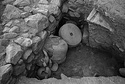
Well shaft cut through a cistern channel which was then packed with three amphorae (P 3123, P 3125, P 4201) of 1st or at latest early 2nd c. A.D. (These three amphorae could be considered with F 15:2) ... 3rd-4th c. A.D ... Well shaft cut through a cistern channel which was then packed with three amphorae (P 3123, P 3125, P 4201) of 1st or at latest early 2nd c. ... (These three amphorae could be considered with F 15:2).
|
A well lined with a very well built stone wall, carefully made and fitted to the curve of the well cutting, with footholds running down its N and S faces. This wall, of small stones, runs to 7.30m. from ... 23-29 March 1937 ... Behind the tile lining a cavity filled with nearly whole amphorae used to prop sides.
|
Roman well, stratified.
Finds from the earth (not recorded in a subdivision):
P 7995, P 8036, P 21834, SS 6338, IL 483, IL 486, BI 309, BI 310,
BI 314.
According to the excavator the shaft had been cleaned ... 2nd-4th c. A.D ... Despite the general paucity of the well fill (only 21 tins of pottery from -7.00m to bottom), a rather large number of amphorae, micaceous water jars and other handled containers were represented among the sherds and some stratification is apparent. |
Michael Laughy ... West and adjacent to Modern Wall 5, we excavated 12th-13th c. A.D. fill, in some places a half meter deep or more. The fill was remarkably uniform in content throughout. Typical pottery included: fine ... 12th-13th c. A.D ... sherds: 1824
"classical black glaze": 38
Lot T 143:
fine sgraffito; slip painted; inscribed ware; plain glaze; brown and green glaze; polychrome glaze; Byzantine lamp fragments; coarse handles, rims, bases, body sherds; cooking ware; earlier finewares; ridged ware; combed ware; amphorae fragments; bone.
|
| Extract from notebook ΠΘ XIX, pp. 3644-3646. Well at 105/ΝΗ (report on sorting of pottery, July 19, 1951 - H.S. Robinson).
"Not a useful well" HSR.
Well dug to 1.50m., vi/9/36; dug from 1.50m. to bottom ... Early Roman; use fillings of 2nd. c. B.C. and 1st. and 4th. c. A.D.; dumped filling of late 4th. c. (HSR)
Fill I: 2nd. c. B.C.
Fill II-V: to second half of 4th. c. A.D.
Fill VI: mixed to Byzantine ... After Christ: practically no fine ware except P 21656 (ΠΘ 3373) and frags. of a grey-ware platter; type XVIII and XX lamps (L 2988-89); numerous amphorae, including frags. of two with high pointed handles (cf. |
| James Artz Pirisino Daniele Kylindreas Miltiades ... Excavation in Room 3 of ΒΘ West revealed 5 ceramic vessels in a row against the eastern face of Wall 12. 3 complete vessels (ΒΘ 122, 124, and 125) were catalogued, along with the base of a plain glazed ... 9th-11th c. A.D ... Other joining fragments include significant portions of course water jars and amphorae, and a large pithos lid with decorative grooves (west:2012:f:42).
|
|
|