|
|
Well on lower slopes of Areopagus.
Diameter ca. 1.50m. Dumped filling of 8th c. at the top. Fill mostly Geometric but containing bits of later (even Roman) pottery. Perhaps cleaned out and refilled with ... 730-700 B.C ... Well on lower slopes of Areopagus.
Diameter ca. 1.50m. |
| A well in the industrial area of the Areopagus, about 7.00m. west of the West Bath, to a depth of 14.60m. This well was the direct successor to A 17:1, replacing it when it collapsed. The use filling at ... Second quarter 6th. c ... Well in Industrial Area of Areopagus |
Well at 19/ΝΒ, on the lower north slope of the Areopagus ... 550-525 B.C ... Well at 19/ΝΒ, on the lower north slope of the Areopagus |
| Cistern on lower north slope of Areopagus.
Latest of thirteen amphora handles dated ca.199; twelve legible coins, the latest dating ca. 196-190. Three intrusive pieces:two semiglazed fragments and piece ... 260-190 B.C ... Cistern on Lower North Slope of Areopagus |
| Located in House H, Room 13 on the lower northwest slope of the Areopagus ... Late 2nd c. B.C ... Located in House H, Room 13 on the lower northwest slope of the Areopagus. |
| Cistern in the valley between the Areopagus and the Hill of the Nymphs. Simple, flask-shaped chamber withdraw-shaft; no tunnels. Mouth cut away in Byzantine times. Lower filling, 3rd c. B.C. Coins:
25 ... 25-30 April 1947 ... Cistern in the valley between the Areopagus and the Hill of the Nymphs. |
Big well at 61/ΙΖ.
A well on the lower northeast slope of the Areopagus. Diameter 2m ... Ca. 520-475 and shortly after ... A well on the lower northeast slope of the Areopagus. Diameter 2m. |
Grave XXIII in notebook = RSY Grave 46.
Late Hellenistic filling in a disturbed grave, west of Areopagus ... 19 June 1939 ... Late Hellenistic filling in a disturbed grave, west of Areopagus. |
Well in house R of industrial area west of the Areopagus. This well, originally tiled, was abandoned and filled at the time of the conversion of the house into a stone-cutters' workshop.
Tiled well but ... Ca. 425-400 B.C ... Well in House R of Industrial Area West of Areopagus |
Fillings to either side of the Great Drain, in the southern part of the area west of the Areopagus; various levels, late 6th. and early 5th c. B.C. to Sullan destruction. Coins:
26 July 1946 #1-#2
30 July ... Late 6th. c. B.C.-1st. c. A.D ... Fillings to either side of the Great Drain, in the southern part of the area west of the Areopagus; various levels, late 6th. and early 5th c. |
| At the northwest foot of Areopagus. Square stone-curbed well with no clear evidence for a period of use; appears to be a single dump ... Ca. 500 B.C ... At the northwest foot of Areopagus. Square stone-curbed well with no clear evidence for a period of use; appears to be a single dump. |
An unfinished well in the northwest room of the Poros Building, west of the Areopagus. Dumped filling. Chips from marble-working, variety of plain and figured wares ... Ca. 400-385 B.C ... An unfinished well in the northwest room of the Poros Building, west of the Areopagus. Dumped filling. |
| Thamneus' Cellar, a storage cellar on the north slope of the Areopagus. Lower filling of mid-6th c. B.C., upper filling of last quarter of 6th c. B.C ... 6th c. B.C ... Thamneus' Cellar, a storage cellar on the north slope of the Areopagus. Lower filling of mid-6th c. |
Tomb at 53-54/ΛΕ-ΛΣΤ-ΛΗ (Late Roman), on the lower north slope of the Areopagus Nb. says ΛΕ-ΛΗ. Deposit list and deposit DB say: ΛΕ-ΛΣΤ ... 350-400 A.D ... Tomb at 53-54/ΛΕ-ΛΣΤ-ΛΗ (Late Roman), on the lower north slope of the Areopagus |
| Well on lower northwest slope of Areopagus. Dug to 6.60m. and abandoned because of danger. Single dumped deposit.
Perhaps this context: P 528, P 1223 (JWH). Coins:
22 April 1932 #1 ... Second half 1st c. B.C.-early 1st c. A.D ... Well on lower northwest slope of Areopagus. Dug to 6.60m. and abandoned because of danger. |
Construction filling of the Poros Building west of the Areopagus. Patch of stony fill beneath the courtyard. Accumulation of the second quarter of the 5th c., deposited in the last quarter ... Ca. 475-450 B.C. and later ... Construction filling of the Poros Building west of the Areopagus. Patch of stony fill beneath the courtyard. |
| Grave I in notebook = RSY Grave 2.
Inhumation burial in Cemetery on West Slope of Areopagus. Outline of grave disturbed by later cutting. Outstretched skeleton, probably of adult female. PD 731-a ... Late 8th century B.C ... Inhumation burial in Cemetery on West Slope of Areopagus. Outline of grave disturbed by later cutting. |
Cistern at 79/Γ (= 80/Δ) on lower north slope of the Areopagus. Filling of 2nd c. B.C. with some later intrusions (Turkish pottery indicates disturbance).
Single Knidian stamped amphora handle dates around ... Hellenistic-Turkish ... Cistern at 79/Γ (= 80/Δ) on lower north slope of the Areopagus. Filling of 2nd c. |
Cistern in valley west of the Areopagus. Dumped filling of late 1st. to early 2nd. c. and of 5th to 6th century. Coins:
7 June 1939 #12
8 June 1939 #18-#19
9 June 1936 #26 ... 1st.-2nd. c. A.D ... Cistern in valley west of the Areopagus. Dumped filling of late 1st. to early 2nd. c. and of 5th to 6th century. |
Well on the north slope of the Areopagus. Unfinished, probably because of hardness of rock, and refilled at once, perhaps with sanctuary dump and with collapsed rock from the shaft itself.
Diameter 1.15m ... 3rd quarter of the 7th c. B.C ... Well on the north slope of the Areopagus. Unfinished, probably because of hardness of rock, and refilled at once, perhaps with sanctuary dump and with collapsed rock from the shaft itself.
|
| Roman Bath, Herulian destruction debris in A3. The high proportion of vessels for eating suggests that this was not the actual bath fill but was probably dumped in from the ruined houses higher on the ... Second half of 3rd and into 4th c. A.D ... The high proportion of vessels for eating suggests that this was not the actual bath fill but was probably dumped in from the ruined houses higher on the Areopagus. [Nbp. 4288] |
Well at 74/Ι, on the lower north slope of the Areopagus.
Use fill from early 1st to 3rd c. A.D.
Dump fill from 4th c. A.D. Coins
9 April 1938 #2
9 May 1938 #1 Container 20 (lost) p. 1529 ... 1st c. to 3d c. A.D ... Well at 74/Ι, on the lower north slope of the Areopagus.
Use fill from early 1st to 3rd c. |
Cistern (and passage) on the north slope of the Areopagus. Fill badly disturbed in modern and Turkish times. The few ancient sherds seem to be chiefly early Roman-1st c. B.C. (p. 256).
Some finds labeled ... 1st c. B.C ... Cistern (and passage) on the north slope of the Areopagus. Fill badly disturbed in modern and Turkish times. |
A rubbish pit at the foot of the northwest slope of the Areopagus. Black figured, plain glazed vases and several lamps. A pair of lekythoi recall both in make and in style the products of the Haimon Painter ... Ca. 480-475 B.C ... A rubbish pit at the foot of the northwest slope of the Areopagus. |
| Well at 52/Ι, on the lower northeast slopes of the Areopagus. It was cut down and re-used in the late Roman period, in connection with the water channel. Use fill of 1st to early 2nd c.
Dump fill 5th to ... Early to Late Roman ... Well at 52/Ι, on the lower northeast slopes of the Areopagus. It was cut down and re-used in the late Roman period, in connection with the water channel. |
Pit at 57/ΚΑ; small pit on the lower north slope of the Areopagus, measuring 1.05x0.80mx0.80m deep. There were traces of burning and a few bones in it, since none of them are recognizably human it is probably ... 480 - 470 B.C ... Pit at 57/ΚΑ; small pit on the lower north slope of the Areopagus, measuring 1.05x0.80mx0.80m deep. |
| Unfinished well-shaft with debris filling (apparently of the Sullan sack), on the lower NW slopes off the Areopagus. Abandoned due to poor quality of bedrock.
Three closely contemporary fills, considered ... End 2nd c. B.C.-second quarter 1st c. B.C ... Unfinished well-shaft with debris filling (apparently of the Sullan sack), on the lower NW slopes off the Areopagus. Abandoned due to poor quality of bedrock.
|
Well on the lower north slope of the Areopagus. The pottery apparently belongs to a filling of one period, since it exhibited no marked difference in character to the bottom. No where was the deposit very ... Ca. 410-390 B.C ... Well on the lower north slope of the Areopagus. The pottery apparently belongs to a filling of one period, since it exhibited no marked difference in character to the bottom. |
Destruction debris in Late Roman Buildings on Lower north slope of Areopagus (see summaries) see now O-Q 18-19. See Agora VII, p. 227 and lists in JP's file (JP is Judith Perlzweig)
Deposit list under ... Destruction debris in Late Roman Buildings on Lower north slope of Areopagus (see summaries) see now O-Q 18-19. |
Crescent-shaped cutting in bedrock at 47/ΙΓ; on the north slope of the Areopagus, slightly to the west of the dromos of the Mycenaean Chamber Tomb.
Dimensions of cutting : max. diameter ca. 2.50m.; depth ... Ca. 500-450 B.C.
400-350 B.C ... Crescent-shaped cutting in bedrock at 47/ΙΓ; on the north slope of the Areopagus, slightly to the west of the dromos of the Mycenaean Chamber Tomb.
|
Fillings in a stone-curbed well in the industrial area west of the Areopagus. Diameter (shaft)1.45m. Water level -5.20m. Drain at mouth 0.58m., increasing to a regular 74m. Coin:
24 July 1947 #5 Subdivisions: ... 350-325 B.C./3rd c. B.C ... Fillings in a stone-curbed well in the industrial area west of the Areopagus. Diameter (shaft)1.45m. |
Well at 67/ΛΓ on the northeast slope of the Areopagus. Connected with the same cistern system as O 20:2.
Dug as several fills but probably a continuous accumulation Coin
28 May 1938 #1 (?) Illegible N ... 300-250 B.C ... Well at 67/ΛΓ on the northeast slope of the Areopagus. Connected with the same cistern system as O 20:2.
|
Rectangular shaft at northwest foot of Areopagus; dumped filling of second half of 4th c. B.C. Pit at 16/Δ-Ε recorded one time as an extension of shaft 17/Δ-Ε (see L 506 and nb.p. 395), but items from ... Ca. 325-275 B.C ... Rectangular shaft at northwest foot of Areopagus; dumped filling of second half of 4th c. |
Well on the lower west slope of the Areopagus. Tiled well. The tiles were carefully made and clamped together with lead, two clamps at each joint.
Several fills but apparently all 2nd c. Material in lowest ... Late 2nd to early 1st c. B.C ... Well on the lower west slope of the Areopagus. Tiled well. |
Deposit in the industrial area west of the Areopagus, underlying a Roman bath. Pottery examined in June 1955; latest pieces noted: one fragment Pergamene and one fragment brittle ware; no certainly post-Sullan ... Late 2nd c. B.C ... Deposit in the industrial area west of the Areopagus, underlying a Roman bath. |
Cistern at 70/ΛΣΤ in the northeast slope of the Areopagus.
Part of system with two chambers and well. Homogeneous fill.
13 stamped amphora handles. Latest lamp type 46 B. N 72206 (Ω-344), picked up near ... Second half of 3rd c. - Early 2nd c. B.C ... Cistern at 70/ΛΣΤ in the northeast slope of the Areopagus.
Part of system with two chambers and well. |
Bottle-shaped cistern with dumped fillings on NW slopes of Areopagus; appears not to have been finished in antiquity: the walls and floor show no traces of stucco.
Lower filling, ca. 375-340 B.C.
Upper ... Ca. 375-275 B.C ... Bottle-shaped cistern with dumped fillings on NW slopes of Areopagus; appears not to have been finished in antiquity: the walls and floor show no traces of stucco.
|
A well (diameter 1m) in the industrial area west of the Areopagus, in the area later occupied by House C. Water level 1.50-2.m Dumped filling of broken bedrock with considerable fragmentary pottery in ... Ca. 500-480 B.C ... A well (diameter 1m) in the industrial area west of the Areopagus, in the area later occupied by House C. |
Well in the industrial area west of the Areopagus.
A flask-shaped cistern in House H with a dumped fill of the late fifth century brought from elsewhere and evidently deposited sometime in the 3rd c. B.C ... Ca. 420-400 B.C ... Well in the industrial area west of the Areopagus.
A flask-shaped cistern in House H with a dumped fill of the late fifth century brought from elsewhere and evidently deposited sometime in the 3rd c. |
A well in the industrial area west of the Areopagus, in part beneath one corner of the northwest room of the West Bath. A waterless shaft (diameter 1.05m) refilled with dug bedrock containing no pottery ... Early 6th. c ... A well in the industrial area west of the Areopagus, in part beneath one corner of the northwest room of the West Bath. |
Pit in House T, Room 3 (through layer 6), in the industrial area west of Areopagus. Very likely pit may have been respectable archaic context, but nothing to go on beyond the two catalogued pieces (LT ... Ca. 500-480 B.C ... Pit in House T, Room 3 (through layer 6), in the industrial area west of Areopagus. Very likely pit may have been respectable archaic context, but nothing to go on beyond the two catalogued pieces (LT Aug. 1958). |
House K: Brown fill (publ. House U). Filling between terrace wall and house wall at the extreme west end of the Areopagus; a brown gravelly filling of early Roman date found here undisturbed but occurring ... Early Roman ... Filling between terrace wall and house wall at the extreme west end of the Areopagus; a brown gravelly filling of early Roman date found here undisturbed but occurring also throughout this general vicinity, sometimes with later intrusions. |
Filling in a cistern chamber in the area west of the Areopagus. Main dumped fill of 2nd. c. B.C., with small amount of later material in uppermost 1.00m. A connecting passage contained some material of ... 2nd. c. B.C ... Filling in a cistern chamber in the area west of the Areopagus. Main dumped fill of 2nd. c. |
Well at 73/Μ on the lower northeast slope of the Areopagus.
Diameter of 0.90m. It seems to have been abandoned because of the very soft stereo that kept falling in from all sides. Many pieces of terracotta ... Ca. 430-420 B.C ... Well at 73/Μ on the lower northeast slope of the Areopagus.
Diameter of 0.90m. |
Well dug through N 18:1 (cistern at 79/ΜΗ) on the lower north slopes of Areopagus; the cistern was the northern chamber of a system; the southern chamber is at 84/ΝΣΤ (N 19:1).
A single dumped deposit ... 3rd-4th c. A.D ... Well dug through N 18:1 (cistern at 79/ΜΗ) on the lower north slopes of Areopagus; the cistern was the northern chamber of a system; the southern chamber is at 84/ΝΣΤ (N 19:1).
|
| Pithos ay the bottom of the north slope of the Areopagus with single fill; Part of Hellenistic Group D.
One stamped amphora handle dates slightly after 146. Latest coin dates in first two decades of 2nd ... 160-130 B.C ... Pithos ay the bottom of the north slope of the Areopagus with single fill; Part of Hellenistic Group D.
|
| In area West of the Areopagus. Fills with many figurines and molds, possibly from a terracotta factory.
Twelve stamped amphora handles; no long-petal bowls; Type 54 A lamp Coins:
31 May 1939 #11
1 June ... Mostly 200-150 B.C ... In area West of the Areopagus. Fills with many figurines and molds, possibly from a terracotta factory.
|
Filling of a well on the lower north slopes of the Areopagus, dug early in the 1st c. B.C. [construction fill]; in use into the the 2nd c. A.D.[well fill] (H Ms.) No apparent stratification.
Hellenistic ... 2nd c. A.D ... Filling of a well on the lower north slopes of the Areopagus, dug early in the 1st c. |
Cistern on lower northeast slope of the Areopagus.
Two Hellenistic fills with late Hellenistic to Roman fill above.
Use fill characterized by broken water jars (lower fill); contemporary dump (middle fill); ... Early 1st c. B.C ... Cistern on lower northeast slope of the Areopagus.
Two Hellenistic fills with late Hellenistic to Roman fill above.
|
Cistern at 65/ΚΗ (and Channel). Cistern in the northwest room of the annex to the Poros Building west of the Areopagus. Part of the same system as D 17:4 and D 17:5, the chambers connected by long tunnels ... 300-250 B.C ... Cistern in the northwest room of the annex to the Poros Building west of the Areopagus. Part of the same system as D 17:4 and D 17:5, the chambers connected by long tunnels. |
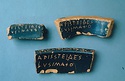
Ostrakon deposit, sand fill in a shallow channel in bedrock at the bottom of the Great Drain in the valley between the Areopagus and the Hill of Nymphs.
This group of ostraka may well come from a single ... Ca. 490-480 B.C ... Ostrakon deposit, sand fill in a shallow channel in bedrock at the bottom of the Great Drain in the valley between the Areopagus and the Hill of Nymphs.
|
A well in House T, Room 2W (Publ. House D), industrial area west of the Areopagus. Lower filling of dug bedrock including a small amount of pottery of the Geometric period. Gravelly filling in collapsed ... 3rd. quarter of 8th. c. B.C ... House D), industrial area west of the Areopagus. Lower filling of dug bedrock including a small amount of pottery of the Geometric period. |
Well under Poros Building Drain at 62/ΛΣΤ, west of the Areopagus. Digging abandoned at 6.10m due to a collapse of the soft bedrock at the west. Small amount of supplementary filling was added in the upper ... Ca. 520-480 B.C ... Well under Poros Building Drain at 62/ΛΣΤ, west of the Areopagus. Digging abandoned at 6.10m due to a collapse of the soft bedrock at the west. |
A filling lying over a cobbled floor in a house-complex on the lower north slopes of the Areopagus.
Area in front of E-W retaining wall, just above cobble pavement, disturbed by coins and pottery as late ... 375-275 B.C ... A filling lying over a cobbled floor in a house-complex on the lower north slopes of the Areopagus.
Area in front of E-W retaining wall, just above cobble pavement, disturbed by coins and pottery as late as the 3rd c. |
Gravel above early road some 5m wide. The bedrock was heavily scored by traffic, and the accumulation of gravel, ca. 0.30m, thick produced Middle Helladic Pottery. This early thoroughfare ran in a northwest-southeast ... Middle Helladic ... This early thoroughfare ran in a northwest-southeast direction, apparently making for the saddle between the Acropolis and the Areopagus. It may be noted in passing that the east to west thoroughfare which skirted the south side of the Agora has had a continuous history from the Middle Helladic period to the present. |
| Cistern at 77/Μ on lower north slopes of the Areopagus. Bottom diameter of 2m connected by tunnel to cistern M-N 18:1.
Only stamped amphora handle dates slightly after 240. Latest coin dates about 200 ... 3rd c. B.C.-196/190 B.C ... Cistern at 77/Μ on lower north slopes of the Areopagus. Bottom diameter of 2m connected by tunnel to cistern M-N 18:1.
|
A small square well at 37/ΚΑ (about 0.60x0.70m), on the north slope of the Areopagus. Curbed with rough stones.
Filling of a small shallow well which contained nothing from the POU and since no water was ... Ca. 350-320 B.C ... A small square well at 37/ΚΑ (about 0.60x0.70m), on the north slope of the Areopagus. Curbed with rough stones.
|
Exploration of area of small early house walls on the NW slopes of Areopagus. Considerable deposits of late 6th-early 5th c. B.C., but some later (all periods) and some early levels, disturbed.
Objects ... Late 6th-Early 5th c. B.C ... Exploration of area of small early house walls on the NW slopes of Areopagus. Considerable deposits of late 6th-early 5th c. |
West Terrace, South End, Layers IV and V. Heavy dumped filling associated with terrace walls at the extreme south end of the excavations in the Areopagus industrial area. The proportion of figured and ... Ca. 420-390 B.C ... Heavy dumped filling associated with terrace walls at the extreme south end of the excavations in the Areopagus industrial area. |
Fillings below the courtyard floor of the Poros Enclosure west of the Areopagus. The lowest layer, over bedrock, is of the archaic period and may have accumulated on the spot before the start of building ... First half of 5th c. B.C ... Fillings below the courtyard floor of the Poros Enclosure west of the Areopagus. The lowest layer, over bedrock, is of the archaic period and may have accumulated on the spot before the start of building operations. |
| Dumped filling of late 2nd c. B.C.; Roman Group F, dumped filling of second quarter to end of 1st c. B.C. on the lower northeast slope of the Areopagus.
Diameter at bottom -3.20m Upper fill: Latest coins ... Second quarter to end of 1st c. B.C ... B.C. on the lower northeast slope of the Areopagus.
Diameter at bottom -3.20m |
| An area about 10m2. on the lower northwest slopes of the Areopagus, southeast of the archaic fountain house. A dumped fill to the end of the 3rd quarter of the 7th c. B.C., containing many votives, overlying ... 7th c. - 625 B.C ... on the lower northwest slopes of the Areopagus, southeast of the archaic fountain house. |
Well on the north slope of the Areopagus; depth at 9.65m; scanty dumped fillings. From about 3.20m to the bottom, little but tile fragments appeared; in the fillings above, the lower is characterized by ... Ca. 350-290 B.C ... Well on the north slope of the Areopagus; depth at 9.65m; scanty dumped fillings. |
Unfinished well, south of the annex to the Poros Building, west of the Areopagus. The shaft was apparently never used as a well. The lower dumped filling contained a quantity of clean red clay, as if from ... Ca. 350-325 B.C ... Unfinished well, south of the annex to the Poros Building, west of the Areopagus. The shaft was apparently never used as a well. |
At 67/ΙΗ, at the northeast slope of the Areopagus.
Cistern with drawshaft, 4.60m deep. The drawshaft had been cleared to bottom in the eighteenth or nineteenth century, and some of the fill in the main ... Most second half of 3rd c. B.C ... At 67/ΙΗ, at the northeast slope of the Areopagus.
Cistern with drawshaft, 4.60m deep. |
East-West Street (63-64/ΙΣΤ, etc.)
Packing in line of ancient east-west street along Areopagus north slopes.
Lower fills, predominantly late 6th-early 5th c. B.C.
Middle fills, last quarter of the 5th ... Various levels and dates ... Packing in line of ancient east-west street along Areopagus north slopes.
|
| Pyre in House T, Room 2 through floor of second period (RSY=Pyre 5) in the industrial area west of the Areopagus.
4th. c. BC.
Concentration of artifacts, burnt bone, and charcoal in floor makeup consisting ... 375-350 B.C ... Pyre in House T, Room 2 through floor of second period (RSY=Pyre 5) in the industrial area west of the Areopagus.
4th. c. BC.
|
Homer A. Thompson ... Well at the northwest foot of the Areopagus. Use filling of the Roman period. After the abandonment of the well and the collapse of the well-curb, the upper 2m of the shaft were filled with a dump apparently ... 1st-3rd c. A.D., 5th century ... Well at the northwest foot of the Areopagus. Use filling of the Roman period. |
Well at 62/ΙΑ, 63/ΙΑ, at the northwest foot of the Areopagus. Use filling in the lowest meter of the shaft.
The upper part of the shaft was filled with clay containing only occasional fragments of pottery; ... Ca. 600-540 B.C ... Well at 62/ΙΑ, 63/ΙΑ, at the northwest foot of the Areopagus. Use filling in the lowest meter of the shaft.
|
| (RSY=Pyre 2). Pyre in the industrial area west of the Areopagus, in House B. In northern corner of room. No pit discerned. A deposit of small stones (a marker/) lay 0.30m above the level of the pyre, ... Third quarter of the 4th. century ... Pyre in the industrial area west of the Areopagus, in House B. |
Fills from construction and reconstruction of a house. "Brown House" = House A (RSY Hesp. 20) (and pit under Layer 4) in the industrial area west of the Areopagus.
Under the original floor of this house ... Second half of the 5th. c. B.C ... "Brown House" = House A (RSY Hesp. 20) (and pit under Layer 4) in the industrial area west of the Areopagus.
Under the original floor of this house were sherds including two red figured pieces (P 17137, P 19880). |
| Pyre in House T, Room 1, Layer 5-6 (RSY=Pyre 3) in the industrial area west of the Areopagus.
First quarter 4th. c. B.C.
Artifacts, bone, and cinders in pit in floor sequence. The pyre was found in digging ... 400-375 B.C.(?) ... Pyre in House T, Room 1, Layer 5-6 (RSY=Pyre 3) in the industrial area west of the Areopagus.
First quarter 4th. c. |
Grid notation in error as 99/ΚΑ sometimes.
A well (diameter 1.20m; diameter inside tiles at bottom 0.85m) in the industrial area west of the Areopagus, at the bottom of the valley, about 10.00m. east of ... 3rd. c. B.C ... A well (diameter 1.20m; diameter inside tiles at bottom 0.85m) in the industrial area west of the Areopagus, at the bottom of the valley, about 10.00m. east of the Great Drain.
|
| Pit (6x10) in the valley between the Areopagus and the Hill of the Nymphs. Large cutting in bedrock with 540 ostraka, mainly of the late eighties of the 5th. c. B. C. Much pottery, principally of the early ... Ca. 500-450 B.C ... Pit (6x10) in the valley between the Areopagus and the Hill of the Nymphs. |
Built against the south wall of the annex to the Poros Building
west of the Areopagus. At the west the upper layer of marble chips carried against it, the lowest were cut by it.
Part of same system as ... 225-100 B.C ... Built against the south wall of the annex to the Poros Building
west of the Areopagus. At the west the upper layer of marble chips carried against it, the lowest were cut by it.
|
| Disturbed Pyre at 59/ΚΗ (ΚΖ), in the area of the Poros Building west of the Areopagus.
Against east wall of room 5 west. concentration of artifacts, ash, carbon and a few bones in stratum, no pit discerned ... 3rd c. B.C ... Disturbed Pyre at 59/ΚΗ (ΚΖ), in the area of the Poros Building west of the Areopagus.
Against east wall of room 5 west. concentration of artifacts, ash, carbon and a few bones in stratum, no pit discerned. |
| Pyre in House D, Room 4 (RSY=Pyre 4) in the industrial area west of the Areopagus.
Notebook refers to House N.
Pottery belongs late in third quarter of the 4th. c. BC. Pyre burned near beginning of last ... 350-300 B.C ... Pyre in House D, Room 4 (RSY=Pyre 4) in the industrial area west of the Areopagus.
Notebook refers to House N.
|
| Pyre in House C, Room 12 (RSY=Pyre 9) in the industrial area west of the Areopagus.
Notebook refers to House N.
Beside west wall of room 12. Pottery, burnt bone, and cinders in a roughly round pit; disturbed ... Ca. 250 B.C ... Pyre in House C, Room 12 (RSY=Pyre 9) in the industrial area west of the Areopagus.
Notebook refers to House N.
|
Dumped filling in a well on the west slope of the Areopagus (apparently separate, no mends between them, but differing little in date) the bottom filling apparently thrown in towards the beginning of the ... Ca. 425-400 B.C. and earlier ... Dumped filling in a well on the west slope of the Areopagus (apparently separate, no mends between them, but differing little in date) the bottom filling apparently thrown in towards the beginning of the last quarter of the fifth century, the middle and top fillings near the end of the century, but all containing considerable material earlier than the lower limit. |
| Pyre in cut in E-W street, layer 7 (Pyre 14). North edge of Piraeus street, west of the Great Drain Bridge, in the area west of Areopagus.
RSY-Pyre.
Pottery, a little burnt bone, and patches of charcoal ... 250-240 B.C ... North edge of Piraeus street, west of the Great Drain Bridge, in the area west of Areopagus.
RSY-Pyre.
|
| Pyre /Burial (?) disturbed, in the area of the Poros Building west of the Areopagus. In northeast corner of room 4 west.
Concentration of artifacts, tiny slivers of bone, and burning in a layer of fill ... Early 4th c. B.C ... disturbed, in the area of the Poros Building west of the Areopagus. In northeast corner of room 4 west.
|
A well on the NW slope of the Areopagus; unfinished well-shaft dug to a depth of only 3.05m., and refilled with broken pottery and other debris. The shaft clearly was begun with the intention of digging ... Ca. 520-480 B.C ... A well on the NW slope of the Areopagus; unfinished well-shaft dug to a depth of only 3.05m., and refilled with broken pottery and other debris. |
| Komos Cistern at 66/Κ, on the north slope of the Areopagus. Homogeneous fill.
Thirty-four stamped amphora handles. Eight Histiaian tetrobols, dating 170-160 at the earliest, found near top, possibly an ... Last quarter of 3rd c. B.C.-Early 2nd century B.C ... Komos Cistern at 66/Κ, on the north slope of the Areopagus. Homogeneous fill.
|
Cistern at 9/Β (10/Β on plan), at the NW foot of the Areopagus, some 200m to the west of the Coroplast's Dump. It had evidently belonged to one of the small houses in that thickly populated residential ... Second half 4th c. B.C ... Cistern at 9/Β (10/Β on plan), at the NW foot of the Areopagus, some 200m to the west of the Coroplast's Dump. |
| Pyre in House N, room 4 (RSY=Pyre 7), in the industrial area west of the Areopagus.
Pottery, mall pieces of calcined bone, log, wood cinders, and charcoal in diamond-shaped pit in floor sequence. The pyre ... Late 4th-early 3rd c. B.C ... Pyre in House N, room 4 (RSY=Pyre 7), in the industrial area west of the Areopagus.
Pottery, mall pieces of calcined bone, log, wood cinders, and charcoal in diamond-shaped pit in floor sequence. |
Destruction debris in Late Roman Buildings on Lower N slope of Areopagus (see summaries under M-Q 17-21).
Over 130 coins came from this filling, of which some 51 survived in a condition to permit accurate ... 6th c. A.D ... Destruction debris in Late Roman Buildings on Lower N slope of Areopagus (see summaries under M-Q 17-21).
|
West Road and Drain. (Road, drain and closely related cuts.) Packing in line of ancient road running along the northwest shoulder of the Areopagus. Includes excavation of 1957 titled "Road Area to North", ... Late 6th c. B.C. - Roman ... Packing in line of ancient road running along the northwest shoulder of the Areopagus. Includes excavation of 1957 titled "Road Area to North", "North cut road area", "North cut, west of road", (not including "Roman Bath" or "area of A7" notations). |
Fillings associated with early houses on the lower north slopes of the Areopagus; various levels and dates.
Both houses were built in the 6th century B.C. and destroyed by the Persians; both also have ... 6rd c. B.C.-3rd c. A.D ... Fillings associated with early houses on the lower north slopes of the Areopagus; various levels and dates.
|
| RSY Grave 51.
The grave lay on the slope of the Areopagus in Roman house O, just east of the line where the hillside is scarped for the foundation of the west wall of the house.
Cutting:the pit cut in ... Archaic period/6th or 7th c ... The grave lay on the slope of the Areopagus in Roman house O, just east of the line where the hillside is scarped for the foundation of the west wall of the house.
|
| An extensive cistern system on the lower north slope of the Areopagus, south chamber with blind tunnel extending further south (south tunnel); north chamber; drawshaft further north, extends to north tunnel ... Ca. 320-240 B.C ... An extensive cistern system on the lower north slope of the Areopagus, south chamber with blind tunnel extending further south (south tunnel); north chamber; drawshaft further north, extends to north tunnel. |
| Mycenaean Chamber Tomb occupies a considerable part of the western half of section ΕΕ; lies about half way up the north slope of the Areopagus towards its eastern end, just below the highest point of the ... Myc. III A:1 ... Mycenaean Chamber Tomb occupies a considerable part of the western half of section ΕΕ; lies about half way up the north slope of the Areopagus towards its eastern end, just below the highest point of the hill. |
|
|