|
|
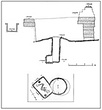
| Side-chamber at the bottom of a circular shaft. AA 27; ST 103 from shaft above burial. PD 427 ... Neolithic ... Side-chamber at the bottom of a circular shaft ... AA 27; ST 103 from shaft above burial. |
Well at 29/ΛΕ, to the SE of the market square, west of the Panathenaic Way.
Circular shaft, caved in at mouth. Diameter 1.20m. Diameter narrows to 0.50m at bottom of shaft, which is slightly concave. No ... Late 8th century B.C ... Well at 29/ΛΕ, to the SE of the market square, west of the Panathenaic Way.
Circular shaft, caved in at mouth. ... Diameter narrows to 0.50m at bottom of shaft, which is slightly concave. |
| Marcie Handler ... The contents of this Hellenistic cistern shaft were excavated in a series of layers: the preserved top of the shaft, six layers in the shaft and the fill within the tunnel. At the bottom of the shaft on ... POU: Mid-3rd c. BC
Dumped fill: after 225 BC ... The contents of this Hellenistic cistern shaft were excavated in a series of layers: the preserved top of the shaft, six layers in the shaft and the fill within the tunnel. At the bottom of the shaft on its northwest side, a vaulted tunnel lead off to the northwest, which was excavated to a distance of 1.5m. The shaft was filled with a mixture of pottery, roof tiles (mostly painted), bone, charcoal, and chunks of the shaft lining that must have fallen from the upper portion of the shaft, which is no longer preserved. |
Cistern shaft, part of cistern system in Η-Ι 16-17. Filling disturbed to bottom; general run of the pottery is to late Hellenistic, lamps as late as Knidos type. Finds from 60/ΙΘ-62/ΙΘ, 61/ΙΗ. "Some Arretine" ... 5 May 1932
18 June 1932 ... Cistern shaft, part of cistern system in Η-Ι 16-17. Filling disturbed to bottom; general run of the pottery is to late Hellenistic, lamps as late as Knidos type. |
A well on the NW slope of the Areopagus; unfinished well-shaft dug to a depth of only 3.05m., and refilled with broken pottery and other debris. The shaft clearly was begun with the intention of digging ... Ca. 520-480 B.C ... A well on the NW slope of the Areopagus; unfinished well-shaft dug to a depth of only 3.05m., and refilled with broken pottery and other debris. The shaft clearly was begun with the intention of digging a well, since footholds were cut in the sides; the reason for the abandonment was not clear; the rock appeared quite suitable for well-sinking. ... Lots ΓΓ 512-515: -1.75m to bottom (Fill II), coarse. |
| A cave-in not long after the digging of this shaft destroyed its possible usefulness as a well and thereafter it was used as a dump. Two principle periods of such use were noted, and within these several ... Ca. 575-480 B.C ... A cave-in not long after the digging of this shaft destroyed its possible usefulness as a well and thereafter it was used as a dump. Two principle periods of such use were noted, and within these several phases.
... Subdivisions:
.1=Upper fill, 0.00m. to 12.00m.
.2=Lower fill, 12.00m. to bottom. |
Well at 53/ΙΗ, east of the east Stoa Plateia. Diameter 1.40-1.50m. Shaft worked with chisel, tapers toward bottom. Plentiful water. Uniform fill with field-stones, perhaps including period of use ... 775-725 B.C ... Well at 53/ΙΗ, east of the east Stoa Plateia. Diameter 1.40-1.50m. Shaft worked with chisel, tapers toward bottom. ... Uniform fill with field-stones, perhaps including period of use |
Diameter 0.95m; water level -9.10m.
Plais shaft cut in stereo from bottom of slender flask-shaped cistern. Scanty fill from house destruction in 5th c. A.D.; Christian lamps; unfinished statuette of Castor ... Late Roman ... Diameter 0.95m; water level -9.10m.
Plais shaft cut in stereo from bottom of slender flask-shaped cistern. ... A.D.; Christian lamps; unfinished statuette of Castor. |
| Shaft oriented N to S (L. 1.30, W. 0.43 at bottom). Fill shot through with cinders and wood ash. Skeleton of a male about 50 years old.
Brann. PD 1065a ... 750-700 B.C ... Shaft oriented N to S (L. 1.30, W. 0.43 at bottom). ... Skeleton of a male about 50 years old.
|
Upper fill (top to around 4.50m.) was in a pit of large dimensions above the preserved well shaft. From the bottom and shaft proper no catalogued pottery. No tiling in place in well but fragments of tiles ... 3rd-4th c. A.D ... Upper fill (top to around 4.50m.) was in a pit of large dimensions above the preserved well shaft. From the bottom and shaft proper no catalogued pottery. No tiling in place in well but fragments of tiles in fill. |
Well on the lower north slope of the Areopagus. The pottery apparently belongs to a filling of one period, since it exhibited no marked difference in character to the bottom. No where was the deposit very ... Ca. 410-390 B.C ... Well on the lower north slope of the Areopagus. The pottery apparently belongs to a filling of one period, since it exhibited no marked difference in character to the bottom. ... Tile curbing in lower part of shaft |
Cistern System #1e: Shaft at 11/ΞΑ.
Agora XXIX: "Well (not cistern shaft, as in Agora XII) ... Communicates with water system through small hole (see C 8:1) probably fortuitously. Single fill, mostly of ... 350-300 B.C ... Cistern System #1e: Shaft at 11/ΞΑ.
Agora XXIX: "Well (not cistern shaft, as in Agora XII) ... ... Single fill, mostly of tiles, with two fairly complete pots at bottom. Coin of 340's/330's-322. |
| A well in the courtyard (Room 8) of a Byzantine House of Period II. The well was covered by a large squared poros wellhead and a marble puteal (apparently neither inventoried). Within the well shaft, the ... 14 July-9 August 1989
2-13 July 1990 ... A well in the courtyard (Room 8) of a Byzantine House of Period II. ... Within the well shaft, the stratified deposit produced two dumped filings of debris that resulted from two distinct destructions, and these were separated by a filling that had accumulated during the Byzantine period of use. A smaller amount of fill at the very bottom of the shaft gave evidence for an earlier period of use of latest Roman date (Hesp. 66 (1997), p. 528). |
| Well at 89-90/ΙΗ-ΙΘ (diameter at top 1.10m), between the southeast corner over the mouth of of the Odeion and the Panathenaic Way. The well lay a thin layer of dug bedrock containing a few Hellenistic ... 650-625 B.C ... Well at 89-90/ΙΗ-ΙΘ (diameter at top 1.10m), between the southeast corner over the mouth of of the Odeion and the Panathenaic Way. ... Toward the bottom of the well its consistency changed to a thick sticky mud which was very difficult to remove.
Carefully dug with a series of eleven steps 0.50m apart on one side of the shaft, ending 1.00m above the bottom. |
Well 15: Mycenaean. It was situated about 35 meters down the slope northwest of the exit of the Mycenaean Fountain.
Well circular or roughly oval in section.
Diameter max. width to -4.0: ca. 1.50, below ... Late Mycenaean ... It was situated about 35 meters down the slope northwest of the exit of the Mycenaean Fountain.
... Water level ca. -2.50. The bottom of the shaft was rough, blocked by a ledge of rock too hard to cut, which still bears in two places the marks of a pointed tool with which it was tested. ... Seems to constitute a dump fill from neighboring houses of the Mycenaean III B period, and is somewhat earlier than the major part of the dump fill of the Fountain. |
Well (diameter shaft 0.95m) with POU and dumped fillings, separated by about 2.00m. of plain mud apparently fallen from the collapsed sides of the well. The fillings are, however, closely contemporary ... Ca. 425-400 B.C ... Well (diameter shaft 0.95m) with POU and dumped fillings, separated by about 2.00m. of plain mud apparently fallen from the collapsed sides of the well. ... Well with curbing wall built of small stones; it was preserved from -7m to bottom, with a diameter of 0.82m. Upper part of well a chaos of rock falls and caves.
|
Well at 19/ΚΔ, beneath the west colonnade of the Square Market Building in the northeast corner of the Agora. Diameter ca. 1.25m. Water level ca. -3.50m. The construction of the well was rather careless, ... Ca. 580-560 B.C ... Well at 19/ΚΔ, beneath the west colonnade of the Square Market Building in the northeast corner of the Agora. ... The construction of the well was rather careless, perhaps caused by the soft crumbly nature of the bedrock
No distinction in date or character could be observed in the filling, from just below the top to the bottom. The concentration of the more complete vases near the bottom, suggested however that the shaft had served as a water supply. |
Well at 18/ΜΓ, on the lower north slope of the Acropolis, under the course of the later Panathenaic Way, west of the Archaic Building.
Diameter 0.97m. Water level 8m.
At the mouth of the well and to a ... Late 8th to 675 B.C ... Well at 18/ΜΓ, on the lower north slope of the Acropolis, under the course of the later Panathenaic Way, west of the Archaic Building.
... The rock from this collapse filled the well-shaft down to a depth of 7m.
below this point lay the water jars from a period of use, to a depth of 8,50m. The filling at the bottom of the well was of mud and sand, without pottery. |
Mycenaean Well (S/1,2-13/20,14/1). Underneath the NE Room of the Library of Pantainos, along its S side, as a cutting in bedrock containing reddish fill with bits of green bedrock. The feature is rectangular ... 30 June-23 July 1975 ... The feature is rectangular in shape, and measured ca. 1.00m NS by 0.65m EW at the bottom.
The function of the well is unclear. ... B.C.) seems to indicate that the shaft of S 13:2 may not have been filled to the top originally (or the fill settled over centuries), and had been covered in some way, not to be rediscovered until the early Roman period.
The location of the well immediately beside a wall of the library main room, as well as the coincidence of the top edge of the well with the bottom level of the library Main Room wall, would suggest that the shaft was cut into during preparations for the construction of the library, which also removed any structural remains that may have been associated with the use phases of the Classical wells.
|
| This filling is the largest deposit of its time found in the Agora. It may be compared with H 6:5 and with N 7:3.
Dug in soft bedrock to a depth of 11.40m; footholds cut on opposite sides of the shaft ... Ca. 490-450 B.C ... This filling is the largest deposit of its time found in the Agora. ... Dug in soft bedrock to a depth of 11.40m; footholds cut on opposite sides of the shaft reached only to 5m. The lowest filling, from 10.75m to bottom, consisting of bedrock fallen from the sides of the well, contained little or no pottery. |
Part of the cistern system 44/ΙΓ - 46/ΙΑ - 42/Θ. The filling of the 46/ΙΑ cistern shaft, with the exception of a little Roman at the top, was the same as the bottom fill of 44/ΙΓ - late Hellenistic, running ... Late 2nd-early 1st c. B.C ... Part of the cistern system 44/ΙΓ - 46/ΙΑ - 42/Θ. The filling of the 46/ΙΑ cistern shaft, with the exception of a little Roman at the top, was the same as the bottom fill of 44/ΙΓ - late Hellenistic, running down to the end of the 1st c. ... One-fifth of bowls long-petal. |
| Rubbish Dump in mouth of abandoned well in Tholos Trench F, Kitchen. Filled with ash, charcoal, broken pottery, roof tiles.
Also from Trench L.
13 March 2014 by Ann Steiner
The deposit has four components ... Ca. 425-400 B.C ... B.C)
Component 3: A second set of collapsed curb stones, ,below the first two, and the material below it to the top of what was still preserved of the well shaft proper: Lots Ζ 691-693; and Ζ 686 (Geometric-late 6th c.)
Component 4: The bottom of the well and what is apparently pottery from a very short period of use. ... well shifts into area of well shaft, both at just above the top-most curbing stones (Lots Ζ 687-690) but below the burning that signifies bottom of Kitchen Dump and below those curbing stones (Lots Ζ 686; 691-693).
|
Fillings in a well on south slope of Kolonos Agoraios. The shaft reached a depth of 20.28m., but produced no use filling. The lower part, from water level at 12.60m. to bottom, provided only mud and gravel ... Ca. 425-400 B.C ... Fillings in a well on south slope of Kolonos Agoraios. The shaft reached a depth of 20.28m., but produced no use filling. The lower part, from water level at 12.60m. to bottom, provided only mud and gravel with occasional thin streaks of sherds of the same period as the main dumped fill above. |
| Well A, early 5th c. B.C. Near the Agora Boundary Stone, northwest corner of Middle Stoa; diameter at top 0.92m, widening to 1.15m and more below. Shaft neatly faced with stones to a depth of 0.70m below ... Ca. 520-480 B.C ... Near the Agora Boundary Stone, northwest corner of Middle Stoa; diameter at top 0.92m, widening to 1.15m and more below. Shaft neatly faced with stones to a depth of 0.70m below well cut in bedrock to about 1m from the bottom, where it narrows from ca. 1.15m to ca. 0.70m. ... Subdivisions: (from the bottom, POU, as published)
.1=11.60-12.12m., POU
.2=7.30-11.60m.
.3=4.85-7.30m.
.4=0.95-4.85m.
.5=0.00-0.95m. |
Cistern on the lower Acropolis slopes, west of Panathenaic Way; dumped filling of 1st century B.C.
Bottom diameter 3.90m. Cistern with connecting draw-shaft and a dead end tunnel dates from Late Hellenistic ... 1st century B.C ... Cistern on the lower Acropolis slopes, west of Panathenaic Way; dumped filling of 1st century B.C.
Bottom diameter 3.90m. ... Most of the fill in it however was of early Roman period.
|
| A well in the industrial area of the Areopagus, about 7.00m. west of the West Bath, to a depth of 14.60m. This well was the direct successor to A 17:1, replacing it when it collapsed. The use filling at ... Second quarter 6th. c ... A well in the industrial area of the Areopagus, about 7.00m. west of the West Bath, to a depth of 14.60m. ... The earth filling of the top 1.90m., where the walls of the well had broken out to form a pit, contained very scanty pottery, of the same date as that of the use filling. ... Dumped filling of same date. |
Well (diameter 0.91m, water level -7m) in House H, Room 10 (and pit over). Plain shaft cut in stereo; pit at mouth of well,reused as drainage pit at start of tile drain running west.
Scanty use filling ... Ca. 425-400 B.C ... Well (diameter 0.91m, water level -7m) in House H, Room 10 (and pit over). Plain shaft cut in stereo; pit at mouth of well,reused as drainage pit at start of tile drain running west.
Scanty use filling at bottom; above this, a broken bedrock fill and above that a dumped filling. The upper part of the well was lined with tiles in the second half of the 4th. c. for use as a collecting basin for a water system, a channel of which entered the well shaft. |
| Grave 7 in notebook. Area disturbed in Roman times; outlines of the shaft had been obliterated.
The northwest end, however, was preserved in a cutting in the rock of the sloping hillside. This cutting, ... 750-700 B.C ... Area disturbed in Roman times; outlines of the shaft had been obliterated.
... The earlier burial, Grave XX, occupied the bottom of the cutting; the later, Grave XIX, rested on a filling of ash 0.38m above it. A thin layer of sand had been sprinkled over the filling of the earlier burial, to serve as a floor for the later.
|
| The cistern was lined with stones at the top with an opening 0.80 m in diameter. For the most part, it seemed to cut into bedrock except along its northern edge where some 5th c. B.C fill remains and main ... 2-19 July 2010 ... B.C fill remains and main continue further down (Lot 663). The shaft has a cement lining with 4 sets of hand-holes place on opposite sides at intervals of about 0.30 m going down. The opening begins to widen very gradually at about 1 m down, forming a bottle shape, with a maximum diameter of 1.55 m at the bottom, and a total depth of 2.80m. |
Cistern at the southeast foot of Kolonos Agoraios.
Nbp. 2369: Two chamber cisterns, 88/ΛΔ and 100/ΚΘ, united by a long straight passage running almost due N-S. A draw shaft at 95/ΚΘ is set just off the ... Late 2nd-early 1st c. B.C.-86 B.C ... Cistern at the southeast foot of Kolonos Agoraios.
... A draw shaft at 95/ΚΘ is set just off the course of the passage to the east and opening into it.
Nbp. 1787: This cistern contained a hopeless mixture of sherds, from hellenistic to late roman ... One can say in a general way that the hellenistic fill lay over the bottom of this cistern and the roman above it, but every basket of Hellenistic contained also Roman sherds.
|
| Report on sorting of pottery, August 1951, by H.S. Robinson [nb p. 3666].
Cistern discovered and dug to 1.60m., vi/10/36; dug to bottom iv/22/37-v/6/37. Diam. At mouth 0.26m.; neck begins to widen out ... 1st. c. B.C. to post-Herulian ... Report on sorting of pottery, August 1951, by H.S. ... Cistern discovered and dug to 1.60m., vi/10/36; dug to bottom iv/22/37-v/6/37. ... Well-plastered, without footholds; at 2.90-3.85m. a passage opens out to the south, curving slightly eastward, for 5.00m., at which point it is blocked by fill from another (cistern?) shaft. At 1.50m. appears the flow of an overflow channel connecting with the well at 105/ΝΗ. |
Well ΑΒ located on the lower terrace to the north of the sanctuary(diameter 1.10m). Foot-holes were cut into the shaft at intervals of ca. 0.40m. The fill consisted mostly of small stones, dug bedrock, ... Second quarter of the 6th century B.C ... Well ΑΒ located on the lower terrace to the north of the sanctuary(diameter 1.10m). Foot-holes were cut into the shaft at intervals of ca. 0.40m. ... No period of use deposit at bottom; the well seems to have been filled shortly after it was dug. |
Roman well, stratified.
Finds from the earth (not recorded in a subdivision):
P 7995, P 8036, P 21834, SS 6338, IL 483, IL 486, BI 309, BI 310,
BI 314.
According to the excavator the shaft had been cleaned ... 2nd-4th c. A.D ... According to the excavator the shaft had been cleaned out at some period and then used as a vothros over a long time (p. 1874). Despite the general paucity of the well fill (only 21 tins of pottery from -7.00m to bottom), a rather large number of amphorae, micaceous water jars and other handled containers were represented among the sherds and some stratification is apparent. |
Cistern at the southeast foot of Kolonos Agoraios.
Nbp. 2369: Two chamber cisterns, 88/ΛΔ and 100/ΚΘ, united by a long straight passage running almost due N-S. A draw shaft at 95/ΚΘ is set just off the ... Use filling of late 4th-early 3rd c. B.C.
Accumulative fillings of late 3rd-early 2nd and late 1st c. B.C.
Upper dumped filling of 3rd c. A.D ... Cistern at the southeast foot of Kolonos Agoraios.
... A draw shaft at 95/ΚΘ is set just off the course of the passage to the east and opening into it.
... Twenty stamped amphora handles. Most of pottery dates in second half of 3rd c. but evidence of disturbance includes coins and Knidian handles, early Roman pottery, lamp, and glass, "Pergamene" ware and fragments of 18 long-petal bowls. |
|
|