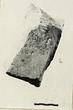
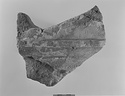
[Agora Object] I 7148: Marble Fragment

Inscribed fragment. Broken all around. Only smooth front and rough picked back preserved. Hymettian marble. Found in wall of Byzantine pithos. Leica ... 3 June 1970 ... Inscribed fragment. Broken all around. Only smooth front and rough picked back preserved. ... Found in wall of Byzantine pithos.

icon

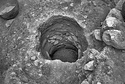
[Agora Deposit] L 2:1: Pithos or Bothros in Byzantine "Room D".

"Room D" is the triangular area at L/15,16-2/10,12, NW of Wall 1, in E corner of basement of No.3. Hastings Street, bounded by the NE and SE walls of basement). Bell-shaped vessel built of horizontally-laid ... 10th-11th c. A.D.

[Agora Object] I 6326: Grave Stone Fragment

Inscribed fragment. Broken above, below, and to right. Rough back, worn, and possibly left side preserved. Hymettian marble. Found in wall of Byzantine pithos, east of the altar of Ares. Leica ... 6 April 1951 ... Inscribed fragment. Broken above, below, and to right. ... Found in wall of Byzantine pithos, east of the altar of Ares.

icon

[Agora Report Page] 1934 Β, s. 20

Section Β 1934. Wells, pits, cisterns, etc (except those connected with the Tholos). Modern wells and cesspools visible at surface at start of excavation. Building A of Section Ζ; Pits and pithoi in passage ... 1934 Β F 11:2 F 11:1 F 12:3 F 12:4 F 12:7 ... Broken pithos (Byzantine) ... Soft late fill (Byzantine and 6th B.C.) ... Pithos in line of wall of Bouleuterion

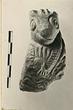
[Agora Object] T 3354: Animal Figurine Fragment

Large eyed animal. Broken all around. Brown clay, traces of red and white paint. ADDENDA Perhaps for a rabbit; cf. T 232, from the same mould. Roman fill beside Byzantine pithos. 4877 Leica ... 20 April 1954 ... Large eyed animal. Broken all around. Brown clay, traces of red and white paint. ... Roman fill beside Byzantine pithos.

icon

[Agora Object] I 6306: Marble Fragment

Inscribed fragment. Broken to right, below and behind. Crowning pediment and left side preserved. Hymettian marble. Found in Byzantine context beside Byzantine pithos, at the west edge of the altar of ... 3 June 1950 ... Inscribed fragment. Broken to right, below and behind. ... Found in Byzantine context beside Byzantine pithos, at the west edge of the altar of Ares.

icon

[Agora Deposit] M 2:1: Well in Byzantine Room J.

Johanna Hobratschk ... South end of Byzantine Room J, adjacent to Pithos B and under St. Philip's st scarp. Built lining at the E and N side, roughly constructed of some large square blocks and slabs, smaller field stones of ... 21 July-3 August 2006 2011 28 June 2012-16 July 2012 ... South end of Byzantine Room J, adjacent to Pithos B and under St. ... Built lining at the E and N side, roughly constructed of some large square blocks and slabs, smaller field stones of different sizes and shapes, reused tile, and broken segments of terracotta well lining.

icon

[Agora Object] I 7397: Marble Fragment: Attic Tribute List

Inscribed fragment. Broken all around, battered and worn but surface generally quite fresh. Parts of fifteen lines of the inscription preserved and one column of the lists of cities and payments. Pentelic ... 8 June 1972 ... Inscribed fragment. Broken all around, battered and worn but surface generally quite fresh. ... Found in Byzantine Pithos.

icon

[Agora Image] 2012.43.1021 (Section Ρ 305)

Room E3, pithos removed, showing continuation of the hard, late Roman strosis found in E5 and to the east. Arrow points to where this strosis is broken by black Byzantine loose fill. From southeast ... AMS Horizontal (normal) ... Room E3, pithos removed, showing continuation of the hard, late Roman strosis found in E5 and to the east. Arrow points to where this strosis is broken by black Byzantine loose fill.

icon

[Agora Image] 2012.43.1022 (Section Ρ 306)

Room E3, pithos removed, showing continuation of the hard, late Roman strosis found in E5 and to the east. Arrow points to where this strosis is broken by black Byzantine loose fill. From south ... AMS Horizontal (normal) ... Room E3, pithos removed, showing continuation of the hard, late Roman strosis found in E5 and to the east. Arrow points to where this strosis is broken by black Byzantine loose fill.

icon

[Agora Image] 2012.43.1023 (Section Ρ 307)

Room E3, pithos removed, showing continuation of the hard, late Roman strosis found in E5 and to the east. Arrow points to where this strosis is broken by black Byzantine loose fill. From southeast ... AMS Horizontal (normal) ... Room E3, pithos removed, showing continuation of the hard, late Roman strosis found in E5 and to the east. Arrow points to where this strosis is broken by black Byzantine loose fill.

[Agora Object] I 6958: Marble Fragments

Inscribed fragments. Two joining fragments from the upper part of a tall grave stele. Broken all around. Back worn smooth. Moulding at top of stele preserved, but palmette above it missing. Two disk rosettes ... 19 August 1959 ... Two joining fragments from the upper part of a tall grave stele. Broken all around. Back worn smooth. ... Found built into Byzantine pithos, at northwest corner of the Archaic temple.

icon

[Agora Notebook Page] Ζ-15-45 (pp. 2821-2822)

Varia (1933). Broken Pithos at 30/Κ. Broken Pithos at 23/ΙΓ. Bothros at 58/Β. From Various Places. Lucy Talcott, Barbara Philippaki et al., Small objects from the Pnyx II, Hesperia Supplement 10, 1955 ... Ζ-15 2821, 2822 Ζ 461 P 1898 Ζ 462 P 1899 Ζ:1933.0324:1 N 17737 Ζ:1933.0324:2 N 17738 Ζ:1933.0324:3 N 17739 Ζ:1933.0324:4 N 17740 Ζ:1933.0324:5 N 17741 Ζ:1933.0324:6 N 17742 Ζ:1933.0324:7 N 17743 Ζ:1933.0324:8 ... 12 A.D.

icon

[Agora Object] T 3781: Horse Figurine

Nose and lower legs broken off. Trace of rider or girth on back. Fragmentary. Buff clay with black glaze remaining over much of body. Cf. Hesperia 2 (1933), pp. 617-620. Just outside break in north wall ... 2 August 1967 ... Nose and lower legs broken off. Trace of rider or girth on back. ... From protoattic fill inside, disturbed by Byzantine pithos 2.

[Agora Object] P 14999: Bowl Fragment with Sgraffito Decoration

Low ring foot; center of floor and part of wall preserved. Rabbit, right, body incised, head and ears sgraffito, legs and paws part incised, part sgraffito. Very long ears. Bit of enclosing circle, incised, ... 11 May 1939

icon

[Agora Object] I 1906: Decree Fragment

Inscribed stele fragment. Broken at the bottom. The sides preserved, and the back, the latter rough picked. At the top a bit of the fascia remains. Tapers toward the top. Decree passed by Orgeones; mentions ... Early 3rd. century B.C ... Inscribed stele fragment. Broken at the bottom. ... Built into a Byzantine pithos, on the north slope of the Areopagus.

[Agora Object] I 6091: Marble Fragment

Inscribed fragment. Broken top, bottom and left. The back preserved, rough picked, and the right side with a bevelled edge along the inscribed face. Nine lines of the inscription preserved, with thirty-eight ... 1 April 1948 ... Inscribed fragment. Broken top, bottom and left. ... Found built into late Byzantine concrete pithos, southwest of the Market Square.

icon

[Agora Object] S 998: Portrait Head of Male Figure

Broken off at neck. Forehead and front part of hair missing, back of neck and back hair also broken off. Features badly chipped and rubbed. Life-size head, with slightly parted lips, broad nose and eyes ... 1st c. B.C. (?) ... Broken off at neck. Forehead and front part of hair missing, back of neck and back hair also broken off. Features badly chipped and rubbed. ... Byzantine pithos in Room XVI, with mixed fill.

icon

[Agora Object] I 5805: Dedication Fragment

Inscribed fragment. Top and bottom, roughly dressed preserved, and smooth dressed back; broken at left; right side chipped along face but original edge probably preserved at back. Shallow frame, within ... 5 May 1939 ... Top and bottom, roughly dressed preserved, and smooth dressed back; broken at left; right side chipped along face but original edge probably preserved at back. ... Found in Byzantine pithos in the industrial area, southwest of the Market Square.

icon

[Agora Object] S 2178: Head Fragment of Male Figure

Right side of head, broken off at right of nose and diagonally across bottom with break running from chin to base of skull. Face very badly battered. Life-sized male head, heavily bearded, with short hair, ... 10 May 1965 ... Right side of head, broken off at right of nose and diagonally across bottom with break running from chin to base of skull. ... Trench zeta; in pithos with Byzantine fill.

icon

[Agora Object] P 3075: Brazier Fragment

Brittle white clay; light green glaze darker in places; fired yellowish-brown where lines or dots have been incised. A triple affair, the outer part of which has an elaborate cut out pattern; its lowest ... 5 February 1934

icon

[Agora Object] A 1133: Tile Standard

One corner and part of one end broken away; otherwise complete. On one face two long concave cuttings, one wide and shaped rather like a rain tile, the other narrow and rather like a cover tile. Anathyrosis ... 17 July 1946 ... One corner and part of one end broken away; otherwise complete. ... Found in line of a Byzantine wall here destroyed; standing almost upright on one of its narrow edges, it leans slightly to S.E. against a Turkish pithos; it would seem to have reached its present position in Turkish period, but may have formed part of Byzantine wall.

icon

[Agora Object] S 1494: Head of Female Figure from Relief

Broken below at neck. Right side from top to mid cheek missing. Nose, mouth, and chin much chipped and bruised. Drill hole at back to separate it from background. Female head, half life-size, left, seen ... 23 April 1951 ... Broken below at neck. ... From marble lining of Byzantine (?) pithos.

icon

[Agora Object] S 850: Portrait Statue of Draped Standing Male Figure

Head, set in socket, missing; socket fully preserved. Feet and lower part of drapery broken off, also upper part of right arm and most of the fingers of the right hand. Left forearm and hand largely missing ... 16 March 1937 ... Feet and lower part of drapery broken off, also upper part of right arm and most of the fingers of the right hand. ... Just west of Great Drain; partially cut by Byzantine pithos. With coin # 23 of 17 March 1937.

icon

[Agora Object] I 6135: Dedicatory Monument Fragments

Inscribed fragments of dedicatory inscription of the Stoa of Attalos. Fragment ΣΑ 317, (a), inscribed face only preserved. Many additional fragments with parts of letters are preserved. Fragment ΣΑ 794, ... a) (ΣΑ 317) March 1949 b) (ΣΑ 794) 4 October 1949 c) (ΣΑ 875) November 1949 d) (ΣΑ 876) November 1949 e) (Τ 3112) 31 March 1955 ... Fragment Υ 454, (f), broken all around; part of underside remains. ... Possibly part of post-excavation accumulation and hence from earlier Greek excavations, or perhaps from fallen wall of Byzantine pithos ar edge of trench. b) (ΣΑ 794), found in debris of late Roman Fortification wall, just north of middle tower (Piers 12-13 E). c) (ΣΑ 875), found in marble pile from demolition of Middle Tower. d) (ΣΑ 876), found in marble pile from demolition of Middle Tower. e) (Τ 3112), found in marble pile. f) (Υ 454), found in the walls of old excavation houses. g) (Υ 458), found in the walls of old excavation houses.

[Agora Webpage] Publications: Picture Books

http://agathe.gr/publications/picture_books.html

Picture Books The Athenian Agora Picture Book series, started in 1951, aims to make information about life in the ancient commercial and political center of Athens available to a wide audience. Each booklet ... RPublication Date: 1961ISBN: 0876616198Picture Book: 6 Although this booklet is based on broken pottery found during the excavation of the Agora, the author ranges far beyond the confines of Athens in her discussion of the purpose and significance of different amphora types. ... These range from a wealthy Mycenaean chamber tomb, filled with the vases and jewelry of a rich noblewoman, to the poignant pithos burial of an infant from around 725 B.C., accompanied by eight tiny vases. ... This booklet presents Byzantine, Frankish, Venetian, Turkish, and modern Greek coins, with many pieces illustrated with clear black and white photos of both obverse and reverse.