|
|
| Classical Building II, Layer 7B ... 1st c. A.D. |
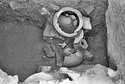
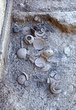
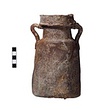
| David Scahill ... Beneath toichobate floor level in Room 1 of Classical Building II, against the south ashlar wall, ca. 1.50m. east of the southwest corner of the building. Deposit of broken pyre pots in small pit, 1.00m ... Ca. 325 B.C ... Excavations | 2001 | Trenches | Scahill | Classical Building II | Room 1 | Beneath Toichobate Floor Level | Pyre J 3:7 |
Middle Stoa Building Fill.
Cf. also H-I-J 14-15, H-K 12-14 (ask SIR) (unsolved)
This deposit is not definitive and must be considered with the above deposits before details are entered into database; ... Before ca. 150 B.C ... Middle Stoa Building Fill.
Cf. also H-I-J 14-15, H-K 12-14 (ask SIR) (unsolved)
This deposit is not definitive and must be considered with the above deposits before details are entered into database; left for later, in the interest of time (Dec 2007/pf) ... SIR published it as H-K 12-14
Asterisk: H-I-J 12-13* |
| A well at the northeast corner of Classical Building, behind back wall. Dumped fill appears to have occurred as a single event as there are joining sherds throughout.
POU date ca. first half 5th c. B.C.; ... 5th c. B.C. |
Byzantine Building: Room XV (loose black filling). Coins:
12 April 1933 #5-#15
13 April 1933 #1 ... Byzantine |
Brian Martens ... This deep stratum (ca. 030m) is delayed Persian destruction cleanup deposited in the 470s B.C. it contains about one generation's worth of pottery, almost exclusively dating between about 500-470 B.C ... 29 June-19 July 2017
12–15 July 2022 ... The stratum abutted E-W polygonal Wall 8 and was laid down for Post-Persian renovations of the building. The dump of pottery raised the floor level of the building; atop J 1:18 was a layer of crushed bedrock and a renewed floor surface.
... Addendum 2022: The collapse of Wall G’ allowed further work on deposit J 1:18 in the 2022 season. |
| Marcie Handler ... Located in the south section of Room E in the Byzantine Building east of the North-South Road. The uppermost 1.5 meters of well lining was built of well-coursed stones (some reused marble blocks) and tiles ... 12th c. A.D ... Excavations | 2001 | Trenches | Handler | Byzantine Building East of the North-South Road | Room E | Well J 2:18 ... Excavations | 2003 | Trenches | Handler | Byzantine Building East of the North-South Road | Room E | Well J 2:18 |
| David Scahill ... Protogeometric/Early Geometric well under floors in Room 1, Classical Building II, on north side of south ashlar wall. See J 3:9 for the burial within this well.
Cf. Hesperia Suppl. 50 (2018), p. 106, ... 27 June 2001
17 July 2002 ... Protogeometric/Early Geometric well under floors in Room 1, Classical Building II, on north side of south ashlar wall. See J 3:9 for the burial within this well.
|
| David Scahill ... Burial in Geometric well (J 3:8), in Classical Building II, Room I, next to south ashlar wall. "No grave goods!"
ADDENDA: J. Papadopoulos later associated P 34449 and P 34450 to that grave. (Cf. Agora ... Geometric ... Burial in Geometric well (J 3:8), in Classical Building II, Room I, next to south ashlar wall ... ADDENDA: J. Papadopoulos later associated P 34449 and P 34450 to that grave. |
| Marcie Handler ... Continued from 2000 season, 10-12 July 2000; BZ XXIII p. 4472.
The hoard was originally excavated during the 2000 season (Lot BZ 1049, 5th-6th centuries AD), from a higher elevation through a gap in the ... 10-12 July 2000
21-22 July 2003 ... Excavations | 2003 | Trenches | Handler | Byzantine Building East of the North-South Road | Room F | Coin Hoard J 1:2 | Fill |
| Marcie Handler ... Fill within the drain from the basin on the west side of Roman Room B through Wall A.
After we removed the fill within the basin on the west side of Roman Room B (BZ XXVII p. 5325), we began excavating ... Late Roman ... Excavations | 2003 | Trenches | Handler | Roman Building East of the North-South Road | Roman Room B | Coin Hoard J 2:21 |
| David Scahill ... Below packed clay floors in Room 2 of Classical Building II; bordered on east and south sides by polygonal cross wall and back wall extension for Classical Building. Late Roman wall and drain installation ... LHIII A:1 |
| Destruction Fill in channel of Apsidal Building.
Cf. nb.p. 989 for continued digging in this channel. Coins:
24 July 1990 #202, #204, #208
27 July 1990 #219-#222
30 July 1990 #226
31 July 1009 #236
1 August ... 14 June-3 August 1990 |
| Marcie Handler ... The remnants of a disturbed pyre in a layer of dumped Hellenistic fill. The fill was found in the area on top of and east of the eastern wall of the Classical Commercial Building at its north end. Fragmentary ... Ca. 225 B.C. |
| Classical Pyre between floors in Room 2 of Classical Building II.
Below floor at 51.66 7masl. Broken pyre pots in fill of ash and carbon, from 51.541-51.513, resting on next floor at 51.513 masl, next ... Ca. 400-390 B.C. |
| Sacrificial Pyre I, Classical Building II.
The pyre was set through the original floor level of the northern room of the Classical Building and apparently is the remainder of a ritual conducted when the ... Ca. 375-350 B.C. |
Classical commercial building, room 3, against south wall. Small fragments of pottery dispersed in fill overlying two floor levels (at 51.897 and 51.941 masl). Five objects of pyre type: ribbon-handled ... 4th c. B.C. |
| Pyre against north face of polygonal wall, Room 2, Classical Building II. No floor preserved above, but the pyre is below floor level 51.820masl, preserved just to the east and above patchy floor with ... Ca. 275-260 B.C. |
| Sacrificial Pyre II, Classical Building II.
Found right beneath the stuccoed channel built for sluicing in the 1st c. A.D., and must have been partly disturbed when the channel was constructed. It may ... Ca. 250 B.C. |
| Matt McCallum ... The pyre was uncovered in a small, triangular area between the BZ Building foundations (but at a lower level) and the northern scarp of the current excavation area. It rested in a patch of orange-brown ... 1-7 August 2006 |
| Marcie Handler ... It was situated in the NW corner of Room 3 in the Classical Commercial Building, just S of Wall 11, the cross-wall that divides Room 3 from Room 4 to the north. The pyre pots were found surrounded by ... Late 4th c. B.C ... It was situated in the NW corner of Room 3 in the Classical Commercial Building, just S of Wall 11, the cross-wall that divides Room 3 from Room 4 to the north. The pyre pots were found surrounded by fill with charcoal and burnt bone below a floor surface preserved immediately to the E (J/13,14-2/7,8; 52.20 masl.).
|
| Handler ... Found in an area of disturbed fill north of a floor surface in Room 4 of the Classical Commercial Building. The floor surface (n. 3 on the west side of Room 4) was preserved at 52.503-52.544 masl., and ... 2nd half 4th c. B.C. |
| Enclosure within Roman Circular Building. The finds apparently reflect the entire area inside the enclosure. Pottery lot ΒΓ 515 identifies the deposit as layer 10 and coin #895 from layer 11 says "layer ... 12-18 August 1971
9-10 May 1972 ... Enclosure within Roman Circular Building. The finds apparently reflect the entire area inside the enclosure. ... Coins:
13 August 1971 #890
9 May 1972 #895 (layer 11, "layer below the deposit")
The Bone bags from J 5:2 were analyzed by Michael MacKinnon: there are domestic taxa represented by a mix of skeletal elements. |
| David Scahill ... At northeast corner of Classical Building II; on south side of dromos of Tomb K 2:5, and separated from it by ca. 0.6m of bedrock. Chamber cut through bedrock. The northeast corner of chamber defined ... LHIII A:1 |
| Marcie Handler ... The Pyre was revealed in a layer of 4th c. fill in the north end of Room 6, just south of Wall 8. Room 6 is defined by the street wall (Wall A) on the west, Wall 7 on the east, Wall 9 on the south (preserved ... 4th c. B.C ... Room 6 is defined by the street wall (Wall A) on the west, Wall 7 on the east, Wall 9 on the south (preserved only as a stub on the east side of the area), and possibly Wall 8 or Wall 6 on the north.
2.5 meters SW of the pyre, a patch of floor surface at J/10-1/20 at 52.188 masl. was found. ... This pyre is the northernmost pyre found in Section ΒΖ North, and its location suggests that the Classical Commercial Building continues this far north. |
| Marcie Handler ... Pyre under floor no. 9 in the center of Room 4. It was adjacent to the southern face of Wall 4, but at lower elevation than the lowest course of the wall foundation (which was found at 52.250 masl.), suggesting ... 375-350 B.C ... It was adjacent to the southern face of Wall 4, but at lower elevation than the lowest course of the wall foundation (which was found at 52.250 masl.), suggesting that the pyre was deposited during a phase of the building that predates Wall 4. Pyre J 2:30 was located approximately 0.20m below Pyre J 2:28, which was excavated during the 2007 excavation season.
The oblong pit for Pyre J 2:30 was cut into Floor no 10 (removed in Lot ΒΖ 2122) and was covered by Floor no 9 (removed in Lot ΒΖ 2120), both of which dated approximately to the last quarter of the 5th c. |
A total of 79 ostraka was recovered from Room 5 of the Classical Building.
More of this deposit was excavated in the 2021 season on the opposite side of the scarp of Wall R, up against the face of Wall ... 500-475 B.C. |
Archaic house with Distyle Porch (= Building J) in southeast of section: packing beneath floors (Layers a and b of Tholos Trench S.Layer b=Beneath original floor dated to ca. 500 B.C.
Layer a=Between original ... 6th-early 5th c. B.C ... Archaic house with Distyle Porch (= Building J) in southeast of section: packing beneath floors (Layers a and b of Tholos Trench S.Layer b=Beneath original floor dated to ca. 500 B.C.
|
Channel J (in ΗΗ)
Cutting that probably originally held a drain. Packed with amphoras and other coarse pottery. It tapped the poros aqueduct wall just East of our explanatory trench at the East end of ... 1st c. B.C. - early 1st. A.D ... Channel J (in ΗΗ)
Cutting that probably originally held a drain. ... Then it swung sharply NW and N as though to avoid some building and moved down at great depth (1.62m)as though along a street. |
Middle Stoa Building Fill (East End) (Inside building and to South) Cf. H-I-J 12-13 (Θ, ΜΣ) and H-I-J 14 -15 (Κ) (unsolved)
This deposit is not definitive and must be considered with the above deposits ... Middle Stoa Building Fill (East End) (Inside building and to South) Cf. H-I-J 12-13 (Θ, ΜΣ) and H-I-J 14 -15 (Κ) (unsolved)
This deposit is not definitive and must be considered with the above deposits before details are entered into database; left for later, in the interest of time (Dec 2007/pf). |
Middle Stoa Building Fill (with filling to S) (See also Κ: H-I-J 14-15 and Λ: K-M 13-14)
This deposit is not definitive and must be considered with the above deposits before details are entered into database; ... To ca. 180 B.C ... Middle Stoa Building Fill (with filling to S) (See also Κ: H-I-J 14-15 and Λ: K-M 13-14)
This deposit is not definitive and must be considered with the above deposits before details are entered into database; left for later in the interest of time (Dec 2007/pf)
Date based on Grace's analysis of ca. 1500 stamped amphora handles in fill. ... Five fragments of long-petal bowls and one fragment of figured bowl of M Monogram Class come from disturbed area of fill at west end of building. Otherwise bowls similar to those in other deposits of early 2nd. c. |
Investigations in the area around the Tholos, especially to the east and south of the building, between it and the Great Drain, and not otherwise specified as deposits.
This "deposit" has no form. It ... various levels and dates ... Investigations in the area around the Tholos, especially to the east and south of the building, between it and the Great Drain, and not otherwise specified as deposits.
... Labeled trenches B, J, K, R are in section Β. |
|
|