|
|
Perhaps originally a grave cutting ... Ca. 390-380 B.C. |
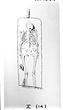
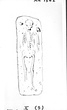
| Rodney S. Young ... Grave 20 (E.L. Smithson: Grave X: PG). Bones discarded. Pit tomb, inhumation (on bier or in coffin?), perhaps of a child. Little ash and carbon in the filling, but the grave offerings were unburned.
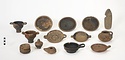
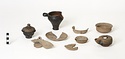
JP ... Developed Protogeometric ... The se pots, all unburned and clustered together, would have been placed in the area immediately above the feet of the deceased.
c) in the lowest 0.30m, very damp earth with very little ash, much heavy black matter "of a different character", from that in the layer above.
... Negs. X-43, X-44 |
Well at the southeast corner, almost on the line of the east-west street. Upper Fill: Late Roman dumped fill.
Lower Fill: Dark Age: ca. 7th c. A.D.
Coin
30 March 1939 #34 ... 7th-Late 6th century |
| Grave X in notebook = RSY Grave 14. PD 731-g ... Ca. 525-500 B.C ... Hesperia 20 (1951), p. 96, fig. 11 and pl. 43 b-c (Grave 14). |
| Pyre in House C, Room 8 (RSY=Pyre 6).
Near east corner of room 8. Artifacts, burnt bone, burnt sticks, and large cinders in a shallow pit dug into surface of layer 3, and covered by layer 2. Some cinders ... 350-325 B.C.-end of 4th c. B.C ... Hesperia Suppl. 47 (2013), no. 43, p. 155, figs. 78, 85, 86 ... Hesperia 20 (1951), pp. 120-121, pl. 51 c (Pyre 6). |
| Grave V in notebook = RSY Grave 5. PD 731-c, Ptg. 244 ... Second quarter of the 6th. c. B.C. |
Containers 43-47. Coins:
22 April 1939 #1-#2
25 April 1939 #1
15 May 1939 #1 ... 3rd c. A.D. |
| Marcie Handler ... The Pyre was revealed in a layer of 4th c. fill in the north end of Room 6, just south of Wall 8. Room 6 is defined by the street wall (Wall A) on the west, Wall 7 on the east, Wall 9 on the south (preserved ... 4th c. B.C. |
Exploration of packing below paving blocks of Panathenaic Way.
Uncatalogued material: 66 sherds, 2 objects (50A) and 43 sherds (50B). Coins:
26 April 1960 #1-#2
3 May 1960 #1-#4, #6-#9 Deposit created ... 1st c. A.D. |
| Tiled Well at S edge of E-W Road, 73/ΜΗ. Contemporary upper and lower fills separated by layer of sterile mud.
Latest coin dates ca. 200. Koan amphora handle with stamped handle dates slightly after 200 ... 210-160 ... Koan amphora handle with stamped handle dates slightly after 200. type 43 A (?) lamp. Fragment of Roman terracotta plaque of late 3rd c. ... Bowls of coarse workmanship , unlike those of early 2nd c. contexts; none from fresh molds, some from very worn molds. ... This suggests date in second quarter of 2nd c. |
| Grave XIV in notebook = RSY Grave 13. PD 731-f ... Late 6th. c. B.C. |
Possibly a short period of use but chiefly a debris filling including a number of fragments from disturbed early burials. Two pot fragments, believed to be from lower body of P 18525, added from Well 3 ... Ca. 575-550 B.C. |
| Identified as Pyre by SIR.
Debris filling of the middle of the 4th c. B.C. including the remains of a sacrificial pyre.
Objects dispersed in red-clay fill uncovered in removal of modern staircase. A broken ... 4th c. B.C. disturbed ... 4th c. B.C. disturbed ... ΓΓ:39-43/ΞΓ-ΞΕ |
| David Scahill ... Behind northeast corner of Classical Building; east wall C. Below Hellenistic levels and early Classical pit. Chamber cut through bedrock, depth ca. 0.90m., diameter ca. 2m., roughly square in shape, angling ... LH III A:1 |
Small pocket between the tumbled wall of large conglomerate blocks and Drain 2 ... 4th c. B.C ... 4th c. B.C ... ΣΤ:40-43/ΚΒ |
| Laura Gawlinski ... Bronze foundry north of bridge on Piraeus street, east of Great Drain.
Keyhole-shaped bronze casting pit, cut into bedrock.
2016: Continuation of the excavation of a rectangular pit with foundry debris, ... Late 6th-early 5th c. B.C.
(Late Archaic/ Early Classical) |
Destruction debris in Late Roman Buildings on Lower N slope of Areopagus (see summaries under M-Q 17-21).
Over 130 coins came from this filling, of which some 51 survived in a condition to permit accurate ... 6th c. A.D ... 6th c. A.D ... Ω:43/ΙΖ |
| Mycenaean Chamber Tomb.
Only the bottom 0.10 to 0.20m of the chamber was preserved along with the partial skeletal remains of two or three occupants. The plan revealed a square chamber (1.80m by 1.80m), ... Myc. III A 1:2 (14th c.) |
Michael Laughy ... West and adjacent to Modern Wall 5, we excavated 12th-13th c. A.D. fill, in some places a half meter deep or more. The fill was remarkably uniform in content throughout. Typical pottery included: fine ... 12th-13th c. A.D ... West and adjacent to Modern Wall 5, we excavated 12th-13th c. A.D. fill, in some places a half meter deep or more. ... Within this fill, we discovered a slightly scattered hoard of 43 coins. At the time of this summary, the legible coins are Frankish, and date to the early 13th c. ... Coins: ΒΘ-96; ΒΘ-98 -128; ΒΘ-135 -145
Pottery lots: T 141, T 143
Notebook: ΒΘ VIII
Baskets: 43, 57; pp. 1557, 1587
X-Section: pp. 1460, 1500
Grid: K/6,9-3/5,9
Elevation: 54.544-54.111m. |
Well at 96/Ι in arm of cistern at 94/Θ (F 15:2). Probably the rebuilding of an earlier well.
P 3149, P 3150, P 3154 are jars from packing in cistern arm; construction fill - early Roman.
P 4588 is listed ... Second half of 3rd c. A.D.=POU |
|
|