|
|
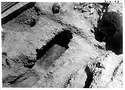
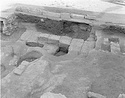
Cesspool in N Exhedra ... Turkish ... Cesspool in N Exhedra |
Roman Dump/Cesspool ... Second half 1st c.-1st half 2nd c. A.D ... Roman Dump/Cesspool. |
Cistern and drawshaft connected by tunnel; used in modern times as cesspool. No stratigraphy noted, but pottery from first five boxes excavated is later than that from boxes 6-18.
11 stamped amphora handles ... Hellenistic and Late Hellenistic ... Cistern and drawshaft connected by tunnel; used in modern times as cesspool. No stratigraphy noted, but pottery from first five boxes excavated is later than that from boxes 6-18.
11 stamped amphora handles. |
Well at 56/ΚΖ, just south of the south wall of the northern Late Roman Building ... Second half of 2nd c. - early 3rd c. A.D ... Top to -12.85: Modern Cesspool. |
Cistern at 63/ΛΑ (part of cistern system 63/ΛΑ-65/ΜΑ-70/ΛΣΤ, consisting of two chambers and a well). Roman upper fill with modern cesspool fill above. Channel finds: MC 517, SS 8078.
Only datable object ... 300-195 B.C ... Roman upper fill with modern cesspool fill above. |
| Mycenaean Small Chamber tomb.
The cist measures 1,90m E to W, 0.75-0.90m N to S, max. depth -1.30m. Nothing was found in it; cleaned in modern times and used as a cesspool. Some of the SW part of it had ... Myc. IIIA, early 14th c ... Nothing was found in it; cleaned in modern times and used as a cesspool. Some of the SW part of it had also been cut away in Roman times by a terracotta drain. All that remains of the chamber is a small segment with a maximum preserved dimension of 1.20m, which is bordered on the north by a modern wall and on the east by a cesspool. The cutting is not straight either in vertical or horizontal section, which shows that the chamber was circular in plan and probably roughly semi-circular in section. |
| Well South of Soft Yellow Poros Foundation. Dumped filling of a collapsed well, that, due to hazardous conditions, could not be cleared below- 2.50m. The well was partly cut on the east side by a Byzantine ... Protogeometric-Early Geometric II, ca. 850 B.C ... The well was partly cut on the east side by a Byzantine storage pithos, and on the south side it was disturbed by another, tile-lined, well of the Roman period (U 19:4), which had been used for water and then as a cesspool inn the early 20th century.
|
|
|