icon

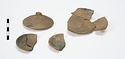
E 29:3: Possible pyre

Above bedrock in N.W. corner of room S, House of Greek Mosaic. Contents suggest "saucer-pyre" ... Late 4th-early 3rd c. B.C ... Above bedrock in N.W. corner of room S, House of Greek Mosaic. Contents suggest "saucer-pyre".

R 15-16

Valerian Wall, undisturbed contents: Lower stretch. Not on concordance, not on cardex neither. No info. Asterisk: R 15-16* ... Valerian Wall, undisturbed contents: Lower stretch.

S 16-17

Valerian Wall, undisturbed contents: Upper stretch. Not on concordance, not on cardex neither. Asterisk: S 16-17* (no info) ... Valerian Wall, undisturbed contents: Upper stretch.

J 17:1: Pit

Pit in floor of cellar of House 634/19. Contents mixed to late Roman. Pottery 4th c. B.C. to 4th c. A.D. discarded ... 25 April 1958 ... Pit in floor of cellar of House 634/19. Contents mixed to late Roman.

K 14:1: Collector's Dump

Pottery Deposit at 57/ΙΔ (also 57/ΙΣΤ and 63-66/Κ-ΚΕ). Contents of pit range from Mycenaean to Turkish; apparently the dump of a modern antiquities dealer ... Modern Context ... Pottery Deposit at 57/ΙΔ (also 57/ΙΣΤ and 63-66/Κ-ΚΕ). Contents of pit range from Mycenaean to Turkish; apparently the dump of a modern antiquities dealer.

icon

I 5:2 BIS: Disturbed Cist Tomb

Susan I. Rotroff ... Grave 2 (bis). Cut into by builders of I 5:2. No remains. Possible contents in I 4-5:1 Layer C (= layer 6, lower building fill), catalogued as ΒΓ 2065 - ΒΓ 2125 ... Middle Helladic or later Bronze Age (date uncertain) ... Possible contents in I 4-5:1 Layer C (= layer 6, lower building fill), catalogued as ΒΓ 2065 - ΒΓ 2125.

E 14:10: Well I

Abandoned digging at 12.85m. due to collapse of side walls. Well H contents probably thrown in to Well I during cleaning in early Roman times; the pottery from the two wells is similar. Cf. E 14:6 ... 350-250 B.C ... Well H contents probably thrown in to Well I during cleaning in early Roman times; the pottery from the two wells is similar.

icon

D 6:3: Urn cremation

Dorothy Burr Thompson ... Grave 25 in notebook. (E.L. Smithson: Grave I: SM). Bones discarded. In some records as Grve XIV (JP)? Notebook says (p. 947) contents: hard earth, no bones. Lisa's list says bones discarded. Negs. X-75, ... Final Mycenaean/Submycenaean ... Notebook says (p. 947) contents: hard earth, no bones.

L 18:2: Well on Lower Slopes of Areopagus

Well on lower slopes of Areopagus. Diameter ca. 1.50m. Dumped filling of 8th c. at the top. Fill mostly Geometric but containing bits of later (even Roman) pottery. Perhaps cleaned out and refilled with ... 730-700 B.C ... Perhaps cleaned out and refilled with its own contents at the time of building of Roman house over it.

I 17:5: Drawshaft, Cistern Shaft at 63/ΚΓ

Cistern shaft at 63/ΚΓ. Part of H-I 16-17 system. Contents of 3rd c. disturbed. Part of extensive cistern system, of which one chamber, three drawshafts, and two blind tunnels were excavated (H 16:2, ... 3rd c., disturbed ... Part of H-I 16-17 system. Contents of 3rd c. disturbed.

Q 17:7: Well G in ΠΑ

Well G, just south of Room D. It was finally filled in the 6th c. A.D. with some attractive sculpture. Its contents suggest that the building was not used for metal work, but was purely domestic containing ... 3rd-6th c. A.D ... Its contents suggest that the building was not used for metal work, but was purely domestic containing abundant household pottery, remnants of wood, bone, stone, fruit stones and animal bones, especially of boar and goat.

icon

N 6:3: Classical Dump

Classical dump at N/1,6-6/6,8. Layer 14 in Early Trench E. A tremendously thick layer of dumped fill with ceramic contents ranging down through the second half of the 5th century and into very early years ... Late 5th c. (Early 4th c.) ... A tremendously thick layer of dumped fill with ceramic contents ranging down through the second half of the 5th century and into very early years of the 4th century B.C.

H 7:2: Late Well to West of Temple of Apollo

The filling from top to bottom uniform, yielding small bits of ancient worked marbles and pottery of the fifth and fourth centuries B.C. mixed with undecorated coarse ware, probably of Byzantine times ... 5th c. A.D.-Byz ... A sherd from the mouth of the well (P 2223, red figure) removed from contents list by E.V.

icon

M 17:8: Pyre in Pithos Y.

Contents of Pithos Y; probably belonging to sacrificial pyre III. In northern corner of courtyard. Characteristic pyre pottery in fill of one of two pithoi set into the floor of the courtyard as part ... 400-350 B.C ... Contents of Pithos Y; probably belonging to sacrificial pyre III.

T 25:2: Well 12 in ΟΑ

Well 12: Archaic. It lies on a rocky ledge about thirty meters north of the Klepsydra, just east of the Panathenaic street. In spite of its depth, it produced little pottery and its contents were of slight ... 6th c. B.C.? ... In spite of its depth, it produced little pottery and its contents were of slight interest in themselves.

icon

B 19:1: Rubbish Pit/Pyre

Rubbish Pit . Pit cut through a house floor. In courtyard, beside door to room 3. Artifacts, bone and scattering of large cinders in roughly rectangular pit dug through floor bedding and covered by red, ... 325-300 B.C ... Although the contents included chicken bones and carbonized matter along with pottery, the evidence indicates that the burning did not take place on the spot but was dumped in from elsewhere.

icon

D 17:14: Disturbed Pyre

Disturbed Pyre at 59/ΚΗ (ΚΖ), in the area of the Poros Building west of the Areopagus. Against east wall of room 5 west. concentration of artifacts, ash, carbon and a few bones in stratum, no pit discerned ... 3rd c. B.C ... Against east wall of room 5 west. concentration of artifacts, ash, carbon and a few bones in stratum, no pit discerned. The contents rested on or above a layer that is said to be at about the same level as the pebble mosaic floor, and thus the pyre probably postdates the laying of that floor.

icon

J 1:7: Hellenistic Cistern Shaft

Marcie Handler ... The contents of this Hellenistic cistern shaft were excavated in a series of layers: the preserved top of the shaft, six layers in the shaft and the fill within the tunnel. At the bottom of the shaft on ... POU: Mid-3rd c. BC Dumped fill: after 225 BC ... The contents of this Hellenistic cistern shaft were excavated in a series of layers: the preserved top of the shaft, six layers in the shaft and the fill within the tunnel.

R 13:10: Courtyard Well

Courtyard Well (R/15-13/20). The well went out of use as a result of the Herulian sack of 267 A.D. in the upper part of the well the well-head itself was found, one of the finest in the Agora collection ... 27 June-15 July 1975 ... Layer: Bottom POU. The contents of the bags seem to correspond to the the second indication.

D-E 8-9:1: Theseion Cisterns A and B (1936)

Two chambers connected by a tunnel, all filled at the same time, but with slight Hellenistic disturbance. Chamber A, to west at 14/ΛΗ, B to east at 14-15/ΛΒ on grid for section RR. Cistern system ca. 20.00m ... Ca. 325-275 B.C ... Abandonment of cistern and source of contents probaby attributable to an undetermined event in the early part of the decade 310 B.C.