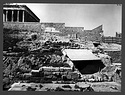
[Agora Deposit] A 20:10: Infant burial(?)

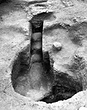
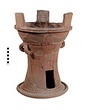
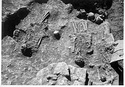
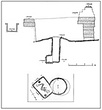
Grave (?) under wall 4. Infant burial(?); a kados, P 16747, lying sideways with a tall cylindrical stand, P 16748, set over it as a cover; the upper parts of the pots cut away ... Late 6th. c. B.C ... Infant burial(?); a kados, P 16747, lying sideways with a tall cylindrical stand, P 16748, set over it as a cover; the upper parts of the pots cut away.

icon

[Agora Deposit] A 16:1: Bronze Casting Pit and Workshop

Debris filling in a bronze casting pit and workshop, characterized by mold fragments but including also a few plain vases and fragments of wine jars. Third quarter of 4th. c. BC. The pit was cut into the ... Ca. 350-325 B.C ... Debris filling in a bronze casting pit and workshop, characterized by mold fragments but including also a few plain vases and fragments of wine jars. ... The pit was cut into the soft bedrock to a depth of -1.43m and is 1.70m wide at its broadest extremity. The ground plan is that of a slightly lop-sided keyhole.

[Agora Deposit] Q 16:1: Cistern A

Cistern chamber in the area of the southeast Temple, the mouth cut back in antiquity ... Late 4th - early 3rd c. B.C.

[Agora Deposit] C 19:4: Pit

Debris filling in a pit cut in bedrock at W side of House H, Room 10 ... Ca. 425-400 B.C ... Debris filling in a pit cut in bedrock at W side of House H, Room 10.

icon

[Agora Deposit] A 18:1: Cistern Between Areopagus and Hill of the Nymphs

Cistern in the valley between the Areopagus and the Hill of the Nymphs. Simple, flask-shaped chamber withdraw-shaft; no tunnels. Mouth cut away in Byzantine times. Lower filling, 3rd c. B.C. Coins: 25 ... 25-30 April 1947

icon

[Agora Deposit] A-B 18:1: Mycenaean Chamber Tomb

Mycenaean tomb: Myc. III A:1-2. SAI Small rectangular chamber, 2.30m wide by 1.80m deep,, entered from the east through a dromos 1.10m wide which contracted to a doorway 0.92m. wide. the doorway preserved ... 2nd half of 14th c ... Mycenaean tomb: Myc. III A:1-2. SAI Small rectangular chamber, 2.30m wide by 1.80m deep,, entered from the east through a dromos 1.10m wide which contracted to a doorway 0.92m. wide. the doorway preserved its rough stone blocking wall to a height of 0.70m to 0.80m., and the dromos the firm red earth with which it had been packed to a height of 1.30m. Only the lower 0.50m of the chamber had been hewn from bedrock, the upper part being cut from very compact gravelly earth. ... Several earlier interments had been swept aside; some bones were found in the corners of the chamber. others in a small pit (0.55x0.30x0.23 deep)near the southeast corner

icon

[Agora Deposit] I 9:2: Burial in Metroon Drain Cut

Side-chamber at the bottom of a circular shaft. AA 27; ST 103 from shaft above burial. PD 427 ... Neolithic

icon

[Agora Deposit] G 6:3: Rectangular Rock-Cut Shaft

A cave-in not long after the digging of this shaft destroyed its possible usefulness as a well and thereafter it was used as a dump. Two principle periods of such use were noted, and within these several ... Ca. 575-480 B.C.

icon

[Agora Deposit] A 14:1: Early Roman Well

Extract from notebook ΠΘ XIX, pp. 3644-3646. Well at 105/ΝΗ (report on sorting of pottery, July 19, 1951 - H.S. Robinson). "Not a useful well" HSR. Well dug to 1.50m., vi/9/36; dug from 1.50m. to bottom ... Early Roman; use fillings of 2nd. c. B.C. and 1st. and 4th. c. A.D.; dumped filling of late 4th. c. (HSR) Fill I: 2nd. c. B.C. Fill II-V: to second half of 4th. c. A.D. Fill VI: mixed to Byzantine ... Robinson). "Not a useful well" HSR. Well dug to 1.50m., vi/9/36; dug from 1.50m. to bottom (22.80m.), iv/9/37 - iv/23/37. Cut in bed-rock (no tiles reported); diameter at mouth: 1.04m.; depth 22.80m. ... One coin (iv/9/37 #1) of Constantine II (323-361 A.D.) suggests a late 4th cent. date for this destruction fill.

[Agora Deposit] N 11:5: Well

Well at 69/ΛΕ (diameter 0.95m). Narrows at bottom. Footholds on east and west. Uniform fill. Bones found in the well make it likely that it had cut through a grave, as it was itself overlain by one ... Late 8th c. B.C ... Bones found in the well make it likely that it had cut through a grave, as it was itself overlain by one.

[Agora Deposit] O 6:1: Archaic Dump

Trench at O/7,8-6/1,5. Layer 5 of Trench A cut in Rooms 1 and 2 of Greek House γ. Soft green clay with bones, ash, much pottery. Probably leveling fill ... Archaic ... Layer 5 of Trench A cut in Rooms 1 and 2 of Greek House γ.

[Agora Deposit] B 12:3: Rectangular Pit

Mixed filling in a well cut rectangular pit. Debris of the second half of the 5th. c., deposited as late as the second quarter of the 4th. c. B.C ... 4th c. B.C. and earlier ... Mixed filling in a well cut rectangular pit.

icon

[Agora Deposit] Q 8:5: Pit Tomb, Child Inhumation

Homer A. Thompson ... PG grave to NW of Pier 19 (Grave 4). It consisted of a rectangular pit, oriented north-south, cut into bedrock. Only the lowest part of the tomb pit was preserved; the upper part was cut away in the Classical ... Earlier-Developed Protogeometric ... It consisted of a rectangular pit, oriented north-south, cut into bedrock. Only the lowest part of the tomb pit was preserved; the upper part was cut away in the Classical period. ... On it were a few bone fragments of a child and six vessels.

icon

[Agora Deposit] D 16:6: Pyre in Cut in E-W Street

Pyre in cut in E-W street, layer 7 (Pyre 14). North edge of Piraeus street, west of the Great Drain Bridge, in the area west of Areopagus. RSY-Pyre. Pottery, a little burnt bone, and patches of charcoal ... 250-240 B.C ... Pyre in cut in E-W street, layer 7 (Pyre 14). ... The pyre was uncovered in digging a thin layer rich in marble chips. ... Organic material:" a minimum of bits of burned bone".

icon

[Agora Deposit] G 12:9: Inhumation of a Woman

Grave 8 in notebook. Inhumation in Tholos Cemetery. Length of shaft 1.75m; Width at upper end 0.95m; Depth from cover 0.70m. One end cut into sloping rock. Skeleton of a woman, with head southeast. Most ... 750-725 B.C ... One end cut into sloping rock. Skeleton of a woman, with head southeast.

[Agora Deposit] D 5:1: Stuccoed Pit

Stuccoed pit, 2m x 2.50 m, rock-cut. Coins: 26 March 1937 #1 (not a coin) ... Ca. 400-350 B.C ... Stuccoed pit, 2m x 2.50 m, rock-cut ... Coins: 26 March 1937 #1 (not a coin)

icon

[Agora Deposit] B 21:23: Disturbed grave/inhumation

Rodney S. Young ... RSY/JP Disturbed Geometric burial over "Sacrificial Pit VI" (Grave B 21:22). Grave IX in notebook. Bones discarded? Pottery found in the upper filling of a sixth century cremation pit, which had perhaps ... Middle Geometric II/Transitional to Late Geometric ... Pottery found in the upper filling of a sixth century cremation pit, which had perhaps cut through a Geometric inhumation to which the disturbed human bones close by may have belonged.

icon

[Agora Deposit] N 20:8: Cremation Burial in Ω

Margaret Crosby ... Grave, disturbed. Rectangular cutting in bedrock 1.70m long and 0.60m deep. The north half was cut away by a modern cellar wall and only 0.20-0.10m of fill was left. A the bottom there was a thick layer ... 510 - 490 B.C ... The north half was cut away by a modern cellar wall and only 0.20-0.10m of fill was left. A the bottom there was a thick layer of burning. also present fragments of long bones and ribs, probably animal.

icon

[Agora Deposit] M 18:6: Urn burial

Grave 3 in notebook. Outside Archaic cemetery, inhumation burial. Deposit list says black glaze pithos (P 8922) containing the bones of a child and four small vases. The pithos lay on its side with the ... Last quarter of 6th century B.C ... Deposit list says black glaze pithos (P 8922) containing the bones of a child and four small vases. ... The bottom had been cut by a late fifth century well and the upper side was caved in.

[Agora Deposit] E 15:1: Well A

Well shaft cut through a cistern channel which was then packed with three amphorae (P 3123, P 3125, P 4201) of 1st or at latest early 2nd c. A.D. (These three amphorae could be considered with F 15:2) ... 3rd-4th c. A.D ... Well shaft cut through a cistern channel which was then packed with three amphorae (P 3123, P 3125, P 4201) of 1st or at latest early 2nd c. ... At 5.50 a group of fallen wall tiles arched over shaft which was empty to below 8.00 (at water level). ... It seems more likely that tiles were robbed in late 4th c., one 1st c. amphora of packing fell in and then a 4th c. dump was dropped in, capped by tile fragments; later a 5th c. dump on top.

icon

[Agora Deposit] C 9:9: Urn cremation

Rodney S. Young ... Grave 2 in notebook (E.L. Smithson: Grave XV: PG). Urn cremation (trench-and-hole), adult female. JP It consists of a roughly rectangular pit or trench cut into bedrock to a depth of 0.35m., measuring ... Late Protogeometric ... JP It consists of a roughly rectangular pit or trench cut into bedrock to a depth of 0.35m., measuring 1.12m long and 0.67m wide. ... The urn-hole, cut to a depth of 0.62m., measured roughly 0.40m in diameter. the urn-hole itself, but not the rectangular trench of the tomb, was sealed by a large, flat stone, broken in situ.

[Agora Deposit] F 13:2: Well 7

Dump, 4th c. Cut through a cistern which was probably constructed in the 4th c. B.C, near the southwest corner of the market square. Coins: 25 May 1935 #1 (with L 1809) (disintegrated) Subdivisions: .1=Upper ... Second half 1st c.-end 2nd c ... Dump, 4th c. Cut through a cistern which was probably constructed in the 4th c.

icon

[Agora Deposit] G 12:17: Inhumation of a Woman

Grave 16 in notebook. Length of shaft 1.81m; width 0.64m; depth from cover 0.54m. Skeleton of a woman , head at northwest end. Most of pots piled over feet and legs of skeleton at southeast end. An iron ... 750 B.C ... Skeleton of a woman , head at northwest end. ... An iron fibula and a bronze pin lay to the right of the skull, other metal jewelry was among the pots at the feet. A bit of human bone and some fragments of Minyan ware found in random positions suggest that Grave XVII was cut through an earlier burial.

[Agora Deposit] I 18:4: Pit-Well

Well east of Geometric Grave. The upper part collapsed into a pit, cut into by Middle Geometric grave I 18:1 and by a Byzantine wall. Some evidence for period of use; little pottery. At the top a few Geometric ... Early Protogeometric ... The upper part collapsed into a pit, cut into by Middle Geometric grave I 18:1 and by a Byzantine wall. ... At the top a few Geometric sherds, perhaps displaced from I 18:3.

[Agora Deposit] T 19:6: Pocket in Bedrock South West of Archaic Temple

S.W. of Archaic Temple : Pocket in bedrock. The pocket was cut through a red clay floor. 71 sherds. Objects: loom weights; lamp. Early ware: Gray Minyan; Mycenaean; Protogeometric-Late Geometric; Subgeometric; ... Early 6th c. B.C. and earlier ... The pocket was cut through a red clay floor.

icon

[Agora Deposit] Q 17:6: Urn burial

Homer A. Thompson ... Child's grave, Geometric. The bones of a child about one month old had been placed into P. 25787, which was lying on its side. The upper side of the pot was cut away in later times. The mouth was closed ... Late 8th c. B.C ... The bones of a child about one month old had been placed into P. 25787, which was lying on its side. The upper side of the pot was cut away in later times.

icon

[Agora Deposit] N 16:4: Urn cremation

Homer A. Thompson ... Cremation burial (trench-and-hole) under S. edge of E-W Street, southern burial. In some records as Grave XLVI. Neat trench, rectangular as preserved, but may have originally been square, cut partly through ... Early Geometric I ... Neat trench, rectangular as preserved, but may have originally been square, cut partly through earth, partly into bedrock, to a depth of about 0.25m. The north side of the trench was destroyed by the a Turkish cess pit. ... Be that as it may, a deep, circular urn-hole was cut into the southeast corner of the pyre trench to a depth of 0.45m below the level of the floor, and measuring 0.35m in diameter.

[Agora Deposit] H 11:2: Well in Tholos Trench Q

A well in room A of the Archaic House. Well with very irregular outline, cut down in the bedrock some 10m NE of the Tholos. Its filling yielded a handful of plain potsherds and the oinochoe P 13256 of ... Sub-Mycenaean(?) ... A well in room A of the Archaic House. Well with very irregular outline, cut down in the bedrock some 10m NE of the Tholos. Its filling yielded a handful of plain potsherds and the oinochoe P 13256 of an advanced Late Helladic III shape.

[Agora Deposit] D 10:1: Thiseion Cistern A (1935)

Cistern A for 1935 (there is another Cistern A, for 1936, D-E 8-9:1) Coins: 16 May 1935 #4-#5 17 May 1935 #1-#2 18 May 1935 #1-#2 20 May 1935 #1-#2 22 May 1935 #1 23 May 1935 #2-#6 24 May 1935 #1-#7 25 ... 16-25 May 1935 6 February 1936 ... Cistern A for 1935 (there is another Cistern A, for 1936, D-E 8-9:1) ... Also, from rock-cut channel leading south from cistern (27/8/1961) S 589, S 590, SS 4316, IL 254, IL 258, IL 286, T 885, T 901, A 578, P 5947, P 6449 and coins ΠΘ-34, ΠΘ-35.

[Agora Deposit] S 17:1: Deposit in Bedrock

Deposit in bedrock cuttings, probably from a household. (Panathenaic Way Cut III, E1 and E2). E1: Mixed 7th-5th c. B.C. E2: Late Geometric-Early 6th c. B.C. Coins: 19 May 1959 #5-#7 ... 5th c. B.C and earlier ... Deposit in bedrock cuttings, probably from a household. (Panathenaic Way Cut III, E1 and E2).

[Agora Deposit] Q 7:1: Pit

Pit in bedrock at SE corner of cut at N end of Stoa Terrace. Small irregular pit, extending under Stoa foundations, containing a number of black-figured pieces ... Late 6th c. B.C ... Pit in bedrock at SE corner of cut at N end of Stoa Terrace. Small irregular pit, extending under Stoa foundations, containing a number of black-figured pieces.

icon

[Agora Deposit] Q 8:7: Pit Tomb, Child (?) Inhumation

Homer A. Thompson ... PG grave north of Stoa Pier 19 (Grave 6). In some records as Grave XLIII. Unlined rectangular pit cut into a shallow depression in bedrock that was formed by the collapse of the roof of Mycenaean Chamber ... Developed Protogeometric ... Unlined rectangular pit cut into a shallow depression in bedrock that was formed by the collapse of the roof of Mycenaean Chamber Tomb Q 8:8. ... Traces of a layer of white clay remained on the floor of the pit and on the collapsed bedrock around it. ... On the floor of the pit, " a few bones and the skull" of the deceased were encountered, the cranium evidently at the south end of the grave.

icon

[Agora Deposit] I 18:3: Simple Trench Cremation

Homer A. Thompson ... (Grave XXX: EG) Rectangular cutting with burned bones of a female 40-45 years old, and both burned and unburned pottery fragments. Rectangular trench, measuring approximately 0.80m long, 0.40m wide, with ... Middle Geometric I ... (Grave XXX: EG) Rectangular cutting with burned bones of a female 40-45 years old, and both burned and unburned pottery fragments. Rectangular trench, measuring approximately 0.80m long, 0.40m wide, with a preserved depth of 0.20m, cut through earth, partly into irregular outcroppings of bedrock, oriented northwest-southeast. A fieldstone paving was found closing the mouth of the trench and lining the sides cut in earth.

icon

[Agora Deposit] G 12:11: Disturbed Adult Inhumation Pit Tomb

Rodney S. Young ... Grave 10 in notebook. No remains. Probably grave of a woman. Only a small portion of the inhumation pit was preserved at the northeast edge of pit A, a large oval cutting of modern date dug for the construction ... Middle Geometric II ... Probably grave of a woman. Only a small portion of the inhumation pit was preserved at the northeast edge of pit A, a large oval cutting of modern date dug for the construction of a circular wall at its center, later used as a cess- pit. ... The tomb was cut with a northeast-southwest orientation, interrupting the series of graves (Tomb XVII-XX), which radiate from the base of the hill.

icon

[Agora Deposit] N 16:3: Disturbed Urn Cremation

Homer A. Thompson ... Cremation burial (trench-and-hole) under S. edge of E-W Street, northern burial. In some records as Grave XLVII. The western part of the offering trench of the tomb was lost to a Turkish cess pit, and ... Middle Geometric I ... B.C. had cut away the upper part of the cinerary urn and the adjoining trench filling. The tomb was found directly below a Classical wall. What survived was the south and east section of the original grave, including a strip of the pyre trench, reddened from burning to a depth of 0.05m, and below it a shallow urn-hole, roughly square, ca. 0.60m to the side, cut through earth almost to the level of bedrock, to a depth of about 0.30m.

icon

[Agora Deposit] B 14:5: Pit

A flask-shaped storage pit or cellar, cut in the rock at the south edge of the levelled top of Kolonos Agoraios. Filled late in first quarter of 6th. c. B.C. (2.95m from east to west by 2.70m from north ... First quarter 6th. c. B.C ... A flask-shaped storage pit or cellar, cut in the rock at the south edge of the levelled top of Kolonos Agoraios. ... Original mouth probably cut away. Floor rather uneven.

[Agora Deposit] J 14:3: Well in the Northeast Corner of the early Peribolos

Located in the NE corner of the early peribolos. Probably originally 1.00-1.50m. deeper, the bedrock above having been cut back in late times. Scanty pottery remains; some evidence for a period of use ... Ca. 600-570 B.C ... Probably originally 1.00-1.50m. deeper, the bedrock above having been cut back in late times. Scanty pottery remains; some evidence for a period of use near bottom.

[Agora Deposit] E 13:1: Well 5

Carefully cut in bedrock with firm footholds on either side. The use filling is represented by a few fragments of water jars (uninventoried), indicating a short period of use. The dumped filling, below ... Ca. 470-425 B.C ... Carefully cut in bedrock with firm footholds on either side. The use filling is represented by a few fragments of water jars (uninventoried), indicating a short period of use. The dumped filling, below 17.35m., contained a high proportion of figured and glazed pieces, in contrast to the scanty common household pottery.

icon

[Agora Deposit] E 19:1: Grave 1

Grave cut into bedrock (L. 2m, W. 0.58m), head toward E; offerings at south end. Skeleton of a male about 40 years old, laid out with knees slightly bent. Brann. PD 434, PD 1058 ... 750-725 B.C ... Grave cut into bedrock (L. 2m, W. 0.58m), head toward E; offerings at south end. Skeleton of a male about 40 years old, laid out with knees slightly bent.

[Agora Deposit] Q 12:2: Well in Stoa Terrace Opposite Pier 2

Well in Stoa Terrace opposite Pier 2. Diameter 1.10m. Well cut with steps on both sides. No water. was probably not much used, although part of a well head was found at 4.50m Estimated Grid ... Into 600-575 B.C ... Diameter 1.10m. Well cut with steps on both sides. No water. was probably not much used, although part of a well head was found at 4.50m

icon

[Agora Deposit] C 9:8: Urn cremation

Grave 1 in notebook (E.L. Smithson: Grave XXV: PG). No remains. Probable trench-and-hole. JP Roughly circular pit measuring 0.39m in diameter cut into bedrock to a depth of 0.72m. Pyre refuse-described ... Late PG/EG I ... JP Roughly circular pit measuring 0.39m in diameter cut into bedrock to a depth of 0.72m. Pyre refuse-described as "ashes and cinders etc"- was encountered throughout the tomb pit, below, around and above the urn. although there is no specific mention of a trench, Young's description of the tomb suggests that a rectangular trench, with a maximum length of about 0.80m and a preserved width of ca. 0.60m, was cut through earth into bedrock. consequently, the tomb appears to be a classic example of an Athenian trench-and-hole, oriented east-west,with the urn-hole at the east. There was no clear evidence that the tomb as a whole was sealed in any way, and any tomb covering would have been destroyed by the construction of the mudbrick foundry.

[Agora Deposit] M 11:3: Well

7th c. well below east part of Odeion Cavea Trench K). Use filling negligible; dumped filling of the second half of the 7th c. B.C. Brann Well H. Diameter 1.10m. Cut into bedrock. During excavation seepage ... 650-600 B.C ... Diameter 1.10m. Cut into bedrock. During excavation seepage water collected. Steps cut on opposite sides of the shaft, 0.40m apart. The bedrock around the mouth of the well had collapsed, forming a crater with a fill of filed stones about two meters thick.

[Agora Deposit] B 21:24: Well

Well. Construction, use and dumped fillings of the Hellenistic period. Tile-lined well with a packing of jars behind the tiles; the well cut through (Fill 4) the passage of a cistern (B 21:25). At 9.00m ... Hellenistic ... Tile-lined well with a packing of jars behind the tiles; the well cut through (Fill 4) the passage of a cistern (B 21:25). At 9.00m. a threatened collapse of the walls caused abandonment of the excavation work at the point when the use-filling had just been reached.

icon

[Agora Deposit] J 10:1: Unfinished Chamber Tomb

Plundered Chamber Tomb. (Tomb XII). A few meters SE of the great white marble altar. The chamber is an irregular rectangle, oriented roughly N-S, with dromos leading in at a very gentle slope from the ... LH III A ... (Tomb XII). A few meters SE of the great white marble altar. The chamber is an irregular rectangle, oriented roughly N-S, with dromos leading in at a very gentle slope from the north. The dromos had been cut through by a Turkish well.

icon

[Agora Deposit] Q 8:6: Cist Tomb, Child Inhumation

Homer A. Thompson ... PG grave to NW of Stoa Pier 19 (Tomb no. 5 in notebook). In some records as Grave XLII. It consisted of a rectangular pit, oriented north-south, cut into bedrock. The sides of the pit were lined and the ... Earlier-Developed Protogeometric ... It consisted of a rectangular pit, oriented north-south, cut into bedrock. The sides of the pit were lined and the floor paved with unworked or only roughly hewn slabs of schist (Th. 0.10-0.15m), defining a cist. The floor of the cist was further covered with a thin layer of sand. ... The skeleton of a child (7-8 years at death) was found on its back in a fully extended supine position, head to the south, filling the cist almost entirely.

icon

[Agora Deposit] D 16:11: Casting pit

Laura Gawlinski ... Bronze foundry north of bridge on Piraeus street, east of Great Drain. Keyhole-shaped bronze casting pit, cut into bedrock. 2016: Continuation of the excavation of a rectangular pit with foundry debris, ... Late 6th-early 5th c. B.C. (Late Archaic/ Early Classical) ... Keyhole-shaped bronze casting pit, cut into bedrock. 2016: Continuation of the excavation of a rectangular pit with foundry debris, first excavated in 1949. ... Appears to be cut into fill at south, but that area is disturbed by a modern water pipe from the landscaping of the Agora. ... Seven standing mudbricks line the bedrock wall at south, surrounding a ceramic stand, hand-formed on a cut bedrock base.

icon

[Agora Deposit] C 9:14: Cremation

Rodney S. Young ... Grave 7 in notebook (E.L. Smithson: Grave XXI: PG). Bones discarded. Disturbed and damaged cremation (originally trench-and-hole), the east end cut away, probably contained the burial urn. JP It consisted ... Late Protogeometric ... Disturbed and damaged cremation (originally trench-and-hole), the east end cut away, probably contained the burial urn. JP It consisted of a rectangular trench cut through hard-packed fill and slightly into bedrock to a depth of 0.48m. the trench oriented east-west, had a preserved length of 0.70m and a width of 0.60m. ... The preserved east end, built up from redeposited green schist bedrock streaked with reddened earth, may have been a barrier between the destroyed urn-hole and the pyre trench, constructed after the fire had subsided.

[Agora Deposit] D-E 8-9:1: Theseion Cisterns A and B (1936)

Two chambers connected by a tunnel, all filled at the same time, but with slight Hellenistic disturbance. Chamber A, to west at 14/ΛΗ, B to east at 14-15/ΛΒ on grid for section RR. Cistern system ca. 20.00m ... Ca. 325-275 B.C ... Two chambers connected by a tunnel, all filled at the same time, but with slight Hellenistic disturbance. Chamber A, to west at 14/ΛΗ, B to east at 14-15/ΛΒ on grid for section RR. ... Basically a single dumped filling; the presence in the filling of a few later objects ... possibly as late as the second half of the 3rd c., probably indicates a supplementary filling.

[Agora Deposit] V 24:1: Mycenaean Well in OA

Well 15: Mycenaean. It was situated about 35 meters down the slope northwest of the exit of the Mycenaean Fountain. Well circular or roughly oval in section. Diameter max. width to -4.0: ca. 1.50, below ... Late Mycenaean ... The bottom of the shaft was rough, blocked by a ledge of rock too hard to cut, which still bears in two places the marks of a pointed tool with which it was tested. About 0.30m below, a late Roman pit which cut into the north side sherds occurred in fair quantity and the fill seemed to be pure. ... Seems to constitute a dump fill from neighboring houses of the Mycenaean III B period, and is somewhat earlier than the major part of the dump fill of the Fountain.

icon

[Agora Deposit] C 10:2: Pot inhumation, probably infant

Rodney S. Young ... Grave 9 (E.L. Smithson: Grave XVIII: PG). Bones discarded. JP Roughly circular pit, about 0.59m in diameter, cut into soft bedrock to a depth of 0.42m. Tomb encountered only about 0.12-0.15m below the ... Protogeometric ... JP Roughly circular pit, about 0.59m in diameter, cut into soft bedrock to a depth of 0.42m.

[Agora Deposit] G 12:21: Well 2

Circular well cut through the old road after it had gone out of use, and filled probably at the time of the building of the drain and building A, and the throwing of fill over the road ... Ca. 430-400 B.C ... Circular well cut through the old road after it had gone out of use, and filled probably at the time of the building of the drain and building A, and the throwing of fill over the road.

icon

[Agora Deposit] N 12:1: Child's Pit Grave

Mycenaean grave. It consisted of a shallow rectangular cutting in bedrock about 1.40m by 0.70m, but it was probably somewhat bigger, since the east side and a large part of the north side had been cut ... Myc. IIIA:1-2 ... It consisted of a shallow rectangular cutting in bedrock about 1.40m by 0.70m, but it was probably somewhat bigger, since the east side and a large part of the north side had been cut away by later builders. It contained a single burial, that of a small child, laid lengthwise in the grave along the south side. ... Many minute glass beads were found under the skull and around the feeding bottle, and doubtless came from a necklace worn by the child.

icon

[Agora Deposit] I 3:1: Well Under Room I of Byzantine House

A tile lined well under Room I of Byzantine House. A concrete shaft belonging to the mill cut off the top of the well and left in place 3 complete sets of tiles and most of a fourth set. All but the lowest ... 17-18 c. A.D ... A tile lined well under Room I of Byzantine House. A concrete shaft belonging to the mill cut off the top of the well and left in place 3 complete sets of tiles and most of a fourth set. All but the lowest set of tiles were cracked and pushed slightly out of alignment, as a result of subsequent construction.

[Agora Deposit] F 11:1: Well

Well cut through the floor of a cistern. Apparently a dumped fill in an unused well. Coins: 16 March 1934 #15 (illegible) 17 March 1934 #2 19 March 1934 #1-#4 20 March 1934 #1-#3 22 March 1934 #1 23 March ... 1st-early 2nd c. A.D ... Well cut through the floor of a cistern. Apparently a dumped fill in an unused well.

[Agora Deposit] S 17:3: Cutting in Bedrock

Cutting in bedrock (Panathenaic Way Cut II, Cutting C1); loose gravelly filling over bedrock including a number of terracotta figurines. Lot ΠΑ 61? P 26458 is probably a slip. One fragment noted as from ... 4th c. B.C ... Cutting in bedrock (Panathenaic Way Cut II, Cutting C1); loose gravelly filling over bedrock including a number of terracotta figurines ... P 26458 is probably a slip. One fragment noted as from S 17:1 (Late Geometric) and the other from S 17:3.

[Agora Deposit] I 16:7: Square Settling Basin

Located beneath line of Poros Gutter, from a square settling basin cut in bedrock at the north end of Trench II, South of Theseion, 1.30m below the modern road surface. The basin is lined with rough-picked ... Last quarter of 5th c. B.C.-early 4th c. B.C ... Located beneath line of Poros Gutter, from a square settling basin cut in bedrock at the north end of Trench II, South of Theseion, 1.30m below the modern road surface. The basin is lined with rough-picked limestone blocks of 0.20-0.30m thickness, closely fitted and bonded with mud mortar, a construction similar too that of the hieron in material and quality, if not size.

icon

[Agora Deposit] P 9:4: Chamber Tomb Opposite ΣΑ Pier 15

Mycenaean Chamber Tomb opposite ΣΑ pier 15. It was discovered about 20m to the west of Pier 15 of the Stoa of Attalos and almost in a line and a few meters south of Tomb XX. although the entire upper part ... Myc. II-IIIA/B ... It was discovered about 20m to the west of Pier 15 of the Stoa of Attalos and almost in a line and a few meters south of Tomb XX. although the entire upper part had been cut away in Classical times, leaving only the lowest o.50 to 0.80m., and a Classical pit had cut away the northwest corner of the chamber, the burials were remarkably undisturbed and the chamber could be planned and measures. the dromos opening to the northeast, was short and steep and irregularly cut. it was 0.70m wide and was preserved to a length of 1.50m; a few stones of the blocking wall of the doorway remained. ... One lay along the east side with head to south and legs doubled up; another in the center with feet toward the door; and a third at the back of the chamber. In the southwest corner were the remains of a swept-up skeleton, and beneath this a shallow pit with swept-up bones and pots from still earlier burials.

icon

[Agora Deposit] B 18:3: Pyre

Pyre in House T, Room 2 through floor of second period (RSY=Pyre 5) in the industrial area west of the Areopagus. 4th. c. BC. Concentration of artifacts, burnt bone, and charcoal in floor makeup consisting ... 375-350 B.C ... The pyre was partly covered by a pebble floor associated with phase 3 of the house, but the fill in which it was found cut through a floor associated with the second phase, and it predates the abandonment of the house substantially. The artifacts rest on a heavy layer of charcoal and ash, with burnt bone throughout, suggesting burning in situ.

icon

[Agora Deposit] P-Q 7-8:1: Artisan Grave

Eugene Vanderpool Homer A. Thompson ... Mycenaean Grave to W. of "Court Room" below Stoa Terrace with "Ballot Box" (Grave XXIX). Unusual type, conforming neither to our pit nor to our cist graves, and consisted of two parts. The outer part was ... Mycenaean III A-B ... The outer part was a rectangular pit (2.10 by 1.30m) cut down in the soft bedrock to a depth of ca. 0.90m, with both long sides walled with field stones, leaving a passage only 0.45m wide in the middle. ... The cutting in bedrock was seen to extend well beyond the stones, forming a rectangular cist (1.50 by 2 by 0.90m deep). Along the north side lay a skeleton with head to the northeast, legs slightly flexed at the knees, and hands crossed over the chest.

icon

[Agora Deposit] Q 10:2: Chamber Tomb at Southeast Corner of Pier 12

Mycenaean Grave at SE corner of Pier 12 (Burial 9). There are no traces of dromos, which must have been located at the north and have been cut away by the trench four the south stylobate of the Square ... Myc. III A:1 ... The dimensions of the chamber are 1.60m east-west by a preserved length of 1.40m north-south. The walls were preserved to a height of 0.065m, and the grave was full of broken bedrock with a little soft brown silt around the bones. The broken bedrock plus the presence of more than one burial is certain indication of a chamber tomb rather than a pit grave.

[Agora Deposit] O 8:4: Chamber Tomb West of Circular Building

Mycenaean Chamber Tomb W. of Circular Building (at Σ:30/ΛΕ?) It had been badly disturbed by a fourth-century B.C. pit which cut into the northeast part of the chamber (rectangular, ca. 1.80m by 1.30m) ... Myc. III A 2 ... It had been badly disturbed by a fourth-century B.C. pit which cut into the northeast part of the chamber (rectangular, ca. 1.80m by 1.30m). ... Two skeletons and traces of a third were found.

icon

[Agora Deposit] C 9:19: Urn cremation

Rodney S. Young ... Destroyed urn cremation. No remains. Originally assigned as part of Tomb C 9:14 (Grave 7) JP "Large fragments of an urn were found in the packing of a Hellenistic water channel which cut through a LPG ... Final Mycenaean/Submycenaean ... Originally assigned as part of Tomb C 9:14 (Grave 7) JP "Large fragments of an urn were found in the packing of a Hellenistic water channel which cut through a LPG burial area and obliterated the urn and urn-hole of LPG grave C 9:14." ... P 6723, although surely an urn, rust-stained inside from the iron jewelry and within a meter of Grave C 9:14, is much earlier than the offerings in that grave and must have come from still another burial trench in the line of the water channel; a narrow burned strip along the edge of the channel opposite the fragments may be part of that trench.

icon

[Agora Deposit] S 17:2: Circular Pit and Irregular Cutting

Circular pit and irregular cutting north of it. Diam. of pit ca. 0.80m; Dimension of irregular cutting ca. 1.00x1.20m. The pit was dug into bedrock and filled with red earth which was packed with undisturbed ... Second half of 7th c. B.C ... At the bottom was a filling of earth and small stones. The pit was well-cut, perhaps as a bedding for a pithos. The irregular cutting contained a similar filling but the pots were stacked, not dumped.

icon

[Agora Deposit] Q 8:4: Chamber Tomb Northeast of Pier 19, Burial 1

Mycenaean Tomb to NE of Pier 19 (Burial #1) Most of the doorway and the dromos had been cut away by the ancient Stoa builders. The dimensions of the chamber were 2.90m wide by 1.60m deep. Unusual features ... Myc. III A:1 ... Mycenaean Tomb to NE of Pier 19 (Burial #1) Most of the doorway and the dromos had been cut away by the ancient Stoa builders. ... Unusual features of the tomb were a small recess in the back or south wall, in which stood the askos, and a rough stone slab which was found on the floor near the center of the east side, but which may once have been a grave marker at ground level. ... In the southeast corner and along the west wall there were swept-up piles of bones and offerings from earlier burials, and in the northwest corner there was a small round pit (0.50m in diameter by 0.20m deep) full of bones.

[Agora Deposit] K 2:6: Early Classical Pit

East of Classical Building II backwall, above Mycenaean chamber tomb K 2:5. Rough circular pit of reddish brown fill cut into geometric fill that extends down inside tomb. Some evidence of burning on pottery ... Ca. 460 B.C ... Rough circular pit of reddish brown fill cut into geometric fill that extends down inside tomb. ... Black glaze, cooking and coarse wares, including a very fine example of a large askos (P 33570).

icon

[Agora Deposit] C 17:2: Pyre North of House G

North of House G (RSY=Pyre 13). Concentration of artifacts, small pieces of bone, and burnt material in stratum, no pit discerned. The pyre is cut by the trench of a wall of a Roman house to north. It ... 290-250 B.C ... The pyre is cut by the trench of a wall of a Roman house to north. It was found in digging "Hellenistic" fill; no further information about the stratigraphy or about the pottery from that fill is available. although the pyre was apparently not burnt in situ, the objects lay in a compact mass, not much disturbed, and they are mostly complete.

icon

[Agora Deposit] J 9:1: Simple Cremation

Rebecca Wood Robinson ... Damaged Protogeometric grave (E.L. Smithson: Grave XL). Small corner only preserved, cut in part into the filling of the Submycenaean Grave J 9:2. In this corner, and spilling into the disturbed upper ... Late Protogeometric ... Small corner only preserved, cut in part into the filling of the Submycenaean Grave J 9:2. In this corner, and spilling into the disturbed upper filling of J 9:2, burned earth and charcoal, with the burned bones of a female of about 40, and four fragmentary vases. A joining fragment of P 21239, was found in higher Hellenistic levels more than a meter distant.

icon

[Agora Deposit] U-V 19:1: Well South of Soft Yellow Poros Foundation

Well South of Soft Yellow Poros Foundation. Dumped filling of a collapsed well, that, due to hazardous conditions, could not be cleared below- 2.50m. The well was partly cut on the east side by a Byzantine ... Protogeometric-Early Geometric II, ca. 850 B.C ... Dumped filling of a collapsed well, that, due to hazardous conditions, could not be cleared below- 2.50m. The well was partly cut on the east side by a Byzantine storage pithos, and on the south side it was disturbed by another, tile-lined, well of the Roman period (U 19:4), which had been used for water and then as a cesspool inn the early 20th century. ... At -1.50m a complete and ordered skeleton (man of 45-50 years old), doubled up so that its thighbones were parallel to and to the backbone, lay on a rough stone slab.

icon

[Agora Deposit] Q 10:3: Chamber Tomb to West of Pier 12

Mycenaean Grave to W of Pier 12 (Burial 11). The northern part of the tomb had been cut away by the foundation trench for the south stylobate of the Square Building that preceded the Stoa, and the dromos, ... Myc. IIB-IIIA:1 ... The chamber was small with an original east-west dimension of 1.60m and a preserved north-south dimension of 1.20m, the walls preserved to a maximum height of 0.90m. A single skeleton lay in some disorder in the eastern part with its head to the south. ... Although it might be argued from the single internment and the absence of any preserved dromos that this was a pit grave, the location of the body along the edge of the cutting would seem rather to indicate a small chamber tomb that has been cut away at the north.

[Agora Deposit] N 21:7: Pit

Refuse pit at 51/Ζ; it had been partly cut away at the north by the late Roman retaining wall; the dumped filling a homogeneous deposit of figured, black and plain wares. Red figure oinochoe in the style ... Ca. 450-420 B.C ... Refuse pit at 51/Ζ; it had been partly cut away at the north by the late Roman retaining wall; the dumped filling a homogeneous deposit of figured, black and plain wares.

[Agora Deposit] H 4:2: Well under Roman Propylon.

A tile-lined well at H/16-4/14,15 under the Roman Propylon. The tiles had been cut down; highest completely preserved tile at 50.696 m. Only three rings of tiling were preserved , the uppermost almost ... Ca. 350 B.C ... A tile-lined well at H/16-4/14,15 under the Roman Propylon. The tiles had been cut down; highest completely preserved tile at 50.696 m. ... Other symbols on tiles found in the well are ΚΡ, ΔΙ, a lotus and a pomegranate.

icon

[Agora Deposit] I 5:4: Cist Τomb, Child Inhumation

Susan I. Rotroff ... Grave 4 under Royal Stoa. Cist Grave cut into bedrock and lined with limestone and schist slabs. There were two layers of cover slabs with a layer of dirt between. Grave measured 0.98x0,25-0,32x0,25-0,30 ... Final Mycenaean/Submycenaean ... Cist Grave cut into bedrock and lined with limestone and schist slabs. There were two layers of cover slabs with a layer of dirt between. ... Grave of a child, bones in very poor condition.

icon

[Agora Deposit] T 15:2: Pit Grave, Adult Inhumation

John Camp ... Protogeometric grave (female inhumation) located about 0.60m northwest of T 15:1. It consisted of a roughly rectangular pit, with the corners slightly rounded, oriented approximately north-south. The pit ... "Submycenaean"/Early Protogeometric ... It consisted of a roughly rectangular pit, with the corners slightly rounded, oriented approximately north-south. The pit was cut to a depth of at least 0.45m at the south end and 0.25m at the north on account of the sloping bedrock. ... Within the pit, the well-preserved skeleton of a woman aged about 40-44 years at death was found laid out in a fully extended position on her back, head to the south.

[Agora Deposit] H 10-11:1: Grading fill of Old Bouleuterion

Lower fill: See Deposit G-I 11-12, where the finds are again listed. Dug as Tholos Trench A, Layer VI, no finds. Dug as Tholos Trench C, Layer IV+Va, A 756, A 757, P 10507. Dug as Tholos Trench N, Layer ... 6th c. B.C ... Dug as Tholos Trench A, Layer VI, no finds. Dug as Tholos Trench C, Layer IV+Va, A 756, A 757, P 10507. ... Upper fill: Dug as Tholos Trench A, Layer V, no finds.

icon

[Agora Deposit] B 17:5: Pyre in Room 2

Pyre in Room 2, area west of street (RSY=Pyre 12). In courtyard. Artifacts, bone, ash, carbon, and cinders in pit in floor sequence. The rectangular pit was cut into a white strosis with marble chips (ΠΠ ... 315-300 B.C ... The rectangular pit was cut into a white strosis with marble chips (ΠΠ 282), filled with red earth, and the surface then trodden hard. ... It was disturbed by a robbing trench, not by an original foundation trench of the shed.

[Agora Deposit] R 11:1: Symbolon Pit

"Symbolon Pit" (Rectangular Pit in bedrock E of Stoa, Room 5). Preserved depth 0.45m, original depth estimated at ca. 1.65m., the upper part having been cut away by successive building operations in the ... Third quarter of 5th c. B.C ... Preserved depth 0.45m, original depth estimated at ca. 1.65m., the upper part having been cut away by successive building operations in the area. Filling of stones and dug bedrock with a considerable quantity of pottery and some animal bones, apparently a refuse pit. ... A good variety of shapes, much as R 13:4, but without any stamped ware (possible connection between the two dumps) 17/8/1959 LT.

icon

[Agora Deposit] J 2:19: Tomb

David Scahill ... At northeast corner of Classical Building II; on south side of dromos of Tomb K 2:5, and separated from it by ca. 0.6m of bedrock. Chamber cut through bedrock. The northeast corner of chamber defined ... LHIII A:1 ... Chamber cut through bedrock. ... Partially articulated skeleton laid out against the north wall of the tomb, with feet to the east. A courseware pitcher upside down in the north east corner. More bones and a skull in a depression under and to the south, with an alabastron, and broken pieces of a second pitcher.

[Agora Deposit] H 12:14: Ostrakon Pit

Ostrakon Pit (Horos Terrace Trench). Oval pit cut into bedrock. Packed filling of stones, coarse sherds and roof tiles; among these a few fragments of finer vases and 22 ostraka, probably from the ostracaphoria ... Ca. 490-480 B.C. and later ... Oval pit cut into bedrock. Packed filling of stones, coarse sherds and roof tiles; among these a few fragments of finer vases and 22 ostraka, probably from the ostracaphoria of 482 B.C. A single fragment of a red-figured lid (P 23018) indicates that the filling of the pit must have taken place as late as the last years of the century (Deposit nb).

icon

[Agora Deposit] O 7:2: Small Chamber Tomb

Mycenaean Chamber Tomb. Only the bottom 0.10 to 0.20m of the chamber was preserved along with the partial skeletal remains of two or three occupants. The plan revealed a square chamber (1.80m by 1.80m), ... Myc. III A 1:2 (14th c.) ... The plan revealed a square chamber (1.80m by 1.80m), entered by a sloping dromos (0.90m wide and preserved to a length of 2.5m) from the northeast. ... Apparently much of the tomb had been cut away by workmen who were engaged in digging the foundations for a large monument in the 4th c.

[Agora Deposit] E 2:3: Foundry Pit

"Foundry Pit": N-S Cut on 50m. line (area of Stoa, Layer VII, with slag). A foundry pit in the courtyard of a small metalworking establishment outside the Agora to the northwest. Both the courtyard and ... Ca. 375-350 B.C ... "Foundry Pit": N-S Cut on 50m. line (area of Stoa, Layer VII, with slag). A foundry pit in the courtyard of a small metalworking establishment outside the Agora to the northwest. Both the courtyard and the pit preserved many traces of iron-working including slag, ash and charcoal, along with a considerable amount of pottery, figured, plain glazed and coarse, all fragmentary but constituting a homogeneous deposit, most of it rather earlier than the most developed material from Olynthos.

icon

[Agora Deposit] N 21:5: Disturbed Tomb with Cist Grave

Mycenaean Small Chamber tomb. The cist measures 1,90m E to W, 0.75-0.90m N to S, max. depth -1.30m. Nothing was found in it; cleaned in modern times and used as a cesspool. Some of the SW part of it had ... Myc. IIIA, early 14th c ... Nothing was found in it; cleaned in modern times and used as a cesspool. Some of the SW part of it had also been cut away in Roman times by a terracotta drain. All that remains of the chamber is a small segment with a maximum preserved dimension of 1.20m, which is bordered on the north by a modern wall and on the east by a cesspool. ... There was also a number of small stones at one point.

icon

[Agora Deposit] J-K 2:2: Chamber Tomb Below Floor of Room 2 of Classical Building II

David Scahill ... Below packed clay floors in Room 2 of Classical Building II; bordered on east and south sides by polygonal cross wall and back wall extension for Classical Building. Late Roman wall and drain installation ... LHIII A:1 ... Chamber cut into soft bedrock, depth ca. 50.926msl, diameter ca. 2m. roughly square. Upper part of tomb cut away by leveling for floors of Classical Building. ... Toward the west against the north side, a bronze dagger and spear point.

icon

[Agora Deposit] N 21-22:1: Tomb of the Ivory Pyxides

Mycenaean Chamber Tomb occupies a considerable part of the western half of section ΕΕ; lies about half way up the north slope of the Areopagus towards its eastern end, just below the highest point of the ... Myc. III A:1 ... It was originally several meters longer but its northern end was cut off by a late Roman retaining wall. ... The maximum preserved depth in front of the doorway is about 2.90m but originally it must have been a meter or two deeper, for the surface of bedrock has been considerably cut down here in modern and ancient times. ... Across the east and west ends of the chamber there is a low rock-cut bench (average width 0.75m; average height 0.60m).

[Agora Deposit] I 13:5: Late Geometric Burial

Burial disturbed. Located in Middle Stoa, north aisle, "upper trench", piers 3 and 4. Two individuals: small child (ca. 5 yrs. old) and adult female. In its disturbed state the burial was found (at elevation ... First half of 7th c. B.C ... In its disturbed state the burial was found (at elevation -57.58m E to -57.52 W), resting against the cut scarp of the bedrock in a pocket 0.65m deep and 0.70m across; evidently, it was originally covered by a mass of cobblestones. ... B.C., when a quantity of Proto-Attic and Early Protocorinthian pottery was dumped into the feature. Either at this date or during a later disturbance, the grave "cairn" was leveled, with the cobblestones strewn downward over the earthen slope of the bedrock escarpment.

icon

[Agora Deposit] G 4:3: Pit

Herm head deliberately buried in a pit with coins of the 2nd half of the 4th c. Head found at an elevation of 51.907. Bottom of the pit at 51.637 m. Coins: 27 June 1972 #199-#205 Bits of bronze, iron ... 2nd half 4th c. B.C ... Herm head deliberately buried in a pit with coins of the 2nd half of the 4th c. ... In both a good run of coins with a concentration in and cut off at the date-bracket 383-395 A.D. A few of these coins of the 380s and early 390s are in fairly fresh condition, but the majority show some if only slight wear. this of course is quite acceptable for a destruction of 396 since most such coins would have been in circulation for 10 to 15 years by then.

icon

[Agora Deposit] C 9:13: Urn cremation

Rodney S. Young ... Grave 6 in notebook (E.L. Smithson: Grave XXII: PG). Bones discarded. Urn cremation (trench-and-hole). JP Roughly rectangular trench cut through hard earth into bedrock to a depth of about 0.35m, approximately ... Late Protogeometric ... JP Roughly rectangular trench cut through hard earth into bedrock to a depth of about 0.35m, approximately 1m long and 0.50m wide. ... A fire-hardened mudbrick, 0.23m square and 0.08-0.09m thick, formed a barrier between the urn and the trench. ... The uppermost layer , to a depth of 0.20m, was characterized by loose blackened earth mixed with ash and charcoal.

[Agora Deposit] D 15:2: Well

Construction and upper fills. Well at 116/ΣΤ, cut less than one meter from a shallower and older well at 115/ΣΤ [D 15:1]. ... a fall of loose fill occurred from the earlier into the later well ... Filling ... 2nd c. A.D. plus 6th c. A.D ... Well at 116/ΣΤ, cut less than one meter from a shallower and older well at 115/ΣΤ [D 15:1]. ... a fall of loose fill occurred from the earlier into the later well ...

icon

[Agora Deposit] B 19:1: Rubbish Pit/Pyre

Rubbish Pit . Pit cut through a house floor. In courtyard, beside door to room 3. Artifacts, bone and scattering of large cinders in roughly rectangular pit dug through floor bedding and covered by red, ... 325-300 B.C ... Rubbish Pit . Pit cut through a house floor. ... Artifacts, bone and scattering of large cinders in roughly rectangular pit dug through floor bedding and covered by red, Hellenistic fill, below a layer of decayed mudbrick.

icon

[Agora Deposit] T 15:1: Pit Grave, Adult Inhumation

John Camp ... Protogeometric Grave about 0.60m to the southeast of T 15:2. Unlined roughly rectangular-elliptical pit, oriented north-south, neatly cut into bedrock to a depth of 0.70m, with rounded corners. The pit ... Early-Developed Protogeometric ... Unlined roughly rectangular-elliptical pit, oriented north-south, neatly cut into bedrock to a depth of 0.70m, with rounded corners. ... Within the pit, the skeleton of a woman, aged about 40-44 years at death, within significant osteoarthritis and degenerative joint disease, was placed on the floor of the tomb, on her back, in a fully extended supine position, arms by the side of the body, head to the south.

icon

[Agora Deposit] I 13:4: Geometric Well in Middle Stoa

Located in Middle Stoa, west, south aisle, beneath pressure pipe (cf. A 4900). The siting of the well is remarkable in its proximity to Well I 13:3, also Geometric in date, which was found in 1968 only ... Second half of 8th c B.C ... Located in Middle Stoa, west, south aisle, beneath pressure pipe (cf. A 4900). The siting of the well is remarkable in its proximity to Well I 13:3, also Geometric in date, which was found in 1968 only some 1.70m to the northwest (under the Klepsydra Drain). Diameter of just over 0.80m. with handholds cut into the west and east sides of the shaft at meter-long intervals all the way down. The filling coincided with, or soon followed, the destruction of a nearby cemetery of cremation burials.

icon

[Agora Deposit] N 16:1: Pit Tomb, Infant Inhumation

Eugene Vanderpool ... Grave (E.L. Smithson: Grave III: SM). The close proximity and similarity of this tomb and tomb M 16-17:1 strongly suggests that they were intentionally laid out in relation to one another and were contemporary ... Late Mycenaean/Submycenaean-Earliest Protogeometric ... The tomb consisted of a rectangular pit cut into bedrock to a preserved depth of 0.30m. ... Fragments of a coarse basin, were intentionally broken and placed above teh tomb as a cover, spanning the full length of the pit. Within the pit, the skeleton of a fetus or newborn infant was placed on its back in an extended position, head to the south.

icon

[Agora Deposit] K 1:4: Pit

The pit consists of an unlined, circular shaft measuring 1.10m. in diameter and at least 2.23m. in depth. The sides of the shaft have roughly cut hand-/foot-holds at irregular intervals and locations ... Late Roman to end of 4th c. A.D ... The sides of the shaft have roughly cut hand-/foot-holds at irregular intervals and locations. ... A.C. and included a great deal of tile and debris (e.g. bones with cut marks, painted plaster, fragments of marble plaques and vessels). ... A.C. the fill yielded larger fragments of pots and a greater concentration of cooking ware, bones and ash.

icon

[Agora Deposit] J 1:1: Coroplast's Dump

Deposit of terracottas, molds and pottery in a shallow pit sloping downward from north to south. This deposit was located beneath a layer of fill under a Late Roman plaster floor (Lots ΒΕ 2093-2095). The ... 1st c. A.D ... Deposit of terracottas, molds and pottery in a shallow pit sloping downward from north to south. This deposit was located beneath a layer of fill under a Late Roman plaster floor (Lots ΒΕ 2093-2095). The deposit was cut at its south end by the Byzantine/Late Roman disturbance excavated in Lots ΒΕ 2087-2088, which explains the presence of terracottas in those contexts.

[Agora Deposit] R 17:6: Flask-Shaped Cistern

Flask-shaped cistern (1959) (Cistern under Room 4 in NE corner of Section). Upper filling soft silt with a little pottery. Lower filling hard silt, almost no pottery. 1.35m in diameter at the floor with ... End of the 4th c. B.C ... Upper filling soft silt with a little pottery. ... It was of the normal 4th c. type, its walls cut from the soft bedrock and plastered with gray hydraulic cement.

icon

[Agora Deposit] J 2:4: Archaic Well

Initially uncovered with a diameter of c. 1.05m. Its south side extends under the south wall of the Classical structure and so clearly predates it. The highest preserved portion of the well shaft (at the ... 22 July-9 August 1994 26 June 1995 3-7 July 1995 ... Initially uncovered with a diameter of c. 1.05m. ... The well is cut through a compact stratum of fill at the top of its the north side; elsewhere it is cut into the gray bedrock. ... Wide range of vessels types and a considerable number of lamps; domestic material.

[Agora Deposit] U 22:3: Well at 20/ΙΔ

A great shaft 2.65m in diameter and over 10m deep cut out in the mid 1st c. to serve in some connection with the Brick Shaft system (U 22:1). Filled in to top (layer 2) in late 1st- early 2nd c. A.D. with ... 18 March 1937, 1-13 April 1937, 24 May-14 June 1937 ... A great shaft 2.65m in diameter and over 10m deep cut out in the mid 1st c. to serve in some connection with the Brick Shaft system (U 22:1). ... A.D. with a fill of mostly Hellenistic sherds (dump).

[Agora Deposit] P 8:5: Well

Well at 19/ΚΔ, beneath the west colonnade of the Square Market Building in the northeast corner of the Agora. Diameter ca. 1.25m. Water level ca. -3.50m. The construction of the well was rather careless, ... Ca. 580-560 B.C ... The concentration of the more complete vases near the bottom, suggested however that the shaft had served as a water supply. In the mouth of the well was a small amount of supplementary fill (425-400 B.C.) ... T 1653 and P 12680 suggest that the well-diggers may have cut through a child's burial of Mycenaean times.

[Agora Deposit] S 20:1: Geometric Well in Panathenaic Way.

Geometric Well on the west side, in the line of the Roman Panathenaic way; 3.70m below paving block of street that overhangs well. It was neatly cut, 1.05m. in diameter, but it was dug only to a depth ... Late Geometric, end of 8th century B.C ... It was neatly cut, 1.05m. in diameter, but it was dug only to a depth of 3.10m, with a rough bottom, and may never have been finished. ... Large assortment of household pottery, with an admixture of early sherds, a few fragments of Corinthian ware, and household items such as loom weights, spindle whorls, iron objects, stone grinders.

icon

[Agora Deposit] K 2:5: Mycenaean Chamber Tomb

David Scahill ... Behind northeast corner of Classical Building; east wall C. Below Hellenistic levels and early Classical pit. Chamber cut through bedrock, depth ca. 0.90m., diameter ca. 2m., roughly square in shape, angling ... LH III A:1 ... Chamber cut through bedrock, depth ca. 0.90m., diameter ca. 2m., roughly square in shape, angling inward toward top. ... Pottery appears to be LH III A:1 with some possibly earlier.

icon

[Agora Deposit] F 19:4: Well

This filling is the largest deposit of its time found in the Agora. It may be compared with H 6:5 and with N 7:3. Dug in soft bedrock to a depth of 11.40m; footholds cut on opposite sides of the shaft ... Ca. 490-450 B.C ... Dug in soft bedrock to a depth of 11.40m; footholds cut on opposite sides of the shaft reached only to 5m. ... The main filling was apparently a single deposit, but the amount of pottery found varied appreciably at different depths, the heaviest concentration being a little over half way down, from 6.40m to 7m. An ample supply of water, encountered (in may) at a depth of 5.30m, along with the relatively sound condition of the rock walls, suggested that the well could have been used.