|
|
No description in Deposit folders ... Geometric ... No description in Deposit folders. |
Disturbed pit with a skull. Pottery discarded. Late context; more likely Turkish than Geometric.
See Hesperia 14 (1945), p. 303 for skull description ... 4 May 1936 ... See Hesperia 14 (1945), p. 303 for skull description. |
| "From the phot. and description, p. 555, this appears to be a built pithos, rather than a cistern." [deposit nb] Grid 30/ΙΔ also mentioned ... 28 July-3 August 1931 ... "From the phot. and description, p. 555, this appears to be a built pithos, rather than a cistern." |
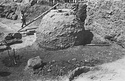

Grave in south peristyle of Hephaisteion. Grave LIV in notebook. No bones mentioned in description. Photo on p. 1847 (KK 369) is probably Grave LVI and photo on p. 1851 (KK 388) is probably Grave LIV ... 9-11 March 1939 ... No bones mentioned in description. |
| Mycenaean Double Grave (Graves A and B).
Grave A was in Layer II. We laid a skull and a few other bones, three vases and a stone bead. We have dug to a maximum of about 0.06m below the top of Layer II ... Myc. IIIA/B ... The skeletal material (AA 177) ... does not agree with the evidence of the plan and the excavator’s description since AA 177 consisted of bones of a M. about 40 to the north, and a F.(?) |
| Grave 1 in notebook (E.L. Smithson: Grave XXV: PG). No remains. Probable trench-and-hole.
JP
Roughly circular pit measuring 0.39m in diameter cut into bedrock to a depth of 0.72m. Pyre refuse-described ... Late PG/EG I ... Pyre refuse-described as "ashes and cinders etc"- was encountered throughout the tomb pit, below, around and above the urn. although there is no specific mention of a trench, Young's description of the tomb suggests that a rectangular trench, with a maximum length of about 0.80m and a preserved width of ca. 0.60m, was cut through earth into bedrock. consequently, the tomb appears to be a classic example of an Athenian trench-and-hole, oriented east-west,with the urn-hole at the east. |
Hellenistic fill South of Middle Stoa near NW corner of Heliaea. This fill contained material later in date than that which made up the middle Stoa Building Fill.
Only the coins (and a few amphora handles ... To ca. 140 B.C ... See Hesperia 57 (1988), pp. 88-89 for a description of the dating and "The lots collected in Kleiner's Deposit III, however, do not seem to form a logical stratigraphic unit ... " |
| C.G. Thomas ... Geometric grave. Bones discarded.
Tomb located about 2m west/west-southwest of the EG1 child inhumation, beneath the restored line of a hypothetical wall connecting the western "apse' and the south wall ... Middle Geometric II ... Preserved between a piece of charcoal and bedrock were bits of very fine textile with close-set threads (August 1995 not found, nor any description in Smithson's notes). |
|
|