|
|
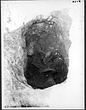
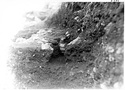
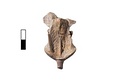
RSY Fido's Grave ... Hellenistic ... Grave of a dog |
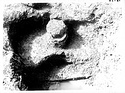
| Pit at 74/ΜΑ (1.10x0.58).
Debris filling containing a quantity of animal bones; probably a household refuse pit Animal bones (domestic animals); cow, pig, goat, sheep, hen, dog, and several varieties ... Ca. 525-470 B.C.
480-440 B.C ... Animal bones (domestic animals); cow, pig, goat, sheep, hen, dog, and several varieties of fishes. |
| Homer A. Thompson ... (Grave XXX: EG)
Rectangular cutting with burned bones of a female 40-45 years old, and both burned and unburned pottery fragments.
Rectangular trench, measuring approximately 0.80m long, 0.40m wide, with ... Middle Geometric I ... The filling consisted of hard-packed burned earth with scattered fieldstones, crude pieces of mudbrick, ash, charcoal, the cremated remains of, the deceased, described by Angel as an arthritic woman about 45-50 years old, as well as what was originally published as a few unburned bones of a dog. Recent reanalysis of the human remains, which were poorly preserved, yielded results consistent with Angel's estimation of age, but Liston noted the possibility that it is a male rather than female. As for the animal bones, probably the belonged to two sheep or goats, at least one specimen of cattle, a hare and a bird,, but there is nothing clearly identifiable as dog; of the 65 fragments of animal bones recovered, only four were clearly burnt. |
| Located at the bifurcation of the Panathenaic Way and West Road.Byzantine fill (9th-10th century) in upper 5.70m. with a series of Classical to Hellenistic accumulations below. Coins:
10 July 1971 #861 ... 14 June-27 July 1971 ... Coins:
10 July 1971 #861
n.d. 1971 #867
The bags from J 5:1 are notable for a high number of dog bones, including several skulls. |
| John Travlos ... (Grave XXXII: EG) Urn cremation (trench-and-hole). Published as cremation burial of a warrior.
The tomb was probably originally oriented north-south, with the urn-hole at the south end. The north side ... Transitional Early Geometric II-Middle Geometric I ... The animal remains included fragments from an immature pig, an adult dog, and an unidentified mammal, the latter the only fragment showing clear signs of burning. |
| Well cut into bedrock under late Roman building in ΕΛ. 1.2m in diameter with small cutting of unclear function at south edge about 0.2m wide. Walls cut straight down, tapering near bottom to 0.8m. Footholds ... Late Archaic ... Layers:
Hellenistic fill under Roman floors
I.(86.34-85.93m) rubble
II.(85.93-85.58m) dark brown rubble
III.(85.57-85.30m) more stony rubble
IV.(85.30-84.80m) very rocky, almost sterile, increase of clay and sand
V.(84.80-84.03m) less rocks, almost sterile, increase of clay and sand
Late 6th/early 5th B.C dumped fills
VI.(84.03-82.64m) mix of clay and sand deposits, dog skulls
VII.(82.64-81.79m) mostly sand
VIII.(81.79-81.39m) light brownish-grey clay, almost sterile
IX.(80.39-80.99m) mix of grey clay, brown clay and sand, much ceramic
X.(80.99-80.24m) sandy, more ceramic
XI.(80.19-77.74m) sandy, enormous stones (some 100kg+). |
| Eugene Vanderpool ... Grave (adult female). (In some records as Grave XXXI).
The tomb was partly destroyed in antiquity; there are sherds of all periods down to Late Roman (and later) note din the fill immediately above it ... Middle Geometric I ... Most of the fragments were identified as dog and were unburned. a few fragments of mudbrick in the upper fill of the well may also have come from the grave. |
|
|