|
|
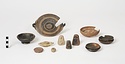
| Laura Gawlinski ... Fill excavated south and west of Early Building Ii, Room E latrine, with a high concentration of votive material, such as pyre saucers, miniature loom weights, and ribbon handled plates. Some traces of ... 400-350 B.C ... Fill excavated south and west of Early Building Ii, Room E latrine, with a high concentration of votive material, such as pyre saucers, miniature loom weights, and ribbon handled plates. |
| David Scahill ... Protogeometric/Early Geometric well under floors in Room 1, Classical Building II, on north side of south ashlar wall. See J 3:9 for the burial within this well.
Cf. Hesperia Suppl. 50 (2018), p. 106, ... 27 June 2001
17 July 2002 ... Protogeometric/Early Geometric well under floors in Room 1, Classical Building II, on north side of south ashlar wall. |
East of Classical Building II backwall, above Mycenaean chamber tomb K 2:5. Rough circular pit of reddish brown fill cut into geometric fill that extends down inside tomb. Some evidence of burning on pottery ... Ca. 460 B.C. |
| Laura Gawlinski ... Well in courtyard of Early Building I, adjacent to wall of Room B. Tile lined; upper course in situ, lower two collapsed probably in antiquity. Letters inscribed on rims (eta, phi, omicron, theta). Medium ... First quarter of the 4th c. B.C ... Well in courtyard of Early Building I, adjacent to wall of Room B. ... Well contained three main dumped fills: a slightly later fill perhaps for leveling after filling settled (Layer I and perhaps Layer II), a fill with ceramic and some stones (Layer III and perhaps Layer II), and a fill with large stones, tiles, and collapsed well lining (Layer IV).
Layer I 58.03-57.40m., softer brownish fill
Layer II 57.40-57.16m., sandier fill with streaks of charcoal
Layer III 57.16-56.24m, similar to Layer II, increase of stones and tiles
Layer III/IV 56.24-56.07m., transition between fill of Layer III and Layer IV
Layer IV 56.07-54.94m., fill primarily consisting of large stones, tiles, and collapsed well lining (little soil or ceramic) |
| Laura Gawlinski ... Circular pit uncovered in Early Building II, south of Room E latrine, adjacent to the preserved latrine floor surface. Continues beneath the latrine surface and the western scarp (unexcavated). Fill relatively ... Late 5th c. B.C ... Circular pit uncovered in Early Building II, south of Room E latrine, adjacent to the preserved latrine floor surface. ... Layer I 57.98-57.87m, harder fill with what appeared to be decomposing mudbrick.
Layer II 58.02-57.65m, softer filling streaked with ash and small bones.
Layer II 57.61-57.45m, large tiles and substantial fragments of amphora.
|
| Investigations in the area of Archaic Temple Added by E.V June 1963 ΕΛ 324-331. In the annual report for 1959 both the building of the temple itself, and the red limestone addition are dated in the early ... First half of 6th c. B.C. - early 5th c. B.C. |
Evidence of stratification into five layers, although joins between the layers. Layer VI added when the construction of the Roman building above required it. No subdivisions assigned.
Flask-shaped cistern ... Early 3rd-late 2nd c. B.C. |
| Well cut into bedrock, associated with late Roman building G in ΕΛ 1.2m in diameter, narrows to 0.5m at bottom. Disturbed by later pits at top. Excavated from 85.77-79.25m (6.52m), but bedrock at 85.91m ... Late 4th/early 5th AD |
|
|