|
|
Well E (diameter 1.10-1.20m) just outside the northwest corner of the southwest Fountain House.
Dug initially as a pit (J 15:2) partially covered by an early Roman wall ... Early 7th c. B.C. |
Firm fill over bedrock on east edge of section, north of the early (Archaic) peribolos wall. Uncatalogued material: 10 sherds, 30 fragments of plemochoai. Deposit created by Margie Miles, 4 inventoried ... 3rd quarter 4th c. B.C. |
| Osteotheke. (Group N). Coin
7 May 1938 #7 83/ΜΔ (83-84/ΜΓ-ΜΕ: If I judge from p. 811, this grid would be the concrete retaining wall). Somebody else wrote the following grid on page 878: 83-85/ΜΓ-ΜΣΤ ... Early 7th cent. |
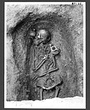
| David Scahill ... Protogeometric/Early Geometric well under floors in Room 1, Classical Building II, on north side of south ashlar wall. See J 3:9 for the burial within this well.
Cf. Hesperia Suppl. 50 (2018), p. 106, ... 27 June 2001
17 July 2002 ... Protogeometric/Early Geometric well under floors in Room 1, Classical Building II, on north side of south ashlar wall. |
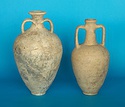
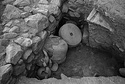
| Marcie Handler ... A deposit of six amphorae and one micaceous water jar was excavated between 20 June and 6 July 2005 in the area north of Wall K. The neck and one handle of one of the amphorae (BZ 1213) had been poking ... Ca. 1st c. A.D ... A deposit of six amphorae and one micaceous water jar was excavated between 20 June and 6 July 2005 in the area north of Wall K. The neck and one handle of one of the amphorae (BZ 1213) had been poking out of the surrounding fill since the end of the 2001 season. ... The second layer of fill (lot 1541) excavated around the amphora dated to the early Roman period (c. 1st century A.D.), and after we removed this layer of fill we revealed the outlines of five more amphorae and one micaceous water jar. ... NOTE: This deposit was first excavated 1-2 August 2001 as a "Late Roman layer with complete vessels" (elev. 53.040-53.370 masl, J/17,18-1/6,8). |
42-50/Ζ-ΙΑ: below uppermost Byz. Floor at level of top of railroad retaining wall (cf. also 50/Ι: from packing of floor). Coins:
24 March 1936 #18-#22
26 March 1936 #9-#10 ... Early Byzantine |
Above well at 48/ΙΕ (J 15:1) ... Early Roman |
Evidence of stratification into five layers, although joins between the layers. Layer VI added when the construction of the Roman building above required it. No subdivisions assigned.
Flask-shaped cistern ... Early 3rd-late 2nd c. B.C. |
| Brian Martens ... It was partially excavated during the 2012 and 2013 seasons. The tomb, located at the center of Room III in the NE area of section ΒΖ, was found under fill surrounding perpendicular mid-to late 6th c ... LHIIIA ... B.C. walls (Walls 17 and 18). N-S Wall 17 and E-W Wall 18 were found during the 2012 excavation season and were excavated below their lowest courses. ... A strip of fill at the north side of the cutting, just below the scarp of Wall L remained unexcavated at the end of the season (J/17,18-1/10,11; 51.290-51.376 masl.)
2018:
We removed a final strip of fill in the chamber below the scarp under Wall K (J/17,19-1/10,11). We recovered additional skeletal material (AA 376, nos. 96–109) as well as a piriform stirrup jar that brings the final phase of the tomb into LH IIIC early. Scarping revealed the blocking wall of the chamber. |
N-S Cut on 20m. line (area of Road, area of Stoa, area N of Stoa)
various levels and dates over the three areas.
Investigations to the northwest of the market square in the area of the road that bordered ... Protogeometric to Late Roman ... Area of Stoa:
Layer I: Early Roman
Layer II: Hellenistic
Layer III: 1st c. ... Plundered trench of early N-S wall: geometric to 4th c. ... Coins:
27 February 1939 #1 |
Fill around the upper block of the southwest corner of the early (Archaic) peribolos wall, south of the Propylon, and hard fill at the side of a trench for a modern wall.
Uncatalogued material: 181 sherds ... 2nd c. B.C ... Fill around the upper block of the southwest corner of the early (Archaic) peribolos wall, south of the Propylon, and hard fill at the side of a trench for a modern wall.
Uncatalogued material: 181 sherds (of which 49 fragments of plemochoai), 3 objects, 1 bone ... Deposit created by Margie Miles, 1 inventoried object, 1 coin (ΘΘ 144). |
House K: Brown fill (publ. House U). Filling between terrace wall and house wall at the extreme west end of the Areopagus; a brown gravelly filling of early Roman date found here undisturbed but occurring ... Early Roman |
| Eugene Vanderpool ... Rectangular pit, oriented east-west, cut party into filling of Early Protogeometric pit-well (I 18:4), to a preserved depth of about 0.30m. A late Byzantine wall founded below the floor of the grave destroyed ... Middle Geometric I |
Two chambers connected by a tunnel, all filled at the same time, but with slight Hellenistic disturbance. Chamber A, to west at 14/ΛΗ, B to east at 14-15/ΛΒ on grid for section RR.
Cistern system ca. 20.00m ... Ca. 325-275 B.C ... Abandonment of cistern and source of contents probaby attributable to an undetermined event in the early part of the decade 310 B.C.
In the early 3rd c. B.C. very possibly ca. 277/6 (see Garden article), the southerly side of Kolonos, outside the Precinct Wall, was levelled off and the double cistern were cut down and filled p. 833 ... Coins:
4 February 1936 #1
5 February 1936 #1
6 February 1936 #1-#2
8 February 1936 #3
10 February 1936 #1-#3
12 February 1936 #1-#13
13 February 1936 #1-#6
14 February 1936 #1 |
Michael Laughy ... West and adjacent to Modern Wall 5, we excavated 12th-13th c. A.D. fill, in some places a half meter deep or more. The fill was remarkably uniform in content throughout. Typical pottery included: fine ... 12th-13th c. A.D. |
| Mycenaean tomb: Myc. III A:1-2.
SAI
Small rectangular chamber, 2.30m wide by 1.80m deep,, entered from the east through a dromos 1.10m wide which contracted to a doorway 0.92m. wide. the doorway preserved ... 2nd half of 14th c ... Mycenaean tomb: Myc. III A:1-2.
SAI
Small rectangular chamber, 2.30m wide by 1.80m deep,, entered from the east through a dromos 1.10m wide which contracted to a doorway 0.92m. wide. the doorway preserved its rough stone blocking wall to a height of 0.70m to 0.80m., and the dromos the firm red earth with which it had been packed to a height of 1.30m.
... The ceiling of the chamber had collapsed at least as early as the 6th c. |
Well shaft cut through a cistern channel which was then packed with three amphorae (P 3123, P 3125, P 4201) of 1st or at latest early 2nd c. A.D. (These three amphorae could be considered with F 15:2) ... 3rd-4th c. A.D ... Well shaft cut through a cistern channel which was then packed with three amphorae (P 3123, P 3125, P 4201) of 1st or at latest early 2nd c. A.D. (These three amphorae could be considered with F 15:2).
... At 5.50 a group of fallen wall tiles arched over shaft which was empty to below 8.00 (at water level).
... Coins:
22 February 1934 #1-#8
23 February 1934 #1-#20 |
Fillings associated with Southwest and North Buildings (78-99/ΙΣΤ-ΚΘ) and early walls to west of Great Drain.
pottery p. 1189, vol VII ... Subdivisions:
.1=Filling over bedrock.
.2=Fillings behind retaining ... Various levels and dates ... Fillings associated with Southwest and North Buildings (78-99/ΙΣΤ-ΚΘ) and early walls to west of Great Drain.
... Subdivisions:
.1=Filling over bedrock.
.2=Fillings behind retaining wall and in road.
.3=Dumped fillings probably of construction of Great Drain.
.4=Fillings of reuse of walls in north part of area.
.5=Late fillings over early walls. |
Double Well by E. Entrance to Square Building (Well A) (formely a O 8:1) Coin
21 April 1951 #1 (disintegrated) Carefull there is two O 8:1, the actual one is a filling around rubble wall at 35/ KE.
Estimated ... 750 to early 7th century B.C. |
| David Scahill ... Behind northeast corner of Classical Building; east wall C. Below Hellenistic levels and early Classical pit. Chamber cut through bedrock, depth ca. 0.90m., diameter ca. 2m., roughly square in shape, angling ... LH III A:1 ... Behind northeast corner of Classical Building; east wall C. Below Hellenistic levels and early Classical pit. ... Possible dromos cutting in northwest corner, running under wall C.
Loose fill of stones and earth filling tomb with large number of geometric sherds ranging early to late Geometric. ... At the floor of the tomb, bone fragments, broken pottery, two figurines and bronze implements along south wall. Pottery appears to be LH III A:1 with some possibly earlier. |
Mycenaean Well (S/1,2-13/20,14/1). Underneath the NE Room of the Library of Pantainos, along its S side, as a cutting in bedrock containing reddish fill with bits of green bedrock. The feature is rectangular ... 30 June-23 July 1975 ... Mycenaean Well (S/1,2-13/20,14/1). Underneath the NE Room of the Library of Pantainos, along its S side, as a cutting in bedrock containing reddish fill with bits of green bedrock. ... [per Jan, some of the info for this lists new grid as ,T1/1 instead of the correct , 14/1. ... Hesperia 92 (2023), fig. 1. |
Well east of Geometric Grave. The upper part collapsed into a pit, cut into by Middle Geometric grave I 18:1 and by a Byzantine wall. Some evidence for period of use; little pottery. At the top a few Geometric ... Early Protogeometric |
Nb page 5044: Great shapeless pit with a well (62/Ξ) at its bottom which we were unable to dig because it was too dangerous. Fill in the pit was of sand and white ash. The finds and pottery 4th. and perhaps ... Late 4th.-early 3rd. c ... The finds and pottery 4th. and perhaps early 3rd. The importance of the pit is for the dating of the poros wall above, already there when the pit was filled ... Coins:
16 June 1948 #1 |
| Pyre in House N, room 4 (RSY=Pyre 7), in the industrial area west of the Areopagus.
Pottery, mall pieces of calcined bone, log, wood cinders, and charcoal in diamond-shaped pit in floor sequence. The pyre ... Late 4th-early 3rd c. B.C. |
Investigations in the Hellenistic Metroon, various levels. Stoa Pits A, B, C, D, E, F, H and I (various layers).
Locations include:
SW corner of Primitive Bouleuterion; from contemporary filling alongside ... 8th-6th c. B.C ... Locations include:
SW corner of Primitive Bouleuterion; from contemporary filling alongside its south wall.
Footing trench of the Primitive Bouleuterion and from filling accumulated during the period of use of the Primitive Bouleuterion.
... B.C.
- early 6th c. B.C. with much earlier material
- early to middle 6th c. ... Coins:
20 April 1934 #1 (from Pit F, footing trench of Period IV, foundation of colonnade) - #2 (Pit E, from dump, probably from footing trench of Period IV). |
Pits in area 96-100/ΝΕ-ΝΘ (lower east slopes of Hill of the Nymphs, near extreme west edge of excavated area).
Shallow pit in bedrock against N. face of wall. dMax. depth 0.20m.d.
Many fills in areas ... Ca. 325-300 B.C ... Shallow pit in bedrock against N. face of wall ... Many fills in areas A 19 and A 20 similar in character to the fills in these pits can probably be cited only with area locations; many have container dates. 1-10-58
The early ΞΞ numbers given [to finds] come from the time the area was dug; the later from the time the pottery was sorted (1957). |
| John Camp ... Protogeometric grave (female inhumation) located about 0.60m northwest of T 15:1. It consisted of a roughly rectangular pit, with the corners slightly rounded, oriented approximately north-south. The pit ... "Submycenaean"/Early Protogeometric |
Well ΑΒ located on the lower terrace to the north of the sanctuary(diameter 1.10m). Foot-holes were cut into the shaft at intervals of ca. 0.40m. The fill consisted mostly of small stones, dug bedrock, ... Second quarter of the 6th century B.C ... Perhaps replaced by T 18:1, 7m to the South. ... Objects : terracotta; loom weights; spindle whorl; cut disk; handmade-coarse ware; lamps.
Early ware : Gray Minyan; Mycenaean; Early Geometric-Protoattic; amphora; oinochoe; ray-based vessels; krater; banded wall fragments; cup/skyphos; plate; oinochoe; skyphos; bowl; banded aryballos; lekanis lid.
|
Well at 15/ΙΕ = Pocket in side of Turkish Pit at 15/ΙΔ.
Shallow well on the lower slopes of the Acropolis, east of the Panathenaic Way, in the area later occupied by the Archaic Building.
Located 3.5m ... 700-675 B.C. with intrusions ... Located 3.5m north of the Archaic peribolos wall, in a spot later covered by the Temple of Triptolemos. The pit was disturbed by two Ottoman pits on the east and north sides and by the wall of a modern cellar sunk through part of it ... Other: 3 plaques; 1 shield; 2 columnar type; 2 animals; 1 leg; 1 handmade object.
|
| James Artz Pirisino Daniele Kylindreas Miltiades ... Excavation in Room 3 of ΒΘ West revealed 5 ceramic vessels in a row against the eastern face of Wall 12. 3 complete vessels (ΒΘ 122, 124, and 125) were catalogued, along with the base of a plain glazed ... 9th-11th c. A.D ... In addition to the vessels along the face of Wall 12, 5 coins were found within the fill, as well as a bronze ring and fragments of painted plaster (ΒΘ 134) from a wall.
... At least 1 vessel with full profile, a plate with poorly preserved glaze, is stored in ΒΘ Lot 404. ... Many fragments of a deep bowl with poorly preserved glaze (ΒΘ 171) were wedged between the wall of the pithos and the southern face of Wall 23. |
|
|