|
|
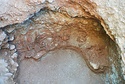
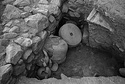
Amphora dump at P/2,3-6/6,8.
Layer "8b" in Room 6 of Greek House δ.
Trench cut into lower levels next to west wall of Room 6. Fragments of amphorai, tiles.
No coins ... Early Hellenistic |
Fillings associated with Southwest and North Buildings (78-99/ΙΣΤ-ΚΘ) and early walls to west of Great Drain.
pottery p. 1189, vol VII ... Subdivisions:
.1=Filling over bedrock.
.2=Fillings behind retaining ... Various levels and dates ... Fillings associated with Southwest and North Buildings (78-99/ΙΣΤ-ΚΘ) and early walls to west of Great Drain.
... Subdivisions:
.1=Filling over bedrock.
.2=Fillings behind retaining wall and in road.
.3=Dumped fillings probably of construction of Great Drain.
.4=Fillings of reuse of walls in north part of area.
.5=Late fillings over early walls. |
| Dorothy Burr Thompson ... Child's Grave (E.L. Smithson: Grave XXVIII: G).
Cf. Container Lot ΣΤ 165 (fill over geometric grave).
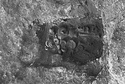
Neat, rectangular, unlined trench, cut into bedrock to a preserved depth of 0.20m,below the level ... Early Geometric I |
| Laura Gawlinski ... Bronze foundry north of bridge on Piraeus street, east of Great Drain.
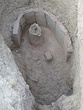
Keyhole-shaped bronze casting pit, cut into bedrock.
2016: Continuation of the excavation of a rectangular pit with foundry debris, ... Late 6th-early 5th c. B.C.
(Late Archaic/ Early Classical) |
Two chambers connected by a tunnel, all filled at the same time, but with slight Hellenistic disturbance. Chamber A, to west at 14/ΛΗ, B to east at 14-15/ΛΒ on grid for section RR.
Cistern system ca. 20.00m ... Ca. 325-275 B.C ... Chamber A, to west at 14/ΛΗ, B to east at 14-15/ΛΒ on grid for section RR.
... Abandonment of cistern and source of contents probaby attributable to an undetermined event in the early part of the decade 310 B.C.
In the early 3rd c. B.C. very possibly ca. 277/6 (see Garden article), the southerly side of Kolonos, outside the Precinct Wall, was levelled off and the double cistern were cut down and filled p. 833. |
Pits in area 96-100/ΝΕ-ΝΘ (lower east slopes of Hill of the Nymphs, near extreme west edge of excavated area).
Shallow pit in bedrock against N. face of wall. dMax. depth 0.20m.d.
Many fills in areas ... Ca. 325-300 B.C ... Pits in area 96-100/ΝΕ-ΝΘ (lower east slopes of Hill of the Nymphs, near extreme west edge of excavated area).
Shallow pit in bedrock against N. face of wall ... Many fills in areas A 19 and A 20 similar in character to the fills in these pits can probably be cited only with area locations; many have container dates. 1-10-58
The early ΞΞ numbers given [to finds] come from the time the area was dug; the later from the time the pottery was sorted (1957). |
Michael Laughy ... West and adjacent to Modern Wall 5, we excavated 12th-13th c. A.D. fill, in some places a half meter deep or more. The fill was remarkably uniform in content throughout. Typical pottery included: fine ... 12th-13th c. A.D ... West and adjacent to Modern Wall 5, we excavated 12th-13th c. ... At the time of this summary, the legible coins are Frankish, and date to the early 13th c. |
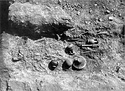
| Pyre in House N, room 4 (RSY=Pyre 7), in the industrial area west of the Areopagus.
Pottery, mall pieces of calcined bone, log, wood cinders, and charcoal in diamond-shaped pit in floor sequence. The pyre ... Late 4th-early 3rd c. B.C. |
| Eugene Vanderpool ... Rectangular pit, oriented east-west, cut party into filling of Early Protogeometric pit-well (I 18:4), to a preserved depth of about 0.30m. A late Byzantine wall founded below the floor of the grave destroyed ... Middle Geometric I ... Rectangular pit, oriented east-west, cut party into filling of Early Protogeometric pit-well (I 18:4), to a preserved depth of about 0.30m. A late Byzantine wall founded below the floor of the grave destroyed the entire eastern half of the earlier burial. In what survived of the west end of the tomb pit was found the well-preserved lower half of the skeleton, oriented east-west, cranium originally to the east. |
| Brian Martens ... It was partially excavated during the 2012 and 2013 seasons. The tomb, located at the center of Room III in the NE area of section ΒΖ, was found under fill surrounding perpendicular mid-to late 6th c ... LHIIIA ... N-S Wall 17 and E-W Wall 18 were found during the 2012 excavation season and were excavated below their lowest courses. ... Disarticulated human remains (ten individuals including adults, children, an infant, and fetuses) were found in the cutting east of Wall 17 and at least one fetal rib was found in the cutting opposite at the west.
... We recovered additional skeletal material (AA 376, nos. 96–109) as well as a piriform stirrup jar that brings the final phase of the tomb into LH IIIC early. Scarping revealed the blocking wall of the chamber. |
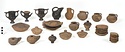
| James Artz Pirisino Daniele Kylindreas Miltiades ... Excavation in Room 3 of ΒΘ West revealed 5 ceramic vessels in a row against the eastern face of Wall 12. 3 complete vessels (ΒΘ 122, 124, and 125) were catalogued, along with the base of a plain glazed ... 9th-11th c. A.D ... Excavation in Room 3 of ΒΘ West revealed 5 ceramic vessels in a row against the eastern face of Wall 12. 3 complete vessels (ΒΘ 122, 124, and 125) were catalogued, along with the base of a plain glazed flat-bottomed basin (ΒΘ 121). In addition to the vessels along the face of Wall 12, 5 coins were found within the fill, as well as a bronze ring and fragments of painted plaster (ΒΘ 134) from a wall.
... Excavation in Room 3 was restricted to a small area south of and adjacent to Wall 23. |
|
|