|
|
Material from trenches:
a) 1.00-7.00m. from East End of Stoa.
b) 18.40-21.40m. from East End of Stoa.
c) 46.60-48-60m. from East End of Stoa.
d) 51.00-53.00m. from East End of Stoa.
e) 79.00-81.00m. from ... 2nd c. B.C ... Material from trenches:
a) 1.00-7.00m. from East End of Stoa.
b) 18.40-21.40m. from East End of Stoa.
c) 46.60-48-60m. from East End of Stoa.
d) 51.00-53.00m. from East End of Stoa.
e) 79.00-81.00m. from East End of Stoa.
Includes drain trench in front of back wall of Stoa (some disturbed, some undisturbed fill), soft fill above stone drain, fill from within stone drain, channel behind stylobate. |
Filling over and behind blocks of E. wall of Great Drain at 10-15/Α-Γ. Coins:
10 May 1954 #1-#2 ... 3rd c. B.C ... Filling over and behind Blocks of East Wall of Great Drain |
Deposit alongside Greek House I, perhaps giving the construction date of the second phase. Deposit list title it as : outside of east wall of Roman House H ... Last quarter of the 4th c. B.C ... Deposit list title it as : outside of east wall of Roman House H. |
Firm fill over bedrock on east edge of section, north of the early (Archaic) peribolos wall. Uncatalogued material: 10 sherds, 30 fragments of plemochoai. Deposit created by Margie Miles, 4 inventoried ... 3rd quarter 4th c. B.C ... Firm fill over bedrock on east edge of section, north of the early (Archaic) peribolos wall. |
| Marcie Handler ... The contents of this Hellenistic cistern shaft were excavated in a series of layers: the preserved top of the shaft, six layers in the shaft and the fill within the tunnel. At the bottom of the shaft on ... POU: Mid-3rd c. BC
Dumped fill: after 225 BC ... Excavations | 2007 | Trenches | Handler | Room M | East of Wall 7 | Cistern J 1:7 |
Filling in the footing trench of the late Roman Fortification.
Includes Layer 1 and Layer 2 of Library Colonnade opposite Room 2. "Note: both these layers are fill thrown into V.W. footing trench." (nb.p ... End 3rd. c. A.D ... Coins:
23 March 1933 #16-#19
24 March 1933 #4-#5(below layer of bricks 1.00m. east of
Ven. wall 24/ΙΗ)
26 April 1933 #1-#5
1 May 1933 #5-#8 (yellow fill against Venetian wall 36/ΙΑ)
27 May 1939 #6-#7
13 June 1939 #3 |
Well at 40/Λ, in the "plataia" ca. 600m north of the terrace wall and ca. 10m east of the Valerian wall. Top diameter of 1.00m, bottomm diameter 0.95m
The shallowness of the shaft, and the fallen condition ... 550-500 B.C ... Well at 40/Λ, in the "plataia" ca. 600m north of the terrace wall and ca. 10m east of the Valerian wall. Top diameter of 1.00m, bottomm diameter 0.95m
The shallowness of the shaft, and the fallen condition of the rock wall suggested that the well was abandoned and filled immediately, before completion. |
| Pyre against north face of polygonal wall, Room 2, Classical Building II. No floor preserved above, but the pyre is below floor level 51.820masl, preserved just to the east and above patchy floor with ... Ca. 275-260 B.C ... Pyre against north face of polygonal wall, Room 2, Classical Building II. No floor preserved above, but the pyre is below floor level 51.820masl, preserved just to the east and above patchy floor with plaster at ca. 51.70 |
Well at 71/ΛΒ (diameter ca. 1.10m) near the east wall of the entrance porch.
Narrows toward bottom, collapsed at top. Six footholds preserved at south, three at north, spaced at ca. 0.50m. Uniform fill ... Late 8th in early 4th c. B.C ... Well at 71/ΛΒ (diameter ca. 1.10m) near the east wall of the entrance porch.
|
| A closely compacted group of 431 bronze coins found at ca. 52.50m., against the east brick wall. No sign of a container. Others dribbled down against the channel wall in a restricted area to as deep as ... Late Roman ... A closely compacted group of 431 bronze coins found at ca. 52.50m., against the east brick wall. No sign of a container. Others dribbled down against the channel wall in a restricted area to as deep as 52.07. |
Channel J (in ΗΗ)
Cutting that probably originally held a drain. Packed with amphoras and other coarse pottery. It tapped the poros aqueduct wall just East of our explanatory trench at the East end of ... 1st c. B.C. - early 1st. A.D ... It tapped the poros aqueduct wall just East of our explanatory trench at the East end of ΗΗ. |
| David Scahill ... Beneath toichobate floor level in Room 1 of Classical Building II, against the south ashlar wall, ca. 1.50m. east of the southwest corner of the building. Deposit of broken pyre pots in small pit, 1.00m ... Ca. 325 B.C ... Beneath toichobate floor level in Room 1 of Classical Building II, against the south ashlar wall, ca. 1.50m. east of the southwest corner of the building. |
Ca. 73-81/Drain. Fillings associated with the construction of the Great Drain South, especially the fill thrown in behind the east wall of the drain at the time of its building.
Cf. A 20-21:1 and B 19:7 ... Ca. 425-400 B.C ... Fillings associated with the construction of the Great Drain South, especially the fill thrown in behind the east wall of the drain at the time of its building.
|
Well east of Geometric Grave. The upper part collapsed into a pit, cut into by Middle Geometric grave I 18:1 and by a Byzantine wall. Some evidence for period of use; little pottery. At the top a few Geometric ... Early Protogeometric ... Well east of Geometric Grave. The upper part collapsed into a pit, cut into by Middle Geometric grave I 18:1 and by a Byzantine wall. Some evidence for period of use; little pottery. |
First trial east Stoa colonnade, N. of S. wall III, layer 12.
Note quantities of cattle bones, the knuckles sawn off and many worked bits. Evidently a bone implement factory near by. [nbp. 2139] Coins: ... Late 3rd c.-earliest 4th c. A.D ... First trial east Stoa colonnade, N. of S. wall III, layer 12.
|
Ash and Carbon Dump in Corridor directly behind Room C of Brick Building.
This material comprises what appears to have been a household dump associated with the period of use of the Brick Building, but ... To mid-2nd century ... The dump is located in the corridor between the back wall of the Brick Building and the retaining wall behind the building , immediately east of the line of the dividing wall between Rooms B and C [City Grid: Q/18-11/2] |
Cistern at 70/ΚΕ and channels. Part of same system as D 17:3 and D 17:5. It was set against a corner of the lowest foundation block. Thus one is forced to assume that enough of the wall remained at least ... Ca. 200-150 B.C ... Thus one is forced to assume that enough of the wall remained at least to preserve its line. After Sulla many of the blocks at the east and were pulled out, the north wall of court F was placed on the western foundations, but at a slightly different angle, and the wall as such ceased to exist.
|
Pit in Tholos Trench V (below Layer e).
In plan it would seem to have been oval, though its east end is c/../ by the south wall of the North Archaic Home. Its N-S width is 1.25m, its E-W length is 1.40m ... 7th-early 6th c. B.C ... In plan it would seem to have been oval, though its east end is c/../ by the south wall of the North Archaic Home. |
One of two late wells [the other at 59/ΙΗ] cutting the line of the east wall of the peribolos and the line of the Byzantine enclosure. The shafts of the two were close together and in their upper parts ... Turkish ... One of two late wells [the other at 59/ΙΗ] cutting the line of the east wall of the peribolos and the line of the Byzantine enclosure. |
| David Scahill ... Behind northeast corner of Classical Building; east wall C. Below Hellenistic levels and early Classical pit. Chamber cut through bedrock, depth ca. 0.90m., diameter ca. 2m., roughly square in shape, angling ... LH III A:1 ... Behind northeast corner of Classical Building; east wall C. Below Hellenistic levels and early Classical pit. ... Possible dromos cutting in northwest corner, running under wall C.
Loose fill of stones and earth filling tomb with large number of geometric sherds ranging early to late Geometric. ... At the floor of the tomb, bone fragments, broken pottery, two figurines and bronze implements along south wall. Pottery appears to be LH III A:1 with some possibly earlier. |
| Initially uncovered with a diameter of c. 1.05m. Its south side extends under the south wall of the Classical structure and so clearly predates it. The highest preserved portion of the well shaft (at the ... 22 July-9 August 1994
26 June 1995
3-7 July 1995 ... Its south side extends under the south wall of the Classical structure and so clearly predates it. The highest preserved portion of the well shaft (at the east) lies at an elevation of 51.03m above sea level. ... It is not clear at exactly what elevation the lining wall originally began, but it seems unlikely that the entire shaft was lined, for the cutting in bedrock for the upper part of the shaft, where it is well preserved on the east side, lies directly above the inner face of the lining wall below. |
Two pebble floors of Roman date, broken into at the SE and north, covered a 6x5m trench in ΕΛ, bounded by the unexcavated east trench and a wall from Byzantine Building D (Wall A). Under these pebble floors ... 220 - 150 B.C ... Two pebble floors of Roman date, broken into at the SE and north, covered a 6x5m trench in ΕΛ, bounded by the unexcavated east trench and a wall from Byzantine Building D (Wall A). |
A well lined with a very well built stone wall, carefully made and fitted to the curve of the well cutting, with footholds running down its N and S faces. This wall, of small stones, runs to 7.30m. from ... 23-29 March 1937 ... A well lined with a very well built stone wall, carefully made and fitted to the curve of the well cutting, with footholds running down its N and S faces. This wall, of small stones, runs to 7.30m. from the well mouth. ... At the east side at the surface, a beam cutting was made to hold a beam to support a brick vault over the mouth of the well. |
| Mycenaean tomb: Myc. III A:1-2.
SAI
Small rectangular chamber, 2.30m wide by 1.80m deep,, entered from the east through a dromos 1.10m wide which contracted to a doorway 0.92m. wide. the doorway preserved ... 2nd half of 14th c ... SAI
Small rectangular chamber, 2.30m wide by 1.80m deep,, entered from the east through a dromos 1.10m wide which contracted to a doorway 0.92m. wide. the doorway preserved its rough stone blocking wall to a height of 0.70m to 0.80m., and the dromos the firm red earth with which it had been packed to a height of 1.30m.
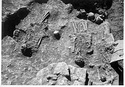
... Two skeletons were found lying in order, their heads toward the east and their legs doubled up. |
| Brian Martens ... Located in the southern section of Room I, now bound by the scarp of Wall U at the north,, the scarp of Wall L at the east,, and a modern pit at the south. At its now low elevations, excavated in the 2015 ... Third quarter of 5th c. B.C ... Located in the southern section of Room I, now bound by the scarp of Wall U at the north,, the scarp of Wall L at the east,, and a modern pit at the south. |
A well (diameter 1.10m) at the east edge of the valley road leading from the SW corner of the Agora, about 90m SW of the Tholos. The mouth of the well was subsequently covered by the east wall of the Great ... Ca. 500-480 B.C ... A well (diameter 1.10m) at the east edge of the valley road leading from the SW corner of the Agora, about 90m SW of the Tholos. The mouth of the well was subsequently covered by the east wall of the Great Drain.
|
Well 12: Archaic.
It lies on a rocky ledge about thirty meters north of the Klepsydra, just east of the Panathenaic street. In spite of its depth, it produced little pottery and its contents were of slight ... 6th c. B.C.? ... It lies on a rocky ledge about thirty meters north of the Klepsydra, just east of the Panathenaic street. ... In the well were not merely the usual quantities of domestic wares, pithoi, tubs and the like, of broken up terracotta rooftiles and crude brick; there was also a number of building stones: three large blocks of poros from some archaic structure, and many small carefully dressed blocks of Acropolis limestone from a polygonal wall or walls. |
Well at 15/ΙΕ = Pocket in side of Turkish Pit at 15/ΙΔ.
Shallow well on the lower slopes of the Acropolis, east of the Panathenaic Way, in the area later occupied by the Archaic Building.
Located 3.5m ... 700-675 B.C. with intrusions ... Shallow well on the lower slopes of the Acropolis, east of the Panathenaic Way, in the area later occupied by the Archaic Building.
Located 3.5m north of the Archaic peribolos wall, in a spot later covered by the Temple of Triptolemos. The pit was disturbed by two Ottoman pits on the east and north sides and by the wall of a modern cellar sunk through part of it |
| Disturbed pyre dispersed in fill of Room 5, House D.
Pyre pots in very fragmentary condition were noticed by Barbara Tsakirgis in later analysis of pottery that had been excavated in 1938; no mention of ... 14 June 1938 ... The fill in which they were found lies partly over the continuation of the eastern wall of the house. Another group of pyre pots excavated in 1969 immediately to the east is probably part of the same disturbed group(s). |
| Mycenaean Small Chamber tomb.
The cist measures 1,90m E to W, 0.75-0.90m N to S, max. depth -1.30m. Nothing was found in it; cleaned in modern times and used as a cesspool. Some of the SW part of it had ... Myc. IIIA, early 14th c ... All that remains of the chamber is a small segment with a maximum preserved dimension of 1.20m, which is bordered on the north by a modern wall and on the east by a cesspool. ... The objects were found lying on or just above the floor of the chamber, close to the wall. They were broken and lying in disorder and pieces of bone, badly decomposed, were mixed in with them. |
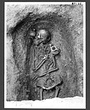
| John Camp ... Protogeometric grave (female inhumation) located about 0.60m northwest of T 15:1. It consisted of a roughly rectangular pit, with the corners slightly rounded, oriented approximately north-south. The pit ... "Submycenaean"/Early Protogeometric ... The left arm was across the waist, the right reaching up over the chest; the head was rolled over onto its right side, facing east.
A substantial Late Roman wall ran across the tomb, covering but not disturbing the skeleton from mid-thigh to instep; the bones were recovered by tunneling. |
| Homer A. Thompson ... Cremation burial (trench-and-hole) under S. edge of E-W Street, northern burial. In some records as Grave XLVII.
The western part of the offering trench of the tomb was lost to a Turkish cess pit, and ... Middle Geometric I ... The tomb was found directly below a Classical wall. What survived was the south and east section of the original grave, including a strip of the pyre trench, reddened from burning to a depth of 0.05m, and below it a shallow urn-hole, roughly square, ca. 0.60m to the side, cut through earth almost to the level of bedrock, to a depth of about 0.30m.
|
|
|