|
|
Well at the southeast corner, almost on the line of the east-west street. Upper Fill: Late Roman dumped fill.
Lower Fill: Dark Age: ca. 7th c. A.D.
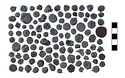
Coin
30 March 1939 #34 ... 7th-Late 6th century ... Well at the southeast corner, almost on the line of the east-west street. |
East-West Street (63-64/ΙΣΤ, etc.)
Packing in line of ancient east-west street along Areopagus north slopes.
Lower fills, predominantly late 6th-early 5th c. B.C.
Middle fills, last quarter of the 5th ... Various levels and dates ... East-West Street (63-64/ΙΣΤ, etc.)
Packing in line of ancient east-west street along Areopagus north slopes.
... These fills correspond closely to the apparent three periods of a house of which very scanty remains were observed directly to the south of the street: notebook House D. |
Packing under cobblestones 7 or 8 meters west of the Temple of Hephaistos. A similar filling found in a small hole in bedrock three or four meters north of the Temple. The high quality of the pottery from ... Ca. 500-440 B.C. |
Area I; layer I. Soft, loose destruction fill of Street Drain in front of Greek House δ. Represents closing of drain in preparation for construction of Basilica. Top elevation 55.40m at west, 55.96m at ... 1st c. A.D ... Soft, loose destruction fill of Street Drain in front of Greek House δ. ... Top elevation 55.40m at west, 55.96m at east. |
| Well in Room 6 of Street Stoa U/2,U/3-13/15.
Associated with the building lying under the Roman Street Stoa. Its fills divided into 5 separate layers, with the bulk of finds belonging to Layer 1, the ... 14 June-21 August 1973 ... Well in Room 6 of Street Stoa U/2,U/3-13/15.
Associated with the building lying under the Roman Street Stoa. Its fills divided into 5 separate layers, with the bulk of finds belonging to Layer 1, the so-called Upper Dump fill. ... At its bottom it was round with a diameter of 1.00m. hand-holes roughly 0.42m apart, were noted on its east and west sides.
|
| Marcie Handler ... The Pyre was revealed in a layer of 4th c. fill in the north end of Room 6, just south of Wall 8. Room 6 is defined by the street wall (Wall A) on the west, Wall 7 on the east, Wall 9 on the south (preserved ... 4th c. B.C ... Room 6 is defined by the street wall (Wall A) on the west, Wall 7 on the east, Wall 9 on the south (preserved only as a stub on the east side of the area), and possibly Wall 8 or Wall 6 on the north.
2.5 meters SW of the pyre, a patch of floor surface at J/10-1/20 at 52.188 masl. was found. |
| Marcie Handler ... Continued from 2000 season, 10-12 July 2000; BZ XXIII p. 4472.
The hoard was originally excavated during the 2000 season (Lot BZ 1049, 5th-6th centuries AD), from a higher elevation through a gap in the ... 10-12 July 2000
21-22 July 2003 |
| Homer A. Thompson ... Cremation burial (trench-and-hole) under S. edge of E-W Street, southern burial. In some records as Grave XLVI.
Neat trench, rectangular as preserved, but may have originally been square, cut partly through ... Early Geometric I ... Cremation burial (trench-and-hole) under S. edge of E-W Street, southern burial. ... As preserved, the trench measured ca. 1.05x 0.60m, and was presumably oriented east-west, but as the north side was destroyed it is possible that the trench extended toward the north and may, therefore, have had a north-south orientation. ... The floor of the trench was not as heavily burned as that of other related cremation tombs, though there was within it,particularly toward the west, a thick deposit of ash, charcoal, and burned sherds, representing pyre debris. |
|
|