|
|
| (Grave XXIX: EG).
Rectangular cutting with remains of charred human bones and both burned and unburned pottery fragments. Bones discarded.
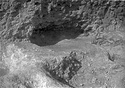
Rectangular trench cut through earth into bedrock, oriented east-west ... Middle Geometric I ... Rectangular trench cut through earth into bedrock, oriented east-west and measuring 1.10m long, 0.70m wide and under 0.30m deep. ... According to the excavator, cremated skull fragments were encountered at the east end of the trench, leg bones near the west end. Burned and unburned sherds representing at least nine vessels were found throughout the trench. The inclusion of the fragmentary cooking pot or chytra led Smithson to suggest that the deceased was a woman. |
| Homer A. Thompson ... Cremation burial (trench-and-hole) under S. edge of E-W Street, southern burial. In some records as Grave XLVI.
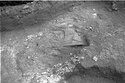
Neat trench, rectangular as preserved, but may have originally been square, cut partly through ... Early Geometric I ... The north side of the trench was destroyed by the a Turkish cess pit. As preserved, the trench measured ca. 1.05x 0.60m, and was presumably oriented east-west, but as the north side was destroyed it is possible that the trench extended toward the north and may, therefore, have had a north-south orientation. ... The floor of the trench was not as heavily burned as that of other related cremation tombs, though there was within it,particularly toward the west, a thick deposit of ash, charcoal, and burned sherds, representing pyre debris. |
| Rodney S. Young ... Grave 2 in notebook (E.L. Smithson: Grave XV: PG). Urn cremation (trench-and-hole), adult female.
JP
It consists of a roughly rectangular pit or trench cut into bedrock to a depth of 0.35m., measuring ... Late Protogeometric ... JP
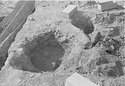
It consists of a roughly rectangular pit or trench cut into bedrock to a depth of 0.35m., measuring 1.12m long and 0.67m wide. The trench was oriented east-west, urn-hole to the east. ... The urn-hole, cut to a depth of 0.62m., measured roughly 0.40m in diameter. the urn-hole itself, but not the rectangular trench of the tomb, was sealed by a large, flat stone, broken in situ. |
| Rodney S. Young ... Grave 7 in notebook (E.L. Smithson: Grave XXI: PG). Bones discarded. Disturbed and damaged cremation (originally trench-and-hole), the east end cut away, probably contained the burial urn.
JP
It consisted ... Late Protogeometric ... Disturbed and damaged cremation (originally trench-and-hole), the east end cut away, probably contained the burial urn.
JP
It consisted of a rectangular trench cut through hard-packed fill and slightly into bedrock to a depth of 0.48m. the trench oriented east-west, had a preserved length of 0.70m and a width of 0.60m. ... The preserved east end, built up from redeposited green schist bedrock streaked with reddened earth, may have been a barrier between the destroyed urn-hole and the pyre trench, constructed after the fire had subsided. |
|
|