|
|
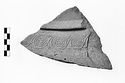
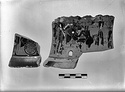
| Three joining fragments from side of bowl. Central zone: chariot race with masks and birds as filling ornament above and below. Upper zone: band of ovules. Lower: acanthus leaves.
Glaze dark red on inside, ... 18 April 1949 ... Central zone: chariot race with masks and birds as filling ornament above and below. ... Wall trench for west wall Poros Building; disturbed Hellenistic with late Roman. |
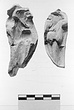
Tail and hind feet missing.
A horse galloping left. It was probably to be attached to some larger object since it is very thin and it's back is quite flat.
Clay: Fine, buff, slightly micaceous. Retaining ... Uncertain, probably late fourth century B.C. |
| Intact.
Rim, plain, with herringbone panels and impressed circles beside discus and handle. Two concentric grooves around inner edge. Discus plain, with concentric grooves and ridges around filling hole ... 10 April 1951 ... Discus plain, with concentric grooves and ridges around filling hole. Handle, solid, double-grooved above, trible below. ... Late Roman fill under north cross wall of late Roman House. |
| Fragment from wall, broken all around.
Running spiral design with crosses in angles. Heavy projecting molding above.
Russet micaceous clay.
Note: the general context was late 4th c. B.C., but it included ... 25 August 1953 ... Fragment from wall, broken all around.
... Heavy projecting molding above.
Russet micaceous clay.
Note: the general context was late 4th c. B.C., but it included a number of black figure sherds, e.g. late Kleinmeister cups. |
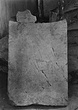
| Inscribed stele.
The small fragment first found fits on top of the larger piece, which preserves the lower part of the stele, its bottom finished square. Bottom and back rough picked; sides dressed.
The ... 169/8 B.C. |
| Intact save for small chips.
Discus, plain with four filling holes. On rim, herringbone. Handle unpierced, two grooves above, below three deep grooves, and on "handle", and on either side.
On reverse, ... 18 May 1937 ... Discus, plain with four filling holes. On rim, herringbone. Handle unpierced, two grooves above, below three deep grooves, and on "handle", and on either side.
... Late Roman fill about level with preserved top of back wall of stoa, above light strosis. |
| Preserves mold for left side of pot-bellied actor with left hand raised above head. Drapery hangs over shoulder. Actor stands on raised base. Face broken away.
Broken all around. Apparently part of relief ... 10 March 1952 ... Preserves mold for left side of pot-bellied actor with left hand raised above head. Drapery hangs over shoulder. ... Area South of East-West late Roman Wall; fourth century hole.Contemporary with Pnyx Assembly Place III filling; 340 B.C. |
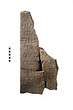
| Inscribed fragments.
Fragment ΙΙ 272 and II 360b a), two joining fragments. Inscribed face, left side and back preserved.
Thirteen lines of the inscription preserved.
Fragment ΙΙ 360a b), inscribed face ... a) (ΙΙ 272) 17 March 1938
a) (II 360b) 1 April 1938
b) (ΙΙ 360a) 1 April 1938
c) (ΙΙ 429) 9 May 1938
c) (II 446) 18 May 1938
d) (ΘΘ 288) 19 May 1938 ... Five lines of the inscription preserved, and trace of a sixth above.
Fragment ΙΙ 429 and ΙΙ 446 c), two joining fragments. Trace of heavy crowning moulding above the inscribed face; part of a cutting preserved in top surface. ... a) (ΙΙ 272), found in east wall of the church of the Hypapanti.
b) (II 360a-b), found in the original filling of the late Roman Fortification, near the Eleusinion.
c) (ΙΙ 429), found in original filling of the late Roman Fortification, south the Eleusinion.
c) (ΙΙ 446), found in the south wall of the church of the Hypapanti.
d) (ΘΘ 288), found in the original filling of the late Roman Fortification, south the Eleusinion. |
| Inscribed base.
Both corners of inscribed face broken. A rectangular plinth, with neat drafting at lower edge all around; above, a very flat cavetto moulding, also rectangular. In the center, a circular ... 18 June 1937 ... A rectangular plinth, with neat drafting at lower edge all around; above, a very flat cavetto moulding, also rectangular. ... Found in green filling on Wall A east of the late Roman Fortification, north of the Acropolis Street. |
| Inscribed fragments.
Monument to Herodes Atticus.
Fragment ΙΙ 300 a), inscribed face only preserved; also part of crowning moulding above.
One line of the inscription preserved, with four letters.
Fragment ... a) (ΙΙ 300) 18 March 1938
b) (ΙΙ 425) 9 May 1938
(ΘΘ 292) 20 May 1938 ... Fragment ΙΙ 300 a), inscribed face only preserved; also part of crowning moulding above.
One line of the inscription preserved, with four letters.
... a) (ΙΙ 300), found in south wall of the church of the Hypapanti.
b) (ΙΙ 425), found in the original filling of the late Roman Fortification, south of the Eleusinion.
(ΘΘ 292), found in the original filling of the late Roman Fortification, south of the Eleusinion.
c) (ΘΘ uncatalogued marbles), found in the area of the Eleusinion. |
| Inscribed fragments.
Fragments a) (ΣΑ 65, II 431, II 445)
Inscribed face, left and right sides preserved.
Trace of crowing moulding above.
Eight lines of the inscription preserved, as joined.
Fragment ... After 128/9 A.D ... Trace of crowing moulding above.
Eight lines of the inscription preserved, as joined.
... a) (ΣΑ 65), found in the area of the Stoa of Attalos.
a), (ΙΙ 431), found in the late Roman Fortification outside the Market Square, on the southeast.
a), (ΙΙ 445), found in the wall of a modern church outside the Market Square, on the southeast.
b) (ΙΙ 435), found in the original filling of the late Roman Fortification outside the market Square, on the southeast. |
| a) Fragment appears to come from some sort of stand, possibly tripodal; it broadens above to a concave insloping surface, smoothed and having a broken edge projecting inward. It is broken left and below, ... 11-18 March 1932 ... a) Fragment appears to come from some sort of stand, possibly tripodal; it broadens above to a concave insloping surface, smoothed and having a broken edge projecting inward. ... Curious filling ornament: vertical rows of small dots.
... ADDENDA b) Fragment joining with this, completing left side, found later (Section Δ' 65, 15 March 1932: among sherds from north face of polygonal wall at 24/Κ. Basket from 0.25m. below top of wall to level of hearth: late Roman sherds). |
|
|