|
|
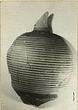
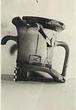
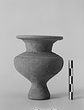
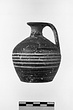
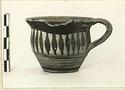
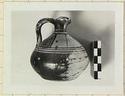
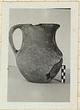
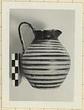
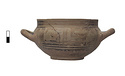
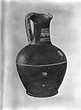
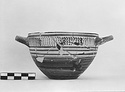
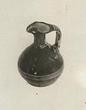
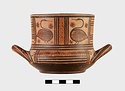
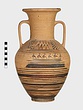
| Many fragments missing; restored in plaster; one handle, much of body and neck missing. High ring foot; plump ovoid body; slightly flaring neck; plain round lip; double rolled handles. Body banded except ... 22-23 June 1939 ... Hesperia 20 (1951), pl. 35:e (Grave 4) ... Agora VIII, no. 2. |
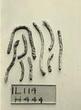
| 13 small pieces, bent and twisted; round in section. Agora sample no. 232. In various parts of the disturbed Mycenaean grave, some where near the head. Leica ... 10-12 May 1933 |
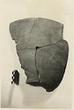
| Mended from many fragments. Part of one side preserved, from above the foot to the shoulder, and with a fragment of the neck. Nothing of base or rim. Shoulder and area above foot glazed; rest of body banded ... 9 August 1947 |
| About one-sixth preserved. Restored in plaster. Ring foot, convex side and flat thickened lip.
Very micaceous red clay. Unglazed. Grave 18. The skeleton of a child was found lying on this fragment. The ... 9 April 1935 ... Grave 18. The skeleton of a child was found lying on this fragment. The grave disturbed ... Leica, VI-38, VII-3, VIII-4 |
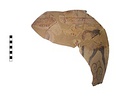
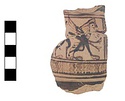
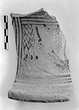
| Ten joining fragments from shoulder and body. On shoulder: downward pointed rays, alternately glazed and outlines; below, a zone of strap pattern. On body: hindquarters of a large horse walking right; ... 9 June 1939 |
| a) The neck of an amphora with part of the shoulder and one handle. The neck, slightly concave in profile, widens as it goes up, ending in a flaring rounded lip. Straight vertical strap handles, shoulder ... 6 February 1935 |
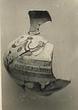
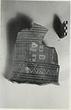
| Two joining fragments preserve part of oinochoe neck. In a reserved panel at front, a winged sphinx marching right. Face and wings drawn in outline. Selected sherds from late and disturbed fills in grave ... 1939-1940 |
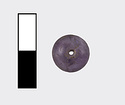
| Globular.
Flattened top and bottom slightly. Χάνδρα από αμέθυστο. Προέρχεται από διαταραγμένη ταφή Μυκηναϊκών χρόνων, νότια του ναού του ’ρεως. From sifting earth from Mycanaean grave.
Cf. J 5, J 7, P ... 13 May 1933 |
| Small concave-sided spindle whorl. Chipped at the top, and around about half the circumference at the bottom.
The sides flare sharply from the small top; bottom flat.
Undecorated.
Reddish-brown steatite ... 13 May 1933 |
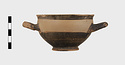
| Broken but complete. Plain black glazed skyphos, flat-bottomed, with reserved band at lip inside and out; inside of handles and handle-spaces reserved. Bottom unglazed.
Black glaze unevenly fired and ... 12 May 1939 |
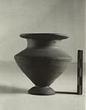
| Intact. Broad double conical body on flaring echinus foot; short straight neck; broad flat projecting lip.
Pinkish-buff clay; unglazed. Grave VI = Grave 10, 5. 1803, 2005 Leica, XX-47 Ptg. 103 ... 25 May 1939 ... Hesperia 20 (1951), pl. 41 a-5 (Grave 10) ... Agora VIII, under no. 237. |
| Base broken, fragments of mouth missing.
Dull black glaze except for reserved bands at lower handle attachment. Handle reserved with horizontal glaze lines.
Clay pinkish-buff. Child's grave. Outside ... 25 October 1956 |
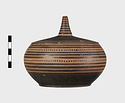
| Intact. Wide mouth with flat projecting lip, turnip-shaped body and solid conical high stem. Two grooves around shoulder.
Sandy buff clay, unglazed, highly micaceous; finer buff slip, much worn. Grave ... 22 May 1939 ... Hesperia 20 (1951), pl. 39 a-1 (Grave 5) ... Agora VIII, under no. 237. |
| Similar to P 1977. Attachment of one horizontal handle preserved. On either side of it, dots. Above and below, narrow bands; around the point of greatest circumference, a broader band with a wavy upper ... 15 May 1933 |
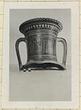
| Burial jar. Cracks around rim, neck, shoulder, but intact. Flat horizontal lip; flaring rim passing directly in to great bulging body. Almost no neck; greatest diameter at about mid-height, tapering rapidly ... 27 June 1949 |
| Flat-bottomed, the body convex-concave to neck; plain lip. Flat strap handle, lip to shoulder.
Coarse micaceous red clay, fired brown to gray on the outside. Inside there remained lumps of some red substance ... 6 February 1935 ... Grave 3. Close to B 1096, the mouth covered with flat stone ... Leica, 7-538, VIII-10 |
| Mouth and some of handle missing. Flat bottom; narrow neck and mouth.
Reserved bands at lower handle attachment. Shoulder and base glazed solidly. Dull black glaze, streaked in places.
Clay pinkish-buff ... 25 October 1956 |
| Intact. Flat bottom; flaring lip. Elongated diamond shaped ornament on upper half of body. Horizontal parallel lines below. Horizontal lines on handle and inside lip.
Clay pinkish-buff. Glaze reddish ... 25 October 1956 |
| Nearly half of a very low ring base preserved; above it the sides flare sharply. Mended from several fragments. At the bottom, a broad and a narrow painted band; above, a group of three narrow bands; at ... 15 May 1933 |
| Squat type with small neck and bulging sides, the greatest width near the bottom. Mended from many pieces; one small horizontal handle preserved and wall from the start of the neck to beyond the inward ... 9 May 1933 |
| Large chips missing from base, and one from lip. Turnip-shaped body with slightly angular shoulder; short wide neck flaring slightly to broad projecting flat-topped lip. Small conical base, with a depression ... 25 May 1939 ... Hesperia 20 (1951), pl. 41 a-7 (Grave 10) ... Agora VIII, under no. 237. |
| Very squat round-bodied oinochoe, with short narrow neck and tiny trefoil mouth. Glazed to shoulder; then three narrow bands below a series of three double triangles, the inner ones cross-hatched, separated ... 13 March 1935 |
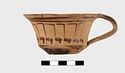
| Flat-bottomed cup with slightly convex side wall, slightly flaring lip; one vertical strap handle from lip. Black band around base; wavy black line on body and handle. Interior glazed except for band inside ... 13 March 1935 |
| Mended from many pieces. Flat-bottomed jug with convex-concave body to plain widely flaring lip. One vertical strap handle, lip to shoulder; depressed at the base.
Coarse gritty micaceous red clay, unglazed ... 1 March 1935 ... Grave 9 ... Leica, VI-56, VIII-10 |
| Mended from many pieces; a small part of the neck preserved with about one-quarter of the swelling body; none of the base. Three bands of paint around the bottom, three at the point of greatest circumference ... 15 May 1933 |
| Similar to P 4969 (Β 1299) in shape, but larger, with somewhat smaller handle and pointed trefoil mouth. Body and handle covered with narrow black bands; mouth black outside.
Slipped; dull black glaze ... 13 March 1935 |
| The lip mended; a few fragments missing.
Squat round-bodied jug with slightly flattened bottom. Low neck and wide outward-flaring lip. No handle. Tie-holes in the lip.
Fine soft rather micaceous buff ... 19 March 1935 |
| Similar to P 4963 (Β 1293) in shape and decoration; the body more rounded and the lip more flaring. Bands and St. Andrew's crosses on handles.
Buff slip; metallic black glaze.
ADDENDA P 4963: Flat-bottomed ... 13 March 1935 |
| Body fragments and much of one handle missing. Low flat base, rounding wall and straight rim. Glazed to handle zone. In handle zone, bordered by bands at sides and below, hatched maeander. Stars beside ... 10 June 1939 |
| Lip and handle fragments missing. Flat bottom, convex-concave side wall; flaring lip, one vertical strap handle. Broad glazed band around bottom, two narrow ones outside lip, between, procession of long-necked ... 6 February 1935 |
| Flat-bottomed kantharos with low base, convex body, and plain straight lip; two vertical strap handles lip to shoulder looped high over lip. One handle broken off but repaired. Wide black band above base; ... 5 March 1935 |
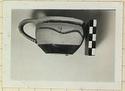
| The handle broken off but mended; two chips missing from the back of the lip; in the front of the shoulder, a small hole. Otherwise intact.
Flat-bottomed oinochoe with slight base-like projection; high ... 2 March 1935 |
| Flat-bottomed kantharos with convex body and plain lip; two high-looped vertical strap handles. From base to lower handle attachments, one wide and three narrow black bands. On body: handle zones set off ... 13 March 1935 |
| Neck fragment broken off at shoulder; none of rim preserved.
From the top: horizontal zigzag; series of short vertical zigzags between three bands above and three below; a wide band divided into three ... 1935 |
| Intact except for small chips. Turnip-shaped jar on high conical foot, concave beneath; wide slightly spreading neck; flat projecting rim. Brownish(?) clay, dull brown surface; the outside of the foot ... 25 May 1939 ... Hesperia 20 (1951), pl. 41 a-6 (Grave 10) ... Agora VIII, under no. 237. |
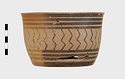
| Broken but complete except for a few chips. Flat bottom; two horizontal loop handles. The lower body glazed black; above, three black bands. Below the lip, a band decorated with wavy vertical black lines ... 19 April 1934 |
| Flat-bottomed cup with rather bulging, rounded, side wall and short plain lip, one vertical strap handle, lip to below shoulder.
Entirely glazed except for reserved band outside lip, another inside lip, ... 14 March 1935 |
| Round-bodied, flat-bottomed handmade pot with narrow neck, flaring lip and one vertical strap handle lip to shoulder. On shoulder at handle attachment zone, incised, two horizontal lines, dotted on each ... 19 March 1935 |
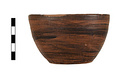
| Intact. Flat-bottomed handless deep bowl, with convex side wall and plain lip. Resting surface reserved.
The rest of the bowl inside and out covered with thin streaky black glaze, probably put on while ... 19 March 1935 |
| Complete neck; one handle broken off but repaired. Inside of lip, a black band; outside, plain maeander. Below lip, between two narrow bands above and two below, cross-hatched triangles. Handle zones marked ... 5 March 1935 |
| a) Pitcher with high convex body and high concave neck ending in plain lip; one vertical strap handle, lip to shoulder. False ring foot. Body to shoulder covered with black bands; shoulder (handle-band) ... 12 March 1935 |
| Flat bottom; body, slight widening at level of handles, flaring rim. Handles low-set on body.
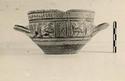
Reserved panel between handles, front and back, divided by vertical lines into two metopes; in each a bird, ... 27 June 1949 |
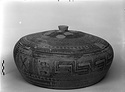
| Mended from many pieces. No lid was found for this pyxis.
Low ring foot, convex rounded shallow side wall with flanged inner lip pierced for tying. Wide band around bottom, three narrow bands, wide zone ... 19 March 1935 |
| Body squat, biconical; short narrow neck; mouth, funnel-shaped; handle, rim to shoulder. Neck, row of dots between glaze bands. Shoulder reserved, three dot rosettes, one in front, one on each side; three ... 27 June 1949 |
| Flat-bottomed oinochoe with rounded body, long narrow neck, trefoil lip and one vertical loop handle. Body decorated to shoulder with alternating glaze bands; one wide, two narrow. Shoulder black. Reserved ... 13 March 1935 |
| Mended from many pieces; a few small bits missing from the wall. Flat-bottomed kantharos with convex-concave body ending in a plain rim. Two high vertical handles. Lower body glazed; above the glaze, three ... 2 March 1935 |
| Intact; oval, not round, at the lip 0.132m.
Low ring base, swelling body with very slightly flaring lip, and two high looped vertical strap handles, lip to shoulder. The lower body glazed solid; from lip ... 13 April 1935 |
| Flat bottom, globular body; neck flaring out to simple round mouth. Rolled handle mid-neck to shoulder. On neck, wavy line bordered by dots; in waves, dot rosettes. Shoulder reserved and undecorated. Below ... 27 June 1949 |
| Flat bottom, tiny plain foot, sides relatively steep curving gently out to plain rim. Body reserved; glaze band at foot; below handles, three glaze bands; below rim, wide glaze band. At center between ... 27 June 1949 |
| Ring foot, ovoid body, rather narrow slightly concave neck and heavily rounded flaring lip. One vertical strap handle, shoulder to lip; two horizontal uptilted loop handles on body. Body decorated with ... 14 March 1935 |
| Mended from many pieces; a number of small chips missing. Skyphos with rather marked shoulder; flat bottom, handles only slightly up-tilted; rim high, slightly flaring. Panel decoration in handle zone ... 17 May 1939 |
| a) From neck of a geometric amphora. Part of one metope panel, bounded by triple lines on all sides. On it, head and front legs of a grazing horse, right. Between legs, tree; between front leg and head, ... 8 February 1935 |
Rim and wall.
One-handler (?). At edge of break below, a little of a raised edge. Suspension hole in rim. Light red clay with small white bits; warm buff surfacing. Matt black glaze wash on rim, just ... Context ca. 420-400 B.C. and earlier ... Similar partial glazing is found on plain phialai in different fabrics and from different sites; cf., from Athens, Syntagma Cemetery (Acropolis Museum): Ἐφ., 1958, pl. 23 below (Grave XLIV = 65). The shallow open shape of 1721 would suit a phiale, as would the suspension hole, but not the bit of ring foot; more likely this was a one-handler, and possibly Rhodian; cf. the pair from Ialysos (no number): Cl. Rh., VIII, p. 152, fig. 138, below, left (Grave 30). |
| Low ring base; squat pear-shaped body; very small neck; trefoil lip.
Glazed all over outside save barred handle and triple stripe around point of greatest circumference.
Attic clay. Brownish-black glaze ... 6 May 1932 ... Similar pieces seem to be later than this example (AM 18 (1893), pl. VIII, 2, no. 10; CVA Pays Bas, 1, II F, pl. ... Child's grave. |
| The lid mended from four pieces; the body from many; chips missing. The flat knob handle an after thought(?).
a) Pyxis. flat-bottomed pyxis with convex side wall and lip flanged inside. Flange and lip ... 19 March 1935 |
| Low ring foot; low, pronounced shoulder sloping up to high straight vertical rim; rolled handles, tilted upwards. On rim, front and back, two metopes, each containing plump goose with scored body. Above ... 27 June 1949 |
| The body mended from several pieces, complete; the lid intact.
a) Amphora with long ovoid body on ring foot, high concave neck flaring into rounded lip; two vertical strap handles, shoulder to middle of ... 13 April 1935 |
| Intact; one chip missing from lip.
High flaring pseudo-ring foot; otherwise as P 5070 (Β 1354) and P 5071 (Β 1355), but with body somewhat deeper, lip somewhat narrower.
Entirely glazed except resting ... 19 March 1935 |
| Intact. No lid was found.
Low base; convex side wall with flanged lip inside to receive lid; lip pierced for tying on lid. Outside: wide band around bottom, then row of small dots. Between three narrow ... 19 March 1935 |
| Mended from several pieces; a few chips missing.
Flat-bottomed bowl with nearly straight slightly convex side wall, very slightly flaring to a plain lip. A single tie hole near the edge.
Resting surface ... 19 March 1935 |
| Lid and body intact.
a) Pyxis: Low base; convex body; point of greatest circumference higher than the middle: flanged inner lip, flange and lid pierced for tying. Wide band around bottom, three narrow ... 19 March 1935 |
| Intact; lip chipped. Similar to P 5070 (Β 1354) in shape; lip slightly flaring. Glazed solid to handle zone; framed parallel chevrons on their sides. Dot rosettes next to handles. On lip, two bands. Inside ... 19 March 1935 |
| Mended from several pieces; a few chips missing from rim and sides.
Flat-bottomed cup with convex body and short straight lip; two horizontal loop handles, tilted slightly upward. Lower body and outer ... 19 March 1935 |
| Intact. Squat rounded body and high slightly concave neck. One high vertical strap handle, from plain lip to shoulder, with strut.
Glazed solid to point of greatest circumference, then three narrow bands ... 19 March 1935 |
| Mended from several pieces; one small chip missing. In shape a Dipylon amphora in miniature. Ring foot, ovoid body, straight neck and flat flaring lip; two upward tilted horizontal loop handles.
Glazed ... 19 March 1935 |
| Lid and body intact.
a) Pyxis: Shallow base; convex body with lip flanged inside to receive lid; flange and lid pierced for tying. Around the bottom, wide band of glaze; on body, between three narrow ... 19 March 1935 |
| The body preserved, with gaps, to the base of the narrow neck; neck, mouth and handle missing. Low base, slightly concave underneath, with flaring edge; plump body with widest point fairly low, and rather ... 8-10, 12 April 1948 |
Broad projecting rim with handle-ridge below it; tall wide neck, rounded shoulder, strap handles. Fine somewhat sandy buff clay, thin fabric; reddish brown glaze on rim inside and out, over the tops of ... Context ca. 350-325 B.C. (?) ... The shape is found in Rhodes in contexts of the early 5th century, e.g. from Ialysos: Cl. Rh., VIII, p. 109, fig. 97 center, above (Grave 8-1), sometimes along- side the squat variety; cf. op. cit., p. 188, fig. 179 left, above, contents of Grave 78. |
Ring askos, the sides rounding over into large central opening; saucer mouth; spout tilted back against handle. Buff slip or surfacing; good black glaze on rim, inside and out, on top of handle and for ... Context ca. 520-490 B.C ... Apollonia 1947- 1949, pls. 60-61; from Istria: Materiale, IV, 1957, p. 60, fig. 41 and Histria, II, pl. 74 (Grave I, 1); Materiale, VII, 1960, p. 276, fig. 3; from Kerch: Otchët, 1898 (1901), p. 18, fig. 17; from Rhodes, a pair in a burial of the first quarter of the 5th century: Cl. Rh., VIII, p. 152, fig. 138, to right and left of center (Ialysos, Grave 30-13 and -14). |
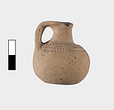
| Mended from several pieces; complete except for small bits. Round-bodied jug on slightly concave bottom; narrow straight neck, trefoil lip, with rolled handle from lip.
Body solid glazed except for a ... 17 May 1939 |
| Intact save chip from end of spout. Trefoil mouth; tall narrow neck; squat body; low flat base. Shoulder decorated with three large crisscrossed triangles and a single line of vertical maeander beside ... 13 March 1947 |
| Mended from many pieces; complete save for chips.
Similar to P 5070 (B 1354) but with low base and somewhat larger. Straight lip. Glazed to handle band and on outer face of handles. A dot rosette beside ... 19 March 1935 |
| The lid mended from three pieces; the body from many.
a) Pyxis: Low ring foot. Convex side wall, the point of greatest circumference higher than the middle. Flanged; pierced for tying. Wide band around ... 19 March 1935 |
| The lid intact except for chips; the body mended from many pieces; a few bits missing.
a) Pyxis: Deep convex-sided pyxis with ring foot; inner lip flanged; flange and lip pierced for tying. Wide band ... 19 March 1935 |
| The lid mended from several pieces; complete except for chips. The body complete, but cracked.
a) Pyxis: Low ring foot; convex body; lip flanged inside to receive lid; flange and lid pierced for tying ... 19 March 1935 |
| Mended from many pieces; the lid complete except for a chip from the knob, the tip of the handle, and small chips; the bowl complete save for a few small bits of wall and rim, and chips to the surface ... 22 April 1939 |
| Body mended from many pieces; complete except for fragments of top, and chips. Lid complete except for tip, and chips.
Deep bodied lamp on high base; walls nearly vertical; broad rim slightly insloping, ... 5 April 1937 ... Unglazed outside; black glaze, irregular inside.
Type VIII (conventional variety) of Corinth collection, type 25D' of Agora collection ... Burned deposit in Room 18 (part of Grave V). |
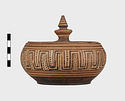
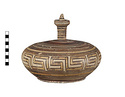
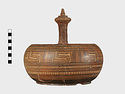
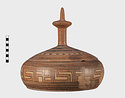
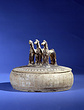
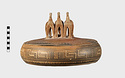
| Mended from several pieces; complete save for a few small bits. A shallow domed lid, from the center of which rises a stout horizontally-ridged stem, on which is set a two-handled cup with straight lip ... 22 April 1939 |
| The lid complete; one horse broken off but repaired; the body intact.
a) Pyxis: Low pseudo-ring foot, convex side-wall, lip flanged inside; flange and lid pierced for tying. Wide band around bottom; between ... 19 March 1935 |
| Intact. Similar in shape to P 5422 (Β' 704) but somewhat larger and a little plumper. No lid.
Body, from bottom to point of greatest circumference, covered with glazed bands, one wide and three narrow, ... 13 April 1935 |
| The body mended from two pieces; the lid from many.
a) Pyxis: Low ring foot; convex body with lip flanged inside to receive lid; flange and lid pierced for tying. On body, two narrow bands around bottom, ... 19 March 1935 |
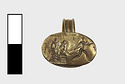
| The man strides right; behind him are the two female figures in flounced skirts; the man holds a spear or branch; from his waist two lines extend to the first woman.
Small symbols in the field to the left ... 10 May 1933 |
|
|