|
|
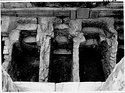
| Grave in opisthodomos of Hephaisteion. Grave LI in notebook.
No mention of bones. Neg. KK 363, XIX-8 (dismantling of the walls of the graves( ... 10 March 1939
16 March 1939 ... KK 363, XIX-8 (dismantling of the walls of the graves(. |
Well at edge of east slope of Kolonos Agoraios. Essentially uniform fill of second half of 8th c. B.C. but some earlier material. Thrown out from destroyed graves ... Early Geometric to third quarter of 8th c. B.C ... Thrown out from destroyed graves. |
Grave in north peristyle of Hephaisteion. Grave LIX in notebook.
No mention of bones. Containers 473 and 474 represent filling between graves. Coins:
11 March 1939 #16 Neg. KK 391 ... Byzantine ... Containers 473 and 474 represent filling between graves. |
| Mycenaean Grave F.
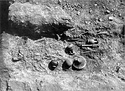
It seemed to be more as a collection of bones and offerings, presumably swept aside to make room for later burials; they are east of and slightly higher than children's graves A and ... Myc. IIIA ... It seemed to be more as a collection of bones and offerings, presumably swept aside to make room for later burials; they are east of and slightly higher than children's graves A and B. |
| Grave 2 in notebook. Child of about two (or 10?) months, body placed in plain pithos, which rested on its side at the bottom of a pit; the mouth closed with a stone slab.
The burial forms a group with ... 750-725 B.C ... The burial forms a group with two other graves (D 16:2, D 16:4) set in angle formed by intersecting roads. |
| Mycenaean Double Grave (Graves A and B).
Grave A was in Layer II. We laid a skull and a few other bones, three vases and a stone bead. We have dug to a maximum of about 0.06m below the top of Layer II ... Myc. IIIA/B ... Mycenaean Double Grave (Graves A and B).
Grave A was in Layer II. ... All of the pottery and bones in both graves are badly crushed. |
The almost complete red figure hydria set into this cutting suggests the possibility of a 5th c. burial put into a much earlier grave cutting; however, the remainder of the filling appears thoroughly disturbed ... 450-425 B.C- Late Roman disturbance ... Filling in this vicinity however disturbed to Late Roman, down to bedrock; no real evidence for graves. |
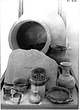
"Fauvel Collection"
Collector's dump? Debris in the cellar of a modern house, probably once that of F.S. Fauvel.
The collection included vases of all periods, from Geometric to Turkish; a number of the ... Modern Context ... The collection included vases of all periods, from Geometric to Turkish; a number of the pieces are non-Attic and many of them apparently derive from graves. The deposit is thus without chronological significance and without any ancient association with the Agora area.
|
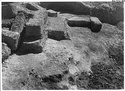
Mycenaean Grave below Stoa stylobate opposite pier 21, about 0.75m below the bottom of the Stoa conglomerate foundations. Although only the south side and the west end could be certainly fixed, the dimensions ... Myc. III A-early IIIB ... Although only the south side and the west end could be certainly fixed, the dimensions as exposed (1.30m by 0.60m) agree with those of the other cist graves. Tumbled in the grave were three rough stone slabs, presumably from a covering. |
| Dorothy Burr Thompson ... Grave 4 in notebook. (E.L. Smithson: Grave XLIV). No remains (not really a grave, note on p. 331).
Roughly rectangular patch of unworked fieldstones, measuring about 1.20x0.80m neatly laid on bedrock, ... 19-21 March 1932 ... The similarity of this feature to funerary deposit/ Q 8:12 in the cemetery along the south bank of the Eridanos, and in close proximity to Mycenaean and Early Iron Age graves, suggests that both deposits are funerary in nature. |
Eugene Vanderpool ... Disturbed burial: Pocket in bedrock (Grave 11: PG). In some records as Grave XI. No remains. No cutting or traces of burning nearby
The coin listed here was found "cleaning bedrock", presumably at the ... Developed to Late Protogeometric ... The vases constitute evidence for early burials on the southeast slopes of the Kolonos Agoraios, although no trace of graves, or of any robbed tomb pits, was preserved nearby. |
| Evelyn Lord Smithson ... Grave 3: (Grave XXVII: EG). Urn cremation (trench-and-hole), adult male. Carbonized figs and grapes included in inventoried objects (no number). [JP]
"Craftsman-Warrior" tomb: combination of weapons and ... Early Geometric I ... The burial forms a group with two other graves (D 16:2, D 16:3) set in angle formed by intersecting roads. |
| Rodney S. Young ... Grave 10 in notebook. No remains. Probably grave of a woman.
Only a small portion of the inhumation pit was preserved at the northeast edge of pit A, a large oval cutting of modern date dug for the construction ... Middle Geometric II ... The tomb was cut with a northeast-southwest orientation, interrupting the series of graves (Tomb XVII-XX), which radiate from the base of the hill.
|
| Well South of Soft Yellow Poros Foundation. Dumped filling of a collapsed well, that, due to hazardous conditions, could not be cleared below- 2.50m. The well was partly cut on the east side by a Byzantine ... Protogeometric-Early Geometric II, ca. 850 B.C ... Filling almost entirely later Protogeometric, with a few sherds of Earliest Protogeometric, all apparently drawn from disturbed graves.
At -1.50m a complete and ordered skeleton (man of 45-50 years old), doubled up so that its thighbones were parallel to and to the backbone, lay on a rough stone slab. |
| N.A. Doenges Evelyn Lord Smithson ... "Near or in Grave" (width 0.50m)
Grave to the east of the southeast corner of the great court of the Gymnasium. Shallow and superimposed on Well N 11:5. It is a simple cist oriented north and south, with ... 750-725 B.C ... The other two skulls were found in the area of the grave, but above it, and since there were other grave-like but empty cuttings in the vicinity it is likely there was a small group of graves here. |
| Eugene Vanderpool Homer A. Thompson ... Mycenaean Grave to W. of "Court Room" below Stoa Terrace with "Ballot Box" (Grave XXIX).
Unusual type, conforming neither to our pit nor to our cist graves, and consisted of two parts. The outer part was ... Mycenaean III A-B ... Unusual type, conforming neither to our pit nor to our cist graves, and consisted of two parts. |
| Marcie Handler ... This deposit is a Mycenaean cist grave with two cover slabs, a type of burial described by Immerwahr in Agora XIII (pp. 103-104). Cist graves appear side by side with chamber tombs in the Mycenaean cemeteries ... LHIIB-LHIIIA:1 ... This deposit is a Mycenaean cist grave with two cover slabs, a type of burial described by Immerwahr in Agora XIII (pp. 103-104). Cist graves appear side by side with chamber tombs in the Mycenaean cemeteries of the Agora.
|
| Eugene Vanderpool ... Rectangular pit, oriented east-west, cut party into filling of Early Protogeometric pit-well (I 18:4), to a preserved depth of about 0.30m. A late Byzantine wall founded below the floor of the grave destroyed ... Middle Geometric I ... Although half of the tomb was entirely destroyed by later building activity, what survived constitutes one of the richest graves on the slopes of Areopagos and in Early Iron Age Athens. |
| Dorothy Burr Thompson ... Child's Grave (E.L. Smithson: Grave XXVIII: G).
Cf. Container Lot ΣΤ 165 (fill over geometric grave).
Neat, rectangular, unlined trench, cut into bedrock to a preserved depth of 0.20m,below the level ... Early Geometric I ... On the left side of the cranium was a pair of cockle shells, compared by the excavator to similar shells found in Rhodian graves. The cranium was at a slightly lower level in the tomb than the feet; the upper part of the skull of the deceased was found near the south corner of the tomb, the jaw bone closer to the east corner. |
|
|