|
|
| Evidence of a 4th Century Building. Hellenistic Building; Room 1 ... ΠΠ-12 2381, 2382 Lot ΠΠ 364 Lot ΠΠ 365 Lot ΠΠ 366 ... Jul 2 1956 ... Evidence of a 4th Century Building ... Hellenistic Building; Room 1 |
| Northwest. Original Building. 4th century. Roman Wall. Hellenistic. Basin. Well. Pithos. Cutting ... ΟΟ-13 2536, 2537 ΟΟ 1051 P 19985 ΟΟ 1417 P 20431 Lot ΟΟ 629 ... 14-16 May 1949 ... 4th century ... Hellenistic |
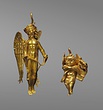
| Gold earrings: youthful Eros with a ribbon (4th century B.C.), J 160, baby Eros playing the kithara (Hellenistic), J 154 ... Craig Mauzy ... Horizontal (normal) ... 11 Oct 2004 ... Gold earrings: youthful Eros with a ribbon (4th century B.C.), J 160, baby Eros playing the kithara (Hellenistic), J 154. |
Part of the mold for the upper part of a lamp.
The groove around the rim and the ivy leaf pattern of the upper body preserved.
Type XIX or XVIII of Corinth collection, type 46C of Agora collection. House ... 22-24 July 1947 ... House H, Room 10; brown fill, mixed Hellenistic. 4th. to 2nd. century B.C. |
| The legs and the part of the body of a lion or panther walking right. Animal leg with drapery falling over is preserved, suggests it had rider (who perhaps holds a staff?).
Part of the lower edge preserved ... 29 May 1947 ... Loose Hellenistic fill; mixed 4th. century to Hellenistic. |
| Dull buff clay, darker inside; red paint on neck.
Cf. Dumont (1872), pl. IX, 3. Par: Dumont 1871, Pl IX,3*
Dip: red paint on neck* Finished 4th century B.C. and Hellenistic fill. Δεινώ̣π̣ας̣
hand
[Θά]σιο̣ν ... 14 March 1936 ... 4th century B.C. and Hellenistic fill. |
Face of terracotta figurine. 4th century or Hellenistic. End of nose and head from ears back gone. Fine work. Wavy hair. Head turned to right. Reddish clay. Munsell (fabric/surface) 5 YR 6/4 light reddish ... 14 December 1933 ... Face of terracotta figurine. 4th century or Hellenistic. |
| Section ΠΠ 1948 ... Mabel Lang ... The western and northern parts of Section ΠΠ were brought down to Roman level. Revealed were Roman houses (North House and South House), drains and roads (East-West Road with two drains underneath it, ... 16 Mar-29 Apr 1948 ... In places where Roman structures had been destroyed, the excavation reached earlier periods (Early Roman, Hellenistic and 4th century B.C. remains). |
| Section ΠΠ March-June, 1956 ... A. Boegehold ... The ruins unearthed in section ΠΠ represent six roughly defined periods: 4th century B.C. to Hellenistic, Augustan, pre-Herulian, post-Herulian, Byzantine and Turkish.
The results of the excavation are ... 20 Feb-29 Jun 1956 ... The ruins unearthed in section ΠΠ represent six roughly defined periods: 4th century B.C. to Hellenistic, Augustan, pre-Herulian, post-Herulian, Byzantine and Turkish.
|
Complete except for a few chips.
Low foot; rounded resting surface; convex underside. Very slight groove above foot. Convex wall. Rim concave on top, with ridge at inner edge. Thick, shiny red glaze, ... 325-300 ... Other concave-rim plates from Hellenistic contexts: 818, 819, and P 21010 (H--K 12--14), very crudely made, but possibly dating in 4th century; P 1092 and P 1093 (H 17:5), also possibly 4th century. |
| Early Building II; Room A. General Late Hellenistic Level. Strosis III. Strosis II. Strosis I. Late Pithoi. Late Hellenistic Fill. Rubble Wall. Hellenistic Fill. 4th Century Fill. Roman Street. Sandy Earth ... Ζ-5 811, 812 ... 1933 ... General Late Hellenistic Level ... Late Hellenistic Fill ... 4th Century Fill |
Part of rim and side with one horizontal handle attachment at left.
Incised on side.
Black glaze.
Type VI (early 4th. century variety) of Corinth collection, type 23C of Agora collection.
In Hellenistic ... 27 February 1936 ... Type VI (early 4th. century variety) of Corinth collection, type 23C of Agora collection.
... In Hellenistic and early Roman fill. |
Parts of wall and one-third of rim missing.
Flat bottom with hole in center, broken away from flat surface to which it was once attached. Squat body with distinct shoulder.
Outwardly thickened rim, with ... 4th century? |
Half of rim and large parts of wall restored.
Rounded resting surface (worn); convex underside. Flaring rim with taut molded profile; inner wall straight. Slightly rising spurs with flaring sides. Dull ... 265-250 |
Fragment of upper part of lower body, broken all around.
Wall is decorated with ribs; top of one rib preserved, outlined by painted ridge. There is also paint in the triangular area between the petals ... Late 4th century? |
| Table of Contents. Preface. List of Illustrations. Abbreviations and Bibliography. Technical Terms and Conventions. Introduction. Imported Lamps. Lamps of the 1st Century Before Christ through the 2nd ... Agora 7 vi ... Lamps of the 4th to 6th Century ... Lamps of the 4th to 7th Century ... Note on the Chronology of the 3rd and 4th Century Lamps |
| House E; Hellenistic and 4th B.C. House; North of East-West Street by Great Drain; i.e., Northwest Corner of Section. House F; Latest Hellenistic-Early Roman House; South of Street Above Northeast Corner ... ΟΟ-7 1328, 1329 ... 1948 ... House E; Hellenistic and 4th B.C. ... Area of Poros Building; 4th Century; Marble Workers ... Area of Poros Building; General 4th Century |
Over half preserved; rim chipped, knob missing. Darkened by fire.
Small, domed lid with projecting rim. Three holes (probably originally four) pierced through dome. Micaceous, light reddish brown fabric ... 4th century? |
P 17703 a, b, c
Three sections preserve over half of foot and part of lower wall (a), part of rim (b), and about one-fourth of lid (c). Burning on edge of rim.
Flat underside. Projecting molding at bottom, ... 4th century |
Connected with G 14:3.
There was a layer of Late Roman fill. It rested over a layer of 2nd c. B.C Hellenistic and then another of 4th c. B.C Hellenistic; the passage between the two cisterns contained ... Late Hellenistic ... B.C Hellenistic and then another of 4th c. B.C Hellenistic; the passage between the two cisterns contained Hellenistic material. Therefore, it appears that this cistern had several periods of use: Hellenistic (at least one phase contemporary with the 2nd century B.C, phase of House E to the north), Late Roman (probably associated with the amphora and perhaps also maybe the platform and the drain), and finally Byzantine.
|
Part of dome, flange, and cylinder preserved.
Flange has thickened edge; face reserved with two grooves. Reserved band with two grooves surrounds dome. Lustrous black-to-green glaze ... Late 4th to early 3rd century? |
| Broken on all sides.
Parts of four lines of the inscription preserved.
Hymettian marble. Found in mixed Hellenistic and Roman context, outside the Market Square, to the southwest, in the disturbed area ... 4th. century B.C. |
Lid.
Broken all around, with knob missing.
Knob or stem made separately, with two square moldings at base.
Decoration in red glaze: lotus petals with dotted ribs alternate with plain petals on wall ... Disturbed 4th-century context |
| Section ΛΛ 193
Excavation Summary ... Dorothy Burr Thompson ... Excavations in Section ΛΛ revealed that the original contour of Kolonos Agoraios had been much sharper than in modern times. No traces of early graves were found in the area; first sign of habitation is ... 1 Feb-23 Jun 1937 ... The best preserved material belongs to the 4th century B.C. The area was probably covered with houses of which five establishments were well preserved, several others less preserved.
In the early 3rd century the easternmost houses went out of use to leave space for the Hellenistic Building.
... In the late 4th century A.D. the area suffered much damage.
|
| Fragment from a large draped statue, probably in himation. It is not immediately apparent to what part of the statue it belongs. Joint-surface for an inset member shows that the statue was pieced.
Carefully ... Late 4th c. B.C. or Hellenistic ... Carefully worked, the thick-textured drapery suggests late 4th century or Hellenistic.
|
Digging abandoned at 17.10m.
Nbp. 2863: The fill in the mouth to -6.50 was a dump of mixed hellenistic and late roman sherds. From -6.50 to -11.00m. small stones with a few late roman sherds 4th-5th c ... 4th-5th c. A.D ... Nbp. 2863: The fill in the mouth to -6.50 was a dump of mixed hellenistic and late roman sherds. From -6.50 to -11.00m. small stones with a few late roman sherds 4th-5th c. From -11m. the well deposit started and was very heavy and continuous to abandonment depth, 4th-5th c. A.D. pots and 4th c. coins. A third century phase was beginning to appear at time of abandonment. |
| Complete except for chips, glaze badly worn. Underside recessed, concave. Foot slopes up toward interior yielding resting surface toward outside. Rim convex and drooping toward outside. Added white garland ... 13 May 1971 |
Back fill in an unfinished well, originally dug only to a depth of 3.80m. Apparently dug in the 3rd. c. B.C. and refilled at once; the filling contained a scattering of 5th. and 4th. c. fragments as well ... To early 3rd century. |
Handle and part of rim missing.
Slightly concave underside, reserved and painted with miltos.
Globular body curves out smoothly into flaring rim. Handle round in section. Dull brown to shiny black glaze ... 4th century? |
| Section ΟΟ 1949
Grave Area ... Margaret Crosby ... A report on the excavation in the immediate vicinity of the Early Geometric burial found in 1948 in Section ΟΟ. Two Geometric graves were uncovered, and also walls and drainage systems belonging to the ... 28 Mar-9 Nov 1949 ... Two Geometric graves were uncovered, and also walls and drainage systems belonging to the industrial establishments of the later 6th and 5th B.C. centuries, as well as sporadic remains from later periods, such as a 4th B.C. century pit and a Hellenistic cistern. |
| Inscribed fragment.
Only the upper left hand part remains.
A stele with gabled top, the mid-part of its front deeply cut back to hold the relief; a figure of the Mother seated on her throne, facing front ... 4th. century B.C. |
[cmk.: bunch of grapes] Worn illegible. Worn illegible ... 4th century B.C. and Hellenistic ... 4th century B.C. and Hellenistic |
[cmk.: cornucopia in incuse oval] Worn illegible. Worn illegible ... 4th century B.C. and Hellenistic ... 4th century B.C. and Hellenistic |
[cmk.: dolphin on trident in incuse square] Worn illegible. Worn illegible ... 4th century B.C. and Hellenistic ... 4th century B.C. and Hellenistic |
[cmk.: dolphin on trident] Worn illegible. Type of beardless head ... 4th century B.C. and Hellenistic ... 4th century B.C. and Hellenistic |
[cmk.: lyre] Worn illegible. Worn illegible ... 4th century B.C. and Hellenistic ... 4th century B.C. and Hellenistic |
[cmk.: bunch of grapes] Written in envelope that is probably K-1495 Worn illegible. Worn illegible ... 4th century B.C. and Hellenistic ... 4th century B.C. and Hellenistic |
Type A Pyxis.
Foot and lower body preserved.
Ring foot with three wide areas cut away to make tripod support; rounded resting surface; slightly convex underside. Cylindrical body, slightly concave. Fairly ... Context of 325-200 with late Hellenistic disturbance |
Aryballos: Impressed Decoration.
One-third of rim and part of body restored, including center of floor.
Flat bottom. Profile in two stages divided by concave band bounded by groove above and below. Stamped ... Context of second half of 4th century and early 3rd century, with a few late 3rd-century pieces |
Fragment of rim missing.
Straight ring foot with angle in inner face; flat resting surface; flat underside. Slightly convex profile with clear horizontal facets.
Plain rim. Metallic black glaze, much ... Late 4th to early 3rd century |
|
|