|
|
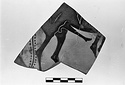
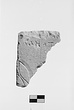
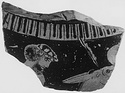
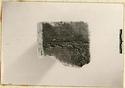
Shoulder fragment with start of neck. Grainy glaze on inside. Max. dim. 0.10.
Return of Hephaistos. The fragment shows the slightly bowed head of Hephaistos (with ivy wreath) and the upper part of the ... Ca. 440 B.C ... Return of Hephaistos. The fragment shows the slightly bowed head of Hephaistos (with ivy wreath) and the upper part of the head and neck of his mule or donkey. ... For the subject, see Brommer, Hephaistos, pp. 10--16 and 201--202 for a list of representations in Attic red figure; more recently, LIMC IV, 1988, pp. 637--645, 652--654, s.v. Hephaistos (A. Hermary); also 288. |
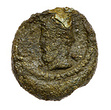
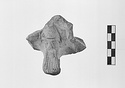
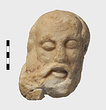
| Obverse:head of Hephaistos, left, filleted (or wearing a small close-fitting hat ?).
Border of dots.
Reverse: plain. Well, dump. 660 Leica ... May 1932 ... Obverse:head of Hephaistos, left, filleted (or wearing a small close-fitting hat ?).
|
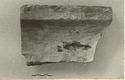
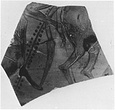
| Open shape. Two joining fragments preserve hindquarters of ithyphallic mule on which a figure is riding. Return of Hephaistos? Only feet of Hephaistos and some of leg preserved. Careful incision. Fragment ... 24 May-9 June 1954 ... Return of Hephaistos? Only feet of Hephaistos and some of leg preserved. |
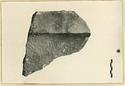
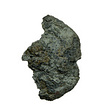
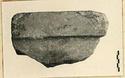
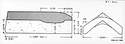
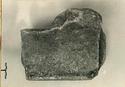
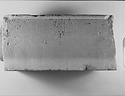
| Broken all around. Roof tile fragment with cement adhering.
Pentelic marble.
From the Temple of Hephaistos. Probably pulled out of Byzantine barrel-vault. Collected from roof of temple. Leica ... September 1974 ... From the Temple of Hephaistos. |
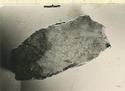
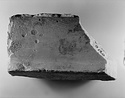
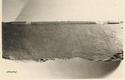
| Roof tile fragment with water curb and anathyrosis. Cement adhering.
Pentelic marble.
From the Temple of Hephaistos. Probably pulled out of Byzantine barrel-vault. Collected from roof of temple. Leica ... September 1974 ... From the Temple of Hephaistos. |
| A: head of Hephaistos, left, in pointed cap.
Uncertain objects in field left and right.
All in circle of dots.
B: Themistokles on galley.
In circle of dots. Under wall. 3986 Leica ... 27 May 1938 ... A: head of Hephaistos, left, in pointed cap.
|
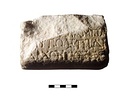
| Inscribed fragment.
Part of an incised wreath.
Above the wreath, two lines of the inscription preserved.
Hymettian marble. Found in gardening operations, south of the temple of Hephaistos. Leica, 98-54-10, ... Winter 1956-1957 ... Found in gardening operations, south of the temple of Hephaistos. |
| Eight joining fragments from upper part of body and edge of shoulder. Shoulder: lotus buds. Top of body: dots. Body: Hephaistos on a mule preceded and followed by a maenad. Branches in field. Green earth ... 21-31 March 1932 ... Body: Hephaistos on a mule preceded and followed by a maenad. |
| One lug remains.
On its inner face mask of Hephaistos (?) with conical hat.
Dull red gritty clay. Removed in 1981. Road, red sandy layer. Container 70.
Predominantly 150-100 B.C. with some Roman intrusion ... April 1934 ... On its inner face mask of Hephaistos (?) with conical hat.
|
| Broken below and at right. Very weathered and pocked. Upper left hand corner from sima of Temple of Hephaistos. Incision of palmette visible. Tenon at end missing.
Pentelic marble.
Cf. A 394, also PD ... 30 August 1972 ... Upper left hand corner from sima of Temple of Hephaistos. Incision of palmette visible. |
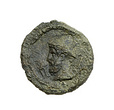
| Edge chipped.
Obverse: bearded profile head of Hephaistos, wearing pointed cap, left. Uncertain symbol in field.
Reverse: Themistokles, left, standing on a galley, holding a trophy. With coins for the ... 29 May 1936 ... Obverse: bearded profile head of Hephaistos, wearing pointed cap, left. |
| A little of under surface, and some of face preserved, with a trace of the start of the molding above.
From the Temple of Ares.
Pentelic marble.
Cf. epikranitis of the Temple of Hephaistos, H. 0.207m ... 3 May 1951 ... Cf. epikranitis of the Temple of Hephaistos, H. 0.207m. |
| Most of disk and small part of rim preserved.
On disc, chest and head of Hephaistos holding torch and hammer. On rim globule rosettes.
Attic clay darkened by fire on both sides.
First half of 3rd. century ... 11 January 1963 ... On disc, chest and head of Hephaistos holding torch and hammer. |
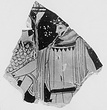
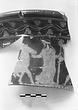
| Two non-joining fragments, the largest mended from five. From a closed pot, amphora or pelike.
a) Parts of two standing figures, left; preserved: Athena (crested helmet, scaled aegis) and Hephaistos (wreath, ... 8 August 1947 ... a) Parts of two standing figures, left; preserved: Athena (crested helmet, scaled aegis) and Hephaistos (wreath, long tunic, cloak folded over shoulders), in a chariot? Hephaistos' right arm extended as if holding the reins. |
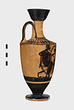
| Handle, mouth, neck, foot fragment missing.
Shoulder: strokes above lotus bud (skipping one).
Scene: Athena seated between two men holding kantharos (Dionysos and Hephaistos?).
Same hand as P 24107 (ΣΑ ... May-June 1954 ... Scene: Athena seated between two men holding kantharos (Dionysos and Hephaistos?).
Same hand as P 24107 (ΣΑ 2407); also P 24477 - P 24483 (ΣΑ 2687 - ΣΑ 2693). |
| Broken around except on top and face. Much of painted pattern preserved on hawk's beak and fascia. Doric cymation on hawk's beak, maeander on fascia.
Top picked smooth with 0.045m. relieving band.
From ... 1953 ... From Temple of Hephaistos.
Pentelic marble.
|
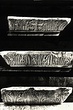
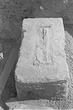
| One corner of block hacked or broken away. Two adjacent sides decorated; on one, in the center, a cross with tendrils in the angles flanked by acanthus leaves; at the corner, water leaves. On long side, ... 1961 ... Temple of Hephaistos-Inside |
| Roughhewn down to a long rectangle from an original square (?). Decorated on two adjacent sides with acanthus alternating with water leaves. Acanthus at corners. Decoration as on A 3304.
Early Christian ... 1961 ... Temple of Hephaistos-Inside |
| Fragment of a flat tile broken on two sides, preserved on one end and bottom.
Rough-picked on side along which a ridge runs. The top is smooth, but dented.
Probably from the Temple of Hephaistos (?) ... 1 April 1932 ... Probably from the Temple of Hephaistos (?).
Island (?) |
| Roof tile fragment from the Temple of Hephaistos with water-cub, anathyrosis and end of two dowel-cuttings. Anathyrosis very similar to that on sima blocks. Dowel cutting 0.063-0.074m. from edge. Cement ... September 1974 ... Roof tile fragment from the Temple of Hephaistos with water-cub, anathyrosis and end of two dowel-cuttings. |
Two non-joining wall fragments, a with start of return, unglazed on inside. Max. dim. a) 0.104, b) 0.024. LIMC IV, 1988, p. 929, no. 5, s.v. Erechtheus.
Athena and Hephaistos. Fragment a preserves Athena ... Ca. 470-460 B.C ... Athena and Hephaistos. Fragment a preserves Athena (part of high-crested helmet, aegis, left forearm with sleeve of chiton) and Hephaistos (most of wreathed head, body to hips clad in a chiton and himation, nearly all of right arm, upper part of left), each to left. ... Brommer (Hephaistos, p. 23) raises the possibility that the theme on 67 is the Birth of Erechthonios, a scene in which Hephaistos appears, but not with his double axe, an instrument better suited to the Birth of Athena. ... The best illustration of this detail is Brommer, Hephaistos, pl. 15:2.
|
| a) Broken behind and at the right end. Traces of painted palmette on concave face.
b) The right end.
Pentelic marble.
From the Temple of Hephaistos (earlier assigned to the Temple of Ares).
a) Marble ... 31 January 1935
17 March 1952 ... From the Temple of Hephaistos (earlier assigned to the Temple of Ares).
|
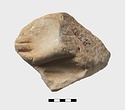
| Much weathered. Rough-picked beneath, with surface cut off by drill holes. Broken at back.
A female right foot, with drapery hanging down beside it.
Possibly a pedimental piece from the Temple of Hephaistos ... 28 April 1936 ... Possibly a pedimental piece from the Temple of Hephaistos.
Parian marble. |
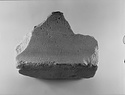
| Fragment of raking sima, broken away at upper ends, and back.
Of same scheme as A 1095 (ΚΚ 1250). Traces of half-housing joint at lower end.
Similar undercutting on underside of lower end.
Pentelic marble ... 8 June 1939 ... Found in interior of Temple of Hephaistos, to which building it probably belongs. |
| Fragment of raking sima, broken away toward upper end and close behind.
On lower end, traces of a half-housing joint. Profile and decoration as of A 1094 (ΚΚ 1249).
Curious undercutting on underside of ... 8 June 1939 ... Found in interior of Temple of Hephaistos, to which building it probably belongs. |
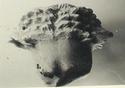
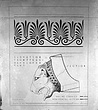
| Lower jaw and muzzle broken away and the whole head torn from the sima. Hair of crown schematically rendered by pyramidal tufts placed on checkerboard arrangement.
Assigned to either the Temple of Ares ... 5 February 1934 ... Assigned to either the Temple of Ares or the Temple of Hephaistos.
Pentelic marble. |
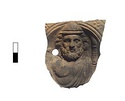
| Shoulder fragment, preserving start of neck.
Tongues below neck. Head and one shoulder of Hephaistos(?) right, riding a mule (ears, back of head and neck preserved). Ivy wreath; shortsleeved garment ... 10 February 1956 ... Head and one shoulder of Hephaistos(?) right, riding a mule (ears, back of head and neck preserved). |
Bowl fragment. Max. dim. 0.035. LIMC IV, 1988, p. 232, no. 337, s.v. Gigantes.
A, Hephaistos(?): in the Gigantomachy(?). The fragment preserves the face of a man with a very long beard, to right, with ... Ca. 490-480 B.C ... Gigantes.
A, Hephaistos(?): in the Gigantomachy(?). ... From the late 6th century on, Hephaistos fights with lumps of molten metal held in his tongs, and these lumps usually have flames. A good example, contemporary with 1424, is Hephaistos in the big Gigantomachy on Berlin 2293 by the Brygos Painter (ARV2 370, 10; Paralip. 365, 10 and 367, 10; Addenda 224). |
| Nose and mouth missing and tips of ears. Full thickness of sima preserved at back. Mane rendered on two rows of rather flat stylized tufts except over forehead where there is a third row of small tufts ... 18 April 1932 ... Assigned to either the Temple of Ares or the Temple of Hephaistos.
Pentelic marble. |
| One end is preserved, though slightly battered. At the other end the tile has been rudely cut off, probably somewhere near the middle. The underside is rough-picked, with a sort of swelling near the original ... 18 April 1934 ... From the Temple of Hephaistos.
White marble. |
| From a large open pot, glazed inside. The back end of a horse, right, followed by a maenad dancing; one leg of a nude male figure seated on the rump of the horse is preserved. Tendril in field. Return ... 6 May 1935 ... Return of Hephaistos to Olympos?
|
| Three joining fragments preserved about half the lower face of the block, with fillet, and of the coffer and coffer molding.
On one outer edge, the finished surface of a cutting.
Pentelic marble.
ADDENDA ... 8 May 1951 ... ADDENDA Originally thought to be from Roman repairs of the Temple of Ares; later assigned to the Temple of Hephaistos; however, probably not from neither of those. |
| Broken at left, and in back below. Joint preserved at right end. Very badly weathered. Trace of astragal molding along top of face.
From the Temple of Hephaistos (?).
Island marble.
ADDENDA Weathering ... July 1951 ... From the Temple of Hephaistos (?).
Island marble.
|
Wall fragment with start of rim. Narrow reserved band on inside near top. Max. dim. 0.044.
Wreathed head of man emerging from between a pair of wings. Preliminary sketch. Relief contour: profile. White ... Third quarter of the 5th century B.C ... A possibility for the figure on 346 is Hephaistos, who appears on a winged throne in the tondo of Berlin 2273 by the Ambrosios Painter (ARV2 174, 31; Addenda 184) and in the tondo of a contemporary unattributed cup, Florence 81600 (LIMC IV, 1988, p. 633, no. 44, pl. 388, s.v. Hephaistos [A. Hermary and A. |
Two non-joining fragments, P 5107 with rim and body, P 44 of wall. Reserved line on side at rim; another 0.06 below rim. Glaze misfired greenish and reddish in places. P.H. P 5107: 0.127; est. diam. at ... Ca. 430 B.C ... Thompson, Garden Lore in Ancient Athens (Agora Picture Book 8), Princeton 1963, fig. 46; LIMC IV, 1988, p. 638, no. 121, s.v. Hephaistos and p. 694, no. 314, s.v. ... Then comes Hephaistos (crown of filleted head, legs) on his donkey (foreparts), led by Dionysos, who is mostly frontal but looking back. ... Hephaistos (A. Hermary). |
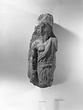
| Broken at top, bottom, sides and back.
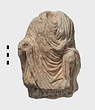
Medium relief. Draped standing male figure, perhaps Hephaistos, preserved from head to knees; left arm broken off below shoulder; face badly battered. Head apparently ... 14 May 1965 ... Draped standing male figure, perhaps Hephaistos, preserved from head to knees; left arm broken off below shoulder; face badly battered. |
| The lower part of a stele similar to I 6969.
Sunken band below 0.055m.
Hymettian marble. Found at C/18-7/5 (Fall 2016). Found at Herakleidon and Neleus Streets. Built into late wall across front of porch ... June 1958, 1963 ... On Site-S.E. of Garden of Temple of Hephaistos |
| Broken above and on one side. Some of the top surface is preserved; bolsters missing at either end. Molding at bottom.
From Sanctuary of Artemis Aristoboule.
Poros. Inventory number erased.
Not found 2016 ... June 1958, 1963 ... On Site-S.E. of Garden of Temple of Hephaistos |
| Fragment of flank sima, broken away at right end, and broken off close behind.
Cyma reversa profile with half round at top edge. A half-housing joint at the left end with a tongue. Traces of a palmette ... 8 June 1939 ... Found in interior of Temple of Hephaistos, to which building it probably belongs. |
| Fragment of raking sima, broken away at lower end. Only the curved upper part remains. Face heavily water-worn.
Of same scheme as A 1095 (ΚΚ 1250) and A 1096 (ΚΚ 1251).
Pentelic marble.
ADDENDA Line of ... 8 June 1939 ... Removed from the wall of a tomb in the west peristyle of the Temple of Hephaistos. |
| Broken from relief, somewhat battered, and the tip of the beard missing.
Bearded male head, bald in front, turned to left.
Three dowel holes in back and one in place of left ear. Outer exposed surface ... 6 May 1937 ... The head of Eurystheus from the West Frieze of the Temple of Hephaistos.
Parian marble.
|
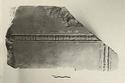
| Fragment from left side of inscribed moulded block.
Back, right and part of under surface broken. Top surface original, but not carefully finished.
The inscription is carved on the front surface (inclined ... 30 June 1931 ... Found outside the excavations at the north, on Hephaistos Street. |
| Broken off below at about knee level. Head (inset) missing. Also right hand. Battered. Stained by wall mortar.
Female figure heavily draped in chiton and himation. Her right hand was extended. Apparently ... July 1963 ... From lower foundations of building being demolished at corner of Hephaistos and Kinetou Streets. |
| Broken on right end and along inner edge.
At the left end there remains a trace of a cutting for a half-housing joint.
Cyma reversa type crowned with an ovolo molding. On the front a band of palmettes ... 1932 ... From raking side of S.W. corner sima of the Temple of Hephaistos.
Fine grained marble.
|
| Inscribed.
Found largely complete, but very much bent and chipped.
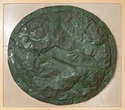
An oval shield with a narrow rim ornamented with a fine multiple guilloche pattern repousse.
The central part of the shield was apparently ... 7 February 1936 ... Filling of cistern system on Kolonos Agoraios, south of the Temple of Hephaistos.
4th c. B.C. fill. |
| a) Rib between coffer, with single astragal. Upper part broken away. Width, coffer to coffer, preserved, and height of coffer face on one side. Rabbet. Return of astragal preserved, but not intersection ... February 1953 ... From the Temple of Hephaistos.
Pentelic marble.
|
| Fragment of upper left corner remains. Excellent workmanship.
Island marble.
The three fragments A 2682, A 2683 and A 2684 may be assigned with certainty to the same roof because of their complete congruity ... 3 April 1957 ... In view of the propinquity of the finding place and the strikingly fresh condition of the fragments, they come in all likelihood from the Temple of Hephaistos. Their presence in a context of the second half of the 3rd c. |
| Heavily weathered on top. Fragment preserving one lateral edge and a little of the ridge.
Excellent work.
Island marble.
The three fragments A 2682, A 2683 and A 2684 may be assigned with certainty to ... 3 April 1957 ... In view of the propinquity of the finding place and the strikingly fresh condition of the fragments, they come in all likelihood from the Temple of Hephaistos. Their presence in a context of the second half of the 3rd c. |
| Fragment from upper end of a tile, the weathering indicates an overlap of ca. 0.045m.
Island marble.
The three fragments A 2682, A 2683 and A 2684 may be assigned with certainty to the same roof because ... 3 April 1957 ... In view of the propinquity of the finding place and the strikingly fresh condition of the fragments, they come in all likelihood from the Temple of Hephaistos. Their presence in a context of the second half of the 3rd c. |
| Mended from five pieces; part of foot missing. Flaring bell mouth with perceptible double curve; two ridges at junction of neck and shoulder; no ring above foot; rather thin disk foot.
On shoulder, rays ... 2 June 1954 ... At the center of the picture, Athena seated left; facing her, a seated male divinity (Hephaistos?); behind her, seated right but looking back, Dionysos; in front of him a dancing Satyr. |
| Corner sima, cut in one piece with the extremities of both the horizontal and raking sima. The sinking for the statue plinth has a curved outline. Beside the main sinking are two drilled hole perhaps intended ... 11 March 1937 ... Assigned to either the Temple of Ares or the Temple of Hephaistos. |
| a) Preserves the false cover tile with a weathering line showing the overlap of the last cover tile 0.04m. from edge of stop tile, which ends 0.05m. from the back of the sima. A space separates the concave ... 21 August 1969 ... and published in Koch (1955), p. 188, fig. 64 (cf. p. 66), as sima fragments from the Temple of Hephaistos, to which they do not, however, belong. |
| Part of the lip and upper wall remains, mended from several pieces. The lip band is decorated by a garland of ivy, the side wall by two zones of figures separated by a band of ovules. Of the upper zone ... 4 March 1935 ... Of the upper zone there remains, from left to right: the ribbon-bound heads of two figures moving right, one of them having negroid features; the crown of the head and the right hand of a figure waving a branch of ivy; Hephaistos(?) riding right on a mule, holding a kantharos behind him; Dionysos(?) |
Fifteen non-joining fragments of wall, P 18278 b--c and P 19582 a--d of torus rim with zone of ornament below. Glaze mottled here and there; has a greenish cast in places; abraded in part on rim. Max ... Ca. 480 B.C ... For sheer size and impressiveness, there does not seem to be another shield quite like it in the rest of the Kleophrades Painter's work, and it fulfills well the requirements for a shield crafted by Hephaistos to be given to the best of the Achaeans. |
|
|