|
|
| Roman Bath, Herulian destruction debris in A3. The high proportion of vessels for eating suggests that this was not the actual bath fill but was probably dumped in from the ruined houses higher on the ... Second half of 3rd and into 4th c. A.D ... Roman Bath, Herulian destruction debris in A3. |
Coarse sherds- Herulian destruction ... Third quarter of 3rd A.D ... Coarse sherds- Herulian destruction. |
| F4. F1. Post Hellenistic. Herulian Destruction. F5 ... ΟΟ-15 2816, 2817 ΟΟ 1061 MC 795 Lot ΟΟ 493 Lot ΟΟ 494 ... May 23 1949 ... Herulian Destruction |
3rd A.D ... South House; Dining Room; Southwest Corner; Herulian Destruction Debris |
Well at 75/Ε. Dumped debris of Herulian destruction, including much material from the first half of the 3rd c ... 3rd c. A.D ... Dumped debris of Herulian destruction, including much material from the first half of the 3rd c. |
| Raised design like two-pronged fork.
Thin colorless glass. South House, room 18, layer G. Containers 173-174.
Debris of Herulian destruction. Leica ... 30 April 1949 ... Debris of Herulian destruction. |
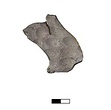
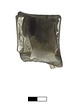
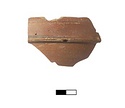
| Fragment from neck of coarse unglazed Roman amphora.
Incised outside, vertically to pot:
Reddish-brown clay. Herulian(?) destruction fill north of house F. Leica ... 7 June 1947 ... Herulian(?) destruction fill north of house F. |
| Herulian destruction debris. Deposit E 18:6. Terracotta ventilator from service area of tepidarium ... Horizontal (normal) ... Herulian destruction debris. |
| Herulian destruction debris. Deposit E 18:6. Terracotta ventilator from service area of tepidarium ... Horizontal (normal) ... Herulian destruction debris. |
| Herulian destruction debris. Deposit E 18:6. Terracotta ventilator from service area of tepidarium ... AMS Horizontal (normal) ... Herulian destruction debris. |
| Herulian destruction debris. Deposit E 18:6. Terracotta ventilator from service area of tepidarium ... AMS Horizontal (normal) ... Herulian destruction debris. |
Wall plaster fallen in Herulian destruction of house. Originally in one piece but unavoidably broken in removal. Also, iron and glass fragment from beneath. Removed May, 1949 ... 20 March 1948 ... Wall plaster fallen in Herulian destruction of house. |
a) Top fill selected; piece of water pipe [as late as early 3rd c. A.D. Herulian destruction ?]
b) Middle fill
c) Coarse selected Resorted 1997, by SIR ... A.D. Herulian destruction ?]
|
| Left side and top preserved. On sima, traces of a painted design in red and white: anthemion and leaf (?). Horos Terrace Trench, Middle: Herulian destruction level. Leica, 80-83-12 ... 20 March 1953 ... Horos Terrace Trench, Middle: Herulian destruction level. |
"Red earth": Herulian destruction debris over Roman House and east of cistern B. Coins:
30 May 1935 #1-#8
31 May 1935 #1-#15 Sherds stored in container Lot ΠΘ 4b ... 27 May 1935
31 May 1935
3 June 1935 ... "Red earth": Herulian destruction debris over Roman House and east of cistern B. |
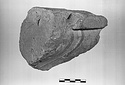
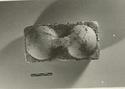
| Mastoid weight. Slightly chipped.
A small rectangular plinth with two breast-like projections connected by a handle.
Pentelic marble. Stoa, Room 2, debris layer 1. Herulian destruction fill. Leica, XVIII-26 ... 27 May 1939 ... Stoa, Room 2, debris layer 1. Herulian destruction fill. |
| F4. C11. Herulian Destruction at High Level. Marble Chip Floor. Court A2. C10. C8. Stamnos Fill. C4. C1 ... ΟΟ-10 1866, 1867 Lot ΟΟ 68 ... Herulian Destruction at High Level |
Herulian Destruction Debris in and around west end of Middle stoa and in and around Civic offices (House F) . Separated in two groups: H-I 12:1 and I 12:1. Asterisk: I 12* ... Herulian Destruction Debris in and around west end of Middle stoa and in and around Civic offices (House F) . |
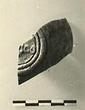
| Fragment of reverse only, with the signature in raised letters within a low double ring.
Unglazed.
Buff clay.
Type XXVII of Corinth collection.
Herulian destruction fill north of House F; as L 4268 ... 29 May 1947 ... Herulian destruction fill north of House F; as L 4268. |
| Inscribed fragment, broken from a large stele.
Part of heading and lists of names by demes preserved.
Pentelic marble. Found in northwest corner, outside Room 4 of Civic Offices, Road (level of Herulian ... 11 April 1953 ... Found in northwest corner, outside Room 4 of Civic Offices, Road (level of Herulian destruction). |
| Mastoid weight; slightly chipped.
A small rectangular plinth with two brest-like projections connected by a handle.
Pentelic marble.
Cf. ST 311 (I 1181). Stoa, Room 2, debris layer 1. Herulian destruction ... 27 May 1939 ... Stoa, Room 2, debris layer 1. Herulian destruction fill. |
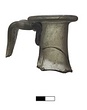
| Three joining fragments preserved medium long narrow neck with wide flat lip and upper part of broad ribbony band-handle.
Pale greenish glass. Library of Pantainos, room 2, debris layer 2. Debris of Herulian ... 1-5 June 1939 ... Debris of Herulian destruction. |
| Three fragments of a dish with a flat base and apparently a widely flaring rippled rim. Edge not preserve.
Cut pattern on outside: rows of ovals. Cut. Herulian destruction debris, burnt layer, layer 8 ... 15 March 1950 ... Cut. Herulian destruction debris, burnt layer, layer 8.
|
South House, Room 12, over pebble mosaic floor. Herulian destruction debris in a house. Coins:
29 April 1956 #1-#7
2 May 1956 #1-#3
9 May 1956 #1
26 May 1956 #1-#4
2 June 1956 #1-#4 PD 1350 ... 9 May 1956 ... South House, Room 12, over pebble mosaic floor. Herulian destruction debris in a house. |
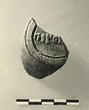
| Fragment of reverse only, with the signature in raised letters within a low ring.
Unglazed.
Pale buff clay.
Type XXVIII of Corinth collection.
Herulian destruction fill north of House F, with T 2367 ... 29 May 1947 ... Herulian destruction fill north of House F, with T 2367 (Θ 1864): mould of Athena Parthenos. |
| Fragment from back part, preserving handle and part of reverse.
At the top of the reverse, within an incised groove, the letters: "EY".
Buff clay.
Type XXVII of Corinth collection. Herulian destruction ... 29 May 1947 ... Herulian destruction fill north of House F; as L 4269. |
| Much mended and in part filled out with plaster. Flat-floored plate with flaring wall and plain rim.
Red clay and glaze.
Late Roman A Plate. S.W. House, vestibule, lying on floor; Herulian destruction ... 17 March 1958 ... House, vestibule, lying on floor; Herulian destruction. |
| Above half of the base preserved.
The center of the bottom remains, with part of a broad cylindrical base finished with a plain rolled resting edge, projecting.
Colorless glass. Building P, room 2, above ... 7 August 1947 ... Building P, room 2, above floor level.
Herulian destruction debris. |
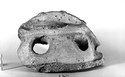
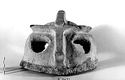
| Oval with a thick top and long ridge, partly broken. Around sides, a zone of large pierced holes. Bottom edge flat. Red clay with coarse bits.
A lantern (?). Cf. A 3671 and MC 1346 (?). Herulian destruction ... 18 March 1958 ... Herulian destruction filling. |
| From upper body, with edge of decorative band above. Head of Herakles in profile right, looking toward a snake (Hydra?) which he grasps with his outstretched hand. Vine tendrils in field.
Details in ... 4 May 1949 ... South House, Room 18, Herulian destruction fill. |
According to the excavator " a pre-herulian filling dumped in to fill the cistern some few years after the Herulian destruction". Coins:
10 June 1936 #2-#6
11 June 1936 #1-#19
12 June 1936 #23-#27 P 11936 ... A.D. 267 to mid 3rd c ... According to the excavator " a pre-herulian filling dumped in to fill the cistern some few years after the Herulian destruction". |
| Single fragment preserves neck and mouth with part of shoulder.
Tall neck spreading slightly to plain lip. Broad shoulder.
Pale greenish glass, somewhat iridescent. North-west corner of peristyle: Roman ... 7 August 1947 ... North-west corner of peristyle: Roman House B on the lower slopes of the hill of the Nymphes. Herulian destruction debris on the floor of the peristyle. |
Herulian debris over the Library of Pantainos.
(Within this area the "Sculptor's Workshop", Iota, "Stoa" Room 1 has a group number of its own for the destruction fill R 14:2)
(Note also that the "Bone ... Herulian debris over the Library of Pantainos.
(Within this area the "Sculptor's Workshop", Iota, "Stoa" Room 1 has a group number of its own for the destruction fill R 14:2)
(Note also that the "Bone Factory" in the Library, Q-R 14:1 is a later, post-Herulian deposit)
(But in general the good Herulian fills included under Q-R 13-14:1)
MC reports that in any of these rooms where she has listed "Herulian debris" the filling is all one thing. |
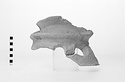
| Mold for shaggy animal, perhaps a boar (or lobster?), such as T 2401.
Two original edges preserved, broken elsewhere.
Note circular break in surface, apparently made before baking. The freshness of the ... 27 February 1953 ... Herulian destruction fill just above South Stoa floor. |
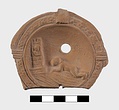
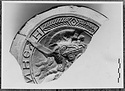
| Discus and rim only preserved.
Rim, panels and globule rosettes.
Discus, at left a tower out of which Hero leans; at right Leander, nude, swimming on top of the sea.
Unglazed.
Light red to orange clay ... 30 June 1947 ... Late Roman fill above House F. Herulian destruction fill. |
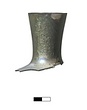
| Round concave bottom and lower part of plump body in one piece.
Ring foot.
Many shattered fragments (30) including some shoulder pieces decorated with very thin ridges belong together.
Thin colorless ... 4 July 1951 ... Herulian destruction fill. |
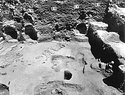
| House F; Room 2. Roman Bath. Polygonal Limestone Wall used with Marble Dust. Building A. Herulian Destruction. House F; Room 4. Wall 2. Wall 2'. House F; Room 1. House F; Room 6. Wall 6 ... ΟΟ-12 2220, 2221 ΟΟ:1949.0331:13 N 47635 ΟΟ:1949.0331:14 N 47636 ΟΟ:1949.0331:15 ΟΟ:1949.0331:16 N 47637 ... 31 Mar 1949 ... Herulian Destruction |
| Handle and attached section of neck preserved.
Straight neck, flat wide ribbon-like handle attached at shoulder and neck below lip.
Pale greenish glass. Well. Post-Herulian fill to bottom. Destruction ... 7-10 July 1947 ... Post-Herulian fill to bottom. Destruction debris.
4th-5th c. |
| Rim sherd of a flanged bowl with part of wall.
Shape is a derivative of conspectus form 34 in Italian Sigillata or of Hayes, form 3 in (later) Çanderli Ware.
Fabric comparable to that of Corinthian molded ... 2-4, 18-24 May 1939 ... Context- pre 267-268 A.D. (Herulian destruction) ... Library destruction fills and Valerian Wall footing trench. |
| Fragment from the shoulder of a small amphora or pitcher; all edges broken.
Letters in dark gray:
Very pale sandy buff clay unglazed. Between stroses Β and Γ, in destruction fill (Herulian?) over North ... 19 March 1938 ... Between stroses Β and Γ, in destruction fill (Herulian?) |
Burned filling over area of NW Temple (apparently Herulian destruction debris) = Trench I, 18-22/ΛΑ-ΜΣΤ and northwest trench, center at 15-19/ΛΣΤ-Μ Coins:
28 March 1933 #25-#28
29 March 1933 #16-#21
30 ... 28-30 March 1933
5-6 April 1933 ... Burned filling over area of NW Temple (apparently Herulian destruction debris) = Trench I, 18-22/ΛΑ-ΜΣΤ and northwest trench, center at 15-19/ΛΣΤ-Μ |
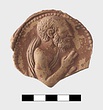
| Broken all around.
Medallion almost complete: within border of dots, the upper part of a bearded figure, right, wearing a himation leaving the right shoulder free; right arm bent at elbow, hand raised ... 16 May 1952 ... Hellenistic Branch of Great Drain, ca. 84-85 lines, Herulian destruction fill. |
| Three joining fragments preserve rather less than half of a circular mold with low rim: a mold for plaque.
Athena Parthenos, her helmet with crest, sphinx, pegasi and cheek pieces and the hair at the back ... 29 May 1947 ... Herulian (?) destruction fill, north of house F. |
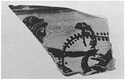
| Female head with very high headdress rendered in gouged style; the eyes pierced, and the headdress at the top, as if for suspension.
Mended from several pieces; lower part of face; upper part of headdress ... 1 July 1947 ... Building C, Room 4; burned fill under stamnos wall. Herulian destruction debris over a Roman house to the west of the Areopagus. |
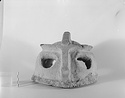
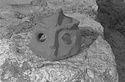
| Back and edges broken away. Helmet shaped terracotta object with six holes around sides. Nosepiece indicated in solid clay, also crest, decorated with four low bosses. Edge broken away in a manner suggesting ... July 1968 ... Cf. another somewhat similar, A 2715 from Herulian context but with helmet-like aspect less emphasized. ... Roman Bath. Herulian destruction debris in A 3. |
| South House; Room 18; Destruction Debris on Floor Level. South House; Room 18; Cut beneath Floor; Southeast Corner. South House; Dining Room; Southwest Corner; Herulian Destruction Debris. North House; ... ΠΠ-6 1044, 1045 ΠΠ 780 P 20035 Lot ΠΠ 174 Lot ΠΠ 175 Lot ΠΠ 176 Lot ΠΠ 177 Lot ΠΠ 178 Lot ΠΠ 179 ... 3rd A.D ... South House; Room 18; Destruction Debris on Floor Level ... South House; Dining Room; Southwest Corner; Herulian Destruction Debris ... North House; Room 4 (Mosaic Room); Cut along South Edge of Mosaic; Destruction Debris Used to Level Area for Building |
| Four joining fragments and one non-joining from a broad, thick overhanging rim,
which is grooved at one point to form a shallow spout, or pour-channel. A large basin with flaring walls.
Coarse red clay ... 17 March 1938 ... In Herulian destruction fill over north stoa, between stroses Β and Γ and lying on blocks of stoa. |
| Head of dog.
Broken at the neck and in back, and the ears chipped.
Heavy fur indicated by a lumpy surface at the back and sides.
Mould-made, hollow, with a join across the ears.
Pinkish buff clay, perhaps ... 3 May 1933 ... Trench II, red earth. Destruction debris, Herulian or later, over S.W. temple. |
| The face, and the hair on the right side, and the finished lower edge of a tragic mask preserved.
Mostly open behind: the plain back turns in sharply where it joins the moulded hair, and then out again, ... 3 May 1933 ... Trench II, red earth. Destruction debris, Herulian or later, over S.W. temple. |
| House B; Brown Destruction Fill. House B; Destruction Fill. Byzantine House III; Destruction Fill. Byzantine House III; Loose Fill. Late Roman Water Channel; To West of Channel; Layer I. Late Roman Water ... ΝΝ-43 Lot ΝΝ 179 Lot ΝΝ 180 Lot ΝΝ 181 Lot ΝΝ 182 Lot ΝΝ 183 Lot ΝΝ 184 Lot ΝΝ 185 Lot ΝΝ 186 ... 15th A.D. |
| "Koumanoudes' Well.
Tile-lined well (diam. 0.85m) at SE corner of courtyard of Roman House E, at top built wall of stones and mortar, bedrock at bottom. Coin
7 August 1971 #495-#500
13 August 1971 #507 ... 28 July-6 August 1971 ... Layer 2: 13.20-15.05 Destruction (Herulian) debris, plaster, revetment, bones, horns. |
Fillings associated with early houses on the lower north slopes of the Areopagus; various levels and dates.
Both houses were built in the 6th century B.C. and destroyed by the Persians; both also have ... 6rd c. B.C.-3rd c. A.D ... The latest period of the house is the Herulian destruction.
|
Soft Trench behind Stoa Stylobate, opposite Piers 21 and 22, along W face of Shop front wall. Herulian destruction debris at the north end of the Stoa of Attalos. Coins:
20 February 1954 #1-#2
22 February ... Late 3rd c. A.D ... Soft Trench behind Stoa Stylobate, opposite Piers 21 and 22, along W face of Shop front wall. Herulian destruction debris at the north end of the Stoa of Attalos. |
| Section Υ: 1958 Excavation Report ... Dorothy Burr Thompson ... Two areas at the north foot of the Areopagus were uncovered. The first area did not yield much of interest due to modern disturbances. Excavations of a well, three pits and a water channel produced however ... 3 Mar-3 May 1958 ... The water channel probably went out of use after the Herulian destruction.
|
| Road Test; Layer V. Road Test; Layer VI. Road Test; Layer VII. Road Test; Layer VIII; Below Road to Stereo. Road Test; Soft Brown in Footing Trench of Poros Wall; House T. Roman Bath; Well; Destruction ... ΝΝ-44 ΝΝ 4868 P 19815 Lot ΝΝ 804 Lot ΝΝ 805 Lot ΝΝ 806 Lot ΝΝ 807 Lot ΝΝ 808 Lot ΝΝ 809 Lot ΝΝ 810 Lot ΝΝ 811 Lot ΝΝ 812 Lot ΝΝ 813 ... Late 6th-Early 5th B.C ... 3rd A.D. Herulian Destruction |
| To south of Drain A; Loose Red to Strosis; Possibly Fill from Early Channel; Disturbed. House B; Fill over Floor. House E: Rooms 1 and 2. Loose Red Fill to Floors. House H; Room 1; Northeast Corner; Destruction ... ΝΝ-43 ΝΝ 2033 T 2260 Lot ΝΝ 83 Lot ΝΝ 73 Lot ΝΝ 84 Lot ΝΝ 85 Lot ΝΝ 86 Lot ΝΝ 87 Lot ΝΝ 88 ... 400 B.C. |
| Index. General Index. A-. Athena. Abaskantos. Achilles. Athens. Athena Promachos. Shrine of Demos and the Graces. Aegean area. Dipoleia. Africa. Hephaisteion cult statue. Agapios. Herulian destruction ... Agora 7 229 N 19:1 D 4:1 P 8:1 C 12:1 Q 15:1 F 19:1 M 17:1 ... Herulian destruction |
| Late Roman Water Channel; East Side; Over Wall; Destruction Fill with Tiles and Mortar. Late Roman Water Channel; Over Water Channel and Drain; Brown Fill and Red Mixed Fill. Late Roman Water Channel; ... ΝΝ-43 ΝΝ 2037 P 17005 Lot ΝΝ 150 Lot ΝΝ 151 Lot ΝΝ 152 Lot ΝΝ 153 Lot ΝΝ 154 Lot ΝΝ 155 Lot ΝΝ 156 ... Late Roman |
| House A; Room 1; Fill over Floor. House A; Room 2; Brown Fill over Marble Chip Floor. Drain A to S; Loose Red to Strosis; Possible Fill from Early Channel; Disturbed. House B; Fill over Floor. House E: ... ΝΝ-44 Lot ΝΝ 81 Lot ΝΝ 82 Lot ΝΝ 83 Lot ΝΝ 73 Lot ΝΝ 84 Lot ΝΝ 85 Lot ΝΝ 86 Lot ΝΝ 87 ... Late Roman |
| Herulian Debris in a house on the lower slopes of the Hill of the Nymphs: House P = South House; Room 2 = Dining Room; Room 3 = Kitchen; Room 18; Room 23; Room 24. Coins:
9 August 1947 #1-#37, #47-#49 ... Mid 3rd c. A.D ... Herulian Debris in a house on the lower slopes of the Hill of the Nymphs: House P = South House; Room 2 = Dining Room; Room 3 = Kitchen; Room 18; Room 23; Room 24 ... The destruction debris from some of the rooms of this house was originally indexed separately, but after it became clear that the filling is one and the same they were combined under a single group number. |
| Demeter, temenos of, at Knidos. Graindor. Demos and the Graces, shrine of. Gray ware lamps. Deposits, Index of. Greek lamps. Dio Chrysostom. Dionydia. Dionysia. Hadrian. Dionysius. Handle shields. Dipoleia ... Agora 7 231 M 17:1 R 10:1 D 11:1 J 18:2 D 4:1 O 17:1 N 17:2 N 19:1 B 21:1 G 8:1 N 19:2 O 18:3 R 13:1 B 14:2 E 14:7 Q 13:1 S 21:3 K 18:1 C 8:2 F 11:1 F 13:2 K 9-10:1 Q 17:4 ... Herulian destruction |
| Post-Sullan Drain; 109-120; Sand Fill. Between Drains; 85-88; Brown Roman Fill. Between Drains; 85-88; Brown Fill over Bedrock. Tank III; North Side; Destruction Fill in Trench of North Wall. Behind Miniature ... ΝΝ-43 ΝΝ 2299 P 17405 Lot ΝΝ 290 Lot ΝΝ 291 Lot ΝΝ 292 Lot ΝΝ 293 Lot ΝΝ 294 Lot ΝΝ 295 Lot ΝΝ 296 Lot ΝΝ 297 ... 1st B.C. |
| Byzantine House III; Destruction Fill. Late Roman Water Channel; To West of Channel; Layer 1. Late Roman Water Channel; To West of Channel; Layer 2. Late Roman Water Channel; To West of Channel; Layer ... ΝΝ-44 Lot ΝΝ 182 Lot ΝΝ 183 Lot ΝΝ 184 Lot ΝΝ 185 Lot ΝΝ 186 Lot ΝΝ 187 Lot ΝΝ 188 Lot ΝΝ 189 Lot ΝΝ 190 ... Early Byzantine |
Debris, Room I of Street Stoa (R/16,20-13/10,15).
The lack of any rooftiles and similar architectural debris suggests that perhaps it was brought in from an adjacent area and dumped in the room. This is ... 6-8 May 1975 ... One would be that after the Herulian sack the upper walls were so badly damaged that it proved easier to cut down the floor level rather than rebuild the walls (cf. refurbishing of the Metroon). Another possible explanation is that the room was quarried for clean bedrock fill (perhaps by the builders of the Late Roman Building to the east), with the resultant filling of the room with destruction debris from Alaric's attack on the city, perhaps taken from the same area where the bedrock fill was to be used (cf. east, in Room 1 and the south half of Room 2. |
| West Terrace; Between Retaining Walls at West; Layer 7. West Terrace; North End. Layer IV; Kalikia. West Terrace; Brown Gravelly Fill to Floor. Late Roman Water Channel; Fill in Channel. Late Roman Water ... ΝΝ-44 Lot ΝΝ 146 Lot ΝΝ 147 Lot ΝΝ 148 Lot ΝΝ 15 Lot ΝΝ 154 ... 3rd B.C. |
| Middle Terrace; Brown Gravelly Fill with Tiles along Bedrock Cutting; East Side. Grave XXI: Fill Over and In Upper Part of Grave. Middle Terrace; Behind Wall A and over Wall B; Gravel and Kalikia Fill ... ΝΝ-44 ΝΝ 2043 P 17011 Lot ΝΝ 130 Lot ΝΝ 13 Lot ΝΝ 198 Lot ΝΝ 132 Lot ΝΝ 133 Lot ΝΝ 134 Lot ΝΝ 135 Lot ΝΝ 136 Lot ΝΝ 137 ... 1st B.C. |
| Frantz, M. A ... American School of Classical Studies at Athens ... This book collects for the first time the archaeological and historical evidence for the area of the Athenian Agora in late antiquity, a period which spans the last flourishing of the great philosophical ... 1988 ... The course of Athenian construction and destruction is traced from the mid-3rd century, through the Herulian invasion, to the period of recovery in the 3rd and 4th centuries (ending with the invasion of the Visigoth, Alaric, in A.D. 396). |
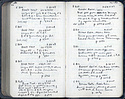
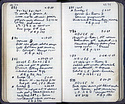
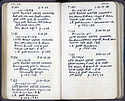
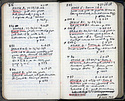
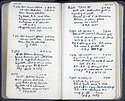
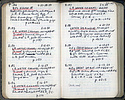
| Extract from notebook ΠΘ XIX, pp. 3644-3646. Well at 105/ΝΗ (report on sorting of pottery, July 19, 1951 - H.S. Robinson).
"Not a useful well" HSR.
Well dug to 1.50m., vi/9/36; dug from 1.50m. to bottom ... Early Roman; use fillings of 2nd. c. B.C. and 1st. and 4th. c. A.D.; dumped filling of late 4th. c. (HSR)
Fill I: 2nd. c. B.C.
Fill II-V: to second half of 4th. c. A.D.
Fill VI: mixed to Byzantine ... For perhaps two centuries thereafter the well must have been out of regular use; cont. 4 (ca. 21.30m.) probably dates from this period and contains predominantly pre-herulian wares: wheel-ridged mugs and pitchers, type XXVII lamp frag. ... One coin (iv/9/37 #1) of Constantine II (323-361 A.D.) suggests a late 4th cent. date for this destruction fill. The top 1.50m. of fill contained mixed sherds with some Byzantine. |
| The Athenian Agora; Volume 24; Late Antiquity A.D. 267-700; Table of Contents. The Athenian Agora; Volume 24; Late Antiquity A.D. 267-700; Table of Contents; Preface. The Athenian Agora; Volume 24; Late ... Agora 24 xi ... The Athenian Agora; Volume 24; Late Antiquity A.D. 267-700; Table of Contents; Invasions and their Aftermath; The Herulian Invasion ... The Athenian Agora; Volume 24; Late Antiquity A.D. 267-700; Table of Contents; The Post Herulian Wall ... The Athenian Agora; Volume 24; Late Antiquity A.D. 267-700; Table of Contents; Recovery; Post Herulian Athens A.D. 267-300 |
http://agathe.gr/publications/monographs.html Monographs Excavations in the civic and cultural center of classical Athens began in 1931 and have continued almost without interruption to the present day. The first Athenian Agora volumes presenting ... The course of Athenian construction and destruction is traced from the mid-3rd century, through the Herulian invasion, to the period of recovery in the 3rd and 4th centuries (ending with the invasion of the Visigoth, Alaric, in A.D. 396). ... These fine wares, like the other table wares of the first seven centuries A.D. discussed here, were all imported—a very different situation to earlier periods where Athens was known as a great ceramic-making center, and perhaps the result of mass destruction of potters’ workshops during the Sullan sack of 86 B.C. |
|
|

.jpg.icon.jpg)

.jpg.icon.jpg)





.jpg.icon.jpg)


.jpg.icon.jpg)


.png.icon.jpg)
.png.icon.jpg)

.png.icon.jpg)