|
|
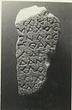
| Inscribed fragment.
Broken on all sides.
The inscribed surface slightly convex.
Nine lines of the inscription preserved.
Pentelic marble.
ADDENDA Joins with I 1362. Found in late context, in the square ... 180-192 A.D ... Hesperia 11 (1942), p. 58, no. 25. |
| Fragment of unfluted column drum.
A flake from the side of an unfluted column drum, the surface of which shows the marks of a fine toothed chisel.
Fifteen lines of the inscription preserved.
Note erasures ... 180-192 A.D ... Hesperia 11 (1942), p. 58, no. 25. |
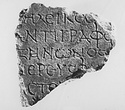
| Inscribed fragment.
Broken on all sides.
Prytany list of officers.
Five lines of the inscription preserved.
Hymettian marble. Found in late context, in the square to the south of the New Bouleuterion ... End of 2nd. century A.D ... Hesperia 11 (1942), p. 58, no. 24 ... Agora III, no. 123, p. 58. |
| Fragment of stele inscribed on three sides.
The back of the stone has been cut down, or broken off; a deep narrow band is cut down each side, leaving the central mass projecrting. Broken at top and bottom ... 200-230 A.D. |
|
|