|
|
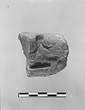
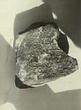
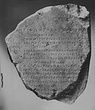
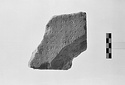
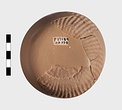
| First interpretation: Mold signed fragment.
Broken at left and chipped along outer edge at top.
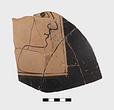
Preserved is a male figure, bearded and partly draped, reclining on a couch and playing the double flutes, ... 27 March 1939 |
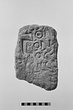
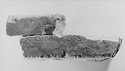
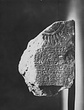
| Inscribed stele.
The stele complete except for a chip from upper left corner.
Inscribed in a single line.
Hymettian marble. Found in the wall of the modern house 635/7, at the south of the Southwest Fountain ... Ca. 100 B.C. |
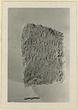
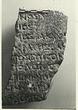
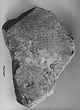
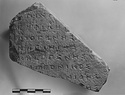
| Inscribed fragment of early Christian epitaph.
Inscribed face only preserved.
Christian grave stone with part of preserved cross in upper left corner.
Four lines of the inscription preserved.
Hymettian ... 15 December 1937 ... Sironen (1997), p. 190, no. 127 ... Hesperia 16 (1947), p. 41, no. 11 ... Agora XVII, no. 1072, p. 190, pl. 84. |
| Inscribed fragment of early Christian epitaph.
Broken away at top, bottom and back.
Four lines of the inscription preserved.
Hymettian marble. Found in a wall of the modern house 647/9 west of the Panathenaic ... 1 October 1937 |
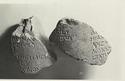
| Inscribed fragments from a round monument.
Fragments Β 200a (a) and B 200b (b), broken all around.
The inscribed surface convex.
Fragment Β 259 (c), broken all around.
Part of four lines of the inscription ... Ca. 180 A.D. |
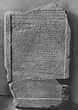
| Inscribed stele.
Broken to right and behind. The top slants downward toward back.
Below the smoothed upper part is a large rough setting tongue.
One line of the inscription remains.
Hymettian marble. Found ... 1st. century B.C. |
| Inscribed fragment of Prytany dedication.
Broken on all sides.
The inscribed surface is convex; four lines of the inscription preserved.
Hymettian marble.
ADDENDA With I 1435 (B 200). Found in late context, ... Ca. 180 A.D. |
| Inscribed fragment.
Broken on all sides.
Part of twelve lines of the inscription preserved.
Hymettian marble. Found in late context, south of the New Bouleuterion. Leica ... Ca. 175 A.D. |
| Inscribed fragment.
Broken all round.
Parts of nine lines of the inscription preserved.
Pentelic marble.
ADDENDA Joins with I 685 and I 1883; with I 91.
Cf. Hesperia 16 (1947), p. 176, no. 78. Found in ... 150-190 A.D ... Hesperia 16 (1947), p. 176, no. 78 ... Hesperia 11 (1942), p. 56, no. 22 ... Agora XV, no. 384, p. 279. |
| Fragments of inscription.
Fragment Β 28 a), broken above and both sides
On the front of the bottom, below the inscribed surface a moulding.
Part of one line of the inscription preserved.
b), another ... a) (Β 28) 18 October 1933
b) 24 December 1934 |
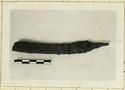
| Long flat blade, pointed at one end, broken at the other; the preserved end intended to be set into a handle.
Cf. Hesperia 16 (1947), p. 197. Grave 20. Leica, 7-423 ... 13 April 1935 |
| Inscribed fragment.
Part of smooth left side preserved; elsewhere broken.
Three lines of the inscription preserved, and bits of two letters in a fourth line below.
Pentelic marble.
ADDENDA Joins with ... Ca. 200 A.D. or later ... Hesperia 16 (1947), p. 183, no. 88 ... Hesperia 11 (1942), p. 40, no. 10 ... Agora XV, no. 481, p. 333. |
| Inscribed stele.
Mended from three pieces; broken away at the top, but the first line of letters preserved. A raised band surrounds the inscribed part at the bottom and sides. Back and bottom rough picked; ... Ca. 180 A.D ... Coarse grained white marble.
Cf. Hesperia 11 (1942), p. 302, no. 61.
Hesperia 16 (1947), p. 178, no. 79.
Hesperia 23 (1954), p. 245, no. 20. |
| Fragment of inscribed stele.
Broken away above, below, and at left. Part of right side preserved, worked with toothed chisel. Back rough, with long drilled grooves.
Seventeen lines of the inscription preserved ... Ca. mid. 3rd. century B.C. |
| Inscribed fragment of early Christian Epitaph.
Back and front faces preserved; one edge curving rough; other edges broken.
Pentelic marble. Found at a late Roman level in front of Bouleuterion Propylon, ... 10 June 1931 |
| Fragments from a relief plaque reused for an inscription.
Fragments Κ 480a (a) and Κ 480b (b), broken at top, bottom, and sides. The second is stained black from the cesspool beneath which it was found ... 165/6 A.D., and ca. 180 A.D. |
| Inscribed fragment.
Part of columnar monument, inscribed face only preserved.
Eight lines of the inscription preserved, and a ninth to left below.
Pentelic marble.
Cf. Hesperia 16 (1947), p. 183, no ... End of 2nd. century A.D ... Hesperia 16 (1947), p. 183, no. 87 ... Hesperia 11 (1942), p. 57, no. 23 ... Agora III, no. 123, p. 58. |
| Fragment from left side (?) of inscription.
Back rough picked.
Otherwise only inscribed surface preserved, which however gives the left margin of inscription. The third line is apparently a later interpolation ... 2nd. century A.D. |
| A knife-like object, broken in two parts;
strengthened with plaster.
Cf. Hesperia 16 (1947), pp. 196-197, pl. XLI, 1-2, fig. 1. Grave 7, lying under the upper left arm of the skeleton. Leica, 7-423 ... 28 February 1935 |
| Inscribed fragment of early Christian epitaph.
Top preserved, and about one fourth of circumference.
Three lines of the inscription preserved on one side, two lines on other.
Hymettian marble. Found in ... January 1937 |
| Fragment of inscription.
Part of the smooth right side preserved; otherwise broken.
Possibly a decree of a deme or tribe.
Ten lines of the inscription preserved; stoichedon.
Pentelic marble.
ADDENDA From ... End of 4th. century B.C. |
| Inscribed fragment of grave stele.
Inscribed face and part of rough picked back only preserved.
Stone with a list of names probably of those who fell in some campaign.
Sixteen lines of the inscription ... Ca. 450 B.C ... Hesperia 33 (1964), p. 21, no. 4, pl. 2 ... Hesperia 17 (1948), p. 45, no. 37 ... Hesperia 16 (1947), p. 208. |
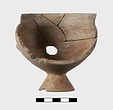
| The handle and about half the body restored in plaster. Conical base; rounded body; rim slightly inset; one vertical band handle. Round hole cut through body (after firing?) at about level of lower handle ... July 1946 |
| Fragment from an inscribed stele.
Edges broken; back, rough picked, preserved, worked smooth to within ca. 0.10m. of the present bottom of the stone, where a boss-like mass, rough picked, projects.
Seventeen ... Late 3rd. or early 2nd. centuries B.C ... Hesperia 16 (1947), nos. 62, 94 ... Hesperia 40 (1971), p. 63, nos. 3, 11 ... Hesperia 3 (1934), p. 12, no. 16. |
| Inscribed fragments.
Fragment Β 181a (a), preserves part of the smooth left side, and the bottom (?).
Fragment Β 181b (b), has part of the left side; otherwise broken.
Hymettian marble. a) (Β 181a) 10/ΚΒ ... 3rd. century B.C. |
| About half missing; restored in plaster. Flat-bottomed bowl with nearly straight side walls, plain rim and no handles. Made by pressing clay into a basket, of which the impression is left on the outside ... 8 June 1946 |
| Three pieces, put together with plaster, from rim, neck and shoulder of a pot with stepped rim and thin glaze wash inside: probably a wide-mouthed amphora. Good black glaze overall; on the shoulder, a ... July 1946 |
| Fragment Θ 26 a), from right side of inscribed block; fine picked on one side, rough picked on the back.
Fragment Κ 115 b), back and left side preserved. Fifteen lines of the inscription preserved.
Fragment ... 127/6 B.C. |
|
|