|
|
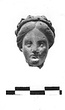
| The hair is parted in the middle and drawn down over the ears. The head is crowned by a narrow fillet backed by a wreath of small overlapping leaves.
Broken off at the top of the neck. Small chips missing ... 24 July 1947 ... Hesperia 17 (1948), pl. |
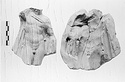
| Standing figure, perhaps a warrior, the right leg advanced, the right arm raised high above his head; a cloak hangs behind him, and a narrow fold of drapery passes across his chest from the right shoulder ... 29 July 1947 ... Hesperia 17 (1948), pl. |
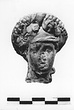
| Male head with a heavy rolled crown worn over a wreath and fillet.
Broken off at neck.
Traces of white.
Greenish-buff clay. Brown Byzantine fill. 3967 Leica, XXIX-36 ... 5 April 1947 ... Hesperia 17 (1948), pl. |
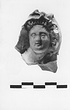
| Head and part of shoulder of a woman, her cloak drawn up loosely over her hair.
No traces of color.
Perhaps from plastic pot (or a study piece).
Pale buff clay.
ADDENDA C. Grandjouan, 1961: Probably ... 16 April 1947 ... Hesperia 17 (1948), pl. |
Fragment of inscribed grave monument.
Bottom preserved; elsewhere broken away.
The inscription on two taeniae, six letters on the upper, and the tops of five on the lower.
Pentelic marble.
ADDENDA Joins ... 28 September 1934 ... Hesperia 17 (1948), p. 48, no. 45. |
Inscribed fragment.
Part of smooth left side preserved.
Seven lines of the inscription preserved.
Pentelic marble.
ADDENDA Belongs to IG II2, no. 1771. Found in wall of the modern house 649/5 southeast ... 138/9-150/1 A.D ... Hesperia 17 (1948), p. 37, no. 22. |
Inscribed fragment.
Inscribed face only preserved.
Six lines of the inscription preserved.
Hymettian marble.
ADDENDA With I 6676. Found in early to late Roman context, west of the west end of the Middle ... ca. 190 B.C ... Hesperia 47 (1978), pp. 260 ff ... Hesperia 17 (1948), p. 17, no. 8. |
| A thin almost circular piece of gold leaf, the edges turned in underneath, as if it had once covered a button.
Probably rivet from bronze sword (B 779). Πέντε χρυσές επενδύσεις κεφαλών ήλων σπάθης. Three ... 2 May 1947 ... Hesperia 17 (1948), pl. ... Agora XIII, pp. 175-176, pl. 36, no. III 17. |
| Inscribed fragment of statue base.
The block has been re-cut for one or more reuses.
Bottom and top are probably the original surfaces; bit of original right edge preserved at front of right side. Rough ... Ca. 403 B.C ... Hesperia 17 (1948), p. 38, no. 24. |
| Inscribed fragments.
Large relief shield commemorating victories.
Sepulchral monument (?).
Fragment Ο 116 a), from a circular monument, perhaps an altar. Broken all around.
Two slightly convex surfaces, ... a) (Ο 116) 25 January 1935
b) (ΣΑ 7) February 1936
c) (Τ 256) 5 March 1936 ... Hesperia 17 (1948), p. 43, no. 35. |
| Inscribed fragment.
Inscribed face only preserved.
Victories.
The inscribed surface convex. Below the inscription a formal pattern in low relief.
Pentelic marble.
ADDENDA Another fragment, found later, ... 6 February 1935 ... Hesperia 17 (1948), p. 43, no. 35. |
| Fragment of dedicatory monument.
Inscribed face only preserved. Part of a cable ornament preserved above.
Victories.
Two letters remain.
Pentelic marble.
ADDENDA With I 2210.
Stored with I 2343. Found ... 9 February 1935 ... Hesperia 17 (1948), p. 43, no. 35. |
| Inscribed fragment.
Broken all around.
Dedicatory monument.
Relief decoration below the inscription.
Pentelic marble.
ADDENDA Same or similar as I 2343, I 2393, I 2399, I 2717, I 2564. Stored with I 2343 ... 23 November 1934 ... Hesperia 17 (1948), p. 43, no. 35. |
| Broken at back and at right side.
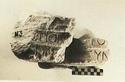
On the base of the sima an elaborate curving floral pattern in high relief, below, on the flat fascia, a maeander in red glaze. On soffit, a bead and reel in red. Red ... 10 March 1938 ... Hesperia 17 (1948), pl. 38.2. |
| Inscribed fragment.
Inscribed face only preserved.
On a large shield (?) in low relief: "H".
Pentelic marble.
ADDENDA With I 2210; similar to I 2343. Found in marble dump, in the area of the southeast ... 4 March 1935 ... Hesperia 17 (1948), p. 43, no. 35. |
| Inscribed.
Sack-sahped pot on a low raised bae, the rim flaring, but here chipped and betn.
Letters in relief, incised in the mold : ΑΡΤΕΜΙΔΩΡΟΥ
ΛΥΚΙΟΝ
Μολύβδινο ενεπίγραφο, φαρμακευτικό αγγείο. Great ... 31 July 1947 ... Hesperia 17 (1948), pl. |
Inscribed fragment.
Broken behind, above and at right.
Left end and bottom dressed with toothed chisel. At back, the corner of a large rectangular cutting for insertion of a votive offering; the cutting ... 5th. century B.C ... Hesperia 17 (1948), p. 38, no. 23. |
| The handle missing at one side, and the end of the spouted mouth; also many small body fragments and chips; the pot warped and the fabric flaky. Low ring foot. Groups of bands around foot; around widest ... 5 June 1947 ... Hesperia 17 (1948), pl. |
Complete except for chip from spout and one body fragment. Squat body, shallow convex on bottom, slightly pointed toward top. Diagonally upwards pointed spout; strap handle. On the lower part the thin ... 5 June 1947 ... Hesperia 17 (1948), pl. |
One handle and small body fragments missing. Low ring foot. Solid glaze, and bands, above foot; bands around shoulder, at neck and below handles; on shoulder, groups of vertical strokes between the handles ... 5 June 1947 ... Hesperia 17 (1948), pl. |
Body fragments, most of the rim, and one handle missing. Plain rim; small flattened bottom. Band handles, shoulder to rim.
Coarse purplish-gray clay with large black and white grits; unglazed. No. 4 ... 5 June 1947 ... Hesperia 17 (1948), pl. |
Complete except for minor chips from mouth and neck. Convex bottom and rounded body; plain flaring rim and round mouth; two vertical band handles, shoulder to rim.
Buff clay, rather coarse and slightly ... 5 June 1947 ... Hesperia 17 (1948), pl. |
| Inscribed fragment.
Fragment of a roof-tile (cover tile) reused for the purpose of the inscription.
Part of one end of the tile is preserved.
Two lines of the inscription preserved.
Pentelic marble. Found ... 5th. century B.C ... Hesperia 17 (1948), pl. |
| Draped female figure wearing a peaked cap with long lappets, over long curling hair; earrings. The lappets stand out from the shoulders. They were added separately by hand after the figure was moulded ... 21 July 1947 ... Hesperia 34 (1965), p. 61 ... Hesperia 17 (1948), p. 181, pl. |
| The nose and lower jaw broken away and it is otherwise much battered. The sima is broken close all around.
Vigorously modeled in style of late fourth century B.C.
The inner core is made of pale yellow ... 1938 ... Hesperia 17 (1948), pl. 38.2. |
| From the floor of a kylix. Part of the reserved ring bordering the medallion remains. Head of a silen, right, a wreath hooked over the tip of his horse's ear.
In the field above, the letter Κ.
Purple ... 24 July 1947 ... Hesperia 17 (1948), pl. 68:1. |
| Preserved is the head of Athena Parthenos in relief left; broken off at neck, the nose chipped, and most of the crest of the helmet missing.
The face is carefully modelled, the iris and pupil of the eye ... 24 April 1939 ... Hesperia 17 (1948), pl. |
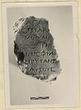
| Inscribed fragment.
Inscribed face only preserved.
Five lines of the inscription preserved.
Pentelic marble.
ADDENDA Belongs with I 3319, I 1367, and IG II2, no. 766. Found in modern wall, in the area ... 244/3 B.C ... Hesperia 57 (1988), pp. 317-318, pl. 87 e ... Hesperia 17 (1948), p. 5. |
Inscribed columnar grave monument.
Full height preserved, but much worn and battered.
Three lines of the inscription preserved.
Hymettian marble. Found in a wall of the Byzantine House III west of the ... 30 April 1947 ... Hesperia 17 (1948), p. 49, no. 48. |
Inscribed fragment of dedication base.
Inscribed face only preserved.
Two lines of the inscription preserved.
Hymettian marble.
Roman Imperial period. Found in modern context in the house 639/15, south ... 15 February 1947 ... Hesperia 17 (1948), p. 46, no. 38. |
| The hair is drawn down in loose waves to the nape, and is crowned by a heavy rolled wreath. The head is bent slightly to her left; she wears earrings (one missing).
A few flecks of white remain.
Brownish-yellow ... 22 July 1947 ... Hesperia 17 (1948), p. 181, pl. |
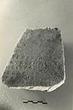
| Fragment of inscribed block.
Bottom preserved; elsewhere broken away.
Surface weathered.
Pentelic marble. Found in a marble dump, in the western part of the Market Square. Leica, XXXI-30 ... 2nd. century A.D ... Hesperia 17 (1948), p. 42, no. 32. |
| Inscribed fragment of grave stele.
Broken on all sides.
On the front, projecting mouldings at the top; two flat fasciae below.
Pentelic marble. Found in the wall of the modern house 637/3, east of the ... 2nd. century A.D ... Hesperia 17 (1948), p. 50, no. 54. |
| Inscribed fragments.
Fragment Σ 10 (a), top of stele with part of original left edge of pediment.
Dish ornament in pediment. Egg and dart moulding between pediment and inscribed part of stele.
Except ... 64/3 B.C. (?) ... Hesperia 17 (1948), p. 30, no. 14. |
Fragment of inscribed stele.
Rough picked back preserved; elsewhere broken.
Above an inscribed band, start of overhanging moulding; below is the upper left corner of a recess. Part of rough picked top ... Ca. 350 B.C ... Hesperia 17 (1948), no. 62, p. 52. |
| Inscribed fragment.
Fragment from upper right corner of stone; monument.
Top has narrow smooth band along front, and slopes away behind. Right side rough picked with smooth, sunk band at front edge; elsewhere ... Ca. 200 A.D ... Hesperia 17 (1948), p. 42, no. 33. |
| Inscribed fragment; grave stone.
Part of top and left side preserved.
Traces of a moulding at top.
Pentelic marble. Found in the wall of the modern house 637β/6 (637b/6), west of the northern part of the ... Ca. 350 B.C ... Hesperia 17 (1948), p. 51, no. 57. |
| Columnar grave monument.
Part of raised band, near top preserved; otherwise broken.
Three lines of the inscription preserved.
The marble streaked, split, and battered. Burnt (?).
Hymettian (?) marble ... 3rd. to 2nd. centuries B.C ... Hesperia 17 (1948), p. 47, no. 43. |
Inscribed fragment with inscription on two fasciae.
Broken all round, save toward the front of the under side, where the start of a third vertical face appears, set back 0.069m. from the lower of the two ... 1933 ... Hesperia 17 (1948), p. 48, no. 45. |
Inscribed fragment.
Letters inscribed on a partially smoothed down broken surface; back worn smooth; worn breaks at sides and top, in crude pediment form, may be contemporary with inscription; broken at ... 1st. century B.C ... Hesperia 17 (1948), p. 48, no. 47. |
|
|