|
|
Horizontal ribbing on bowl. High concave lip inset from bowl. High boss, flat on top. Glazed all over, except for interior of boss.
Others:
1. Berlin inv. 4499.
2. Cracow, Univ. inv. 280 (old 1233): ... 500-480 B.C. |
Fragment; rim, wall and handle.
From a large deep basin; outcurved rim. Glaze inside, on rim and for a band outside.
Also early, from the Acropolis North Slope, Athens, Agora Museum, A-P 993: Hesperia, ... Context, ca. 550-525 B.C. |
Rim fragment.
Overhanging rim. Impressed slanting leaves. Corinthian tile fabric; pinkish buff surfacing.
The finish much less fine than on 1863. Close, from Corinth C-37-2079: Hesperia, VII, 1938, p ... late archaic context. |
Flaring rim.
1926 and 1927 stand for the chytrai in common use in the decades just before and just after 500 B.C. See also, from Corinth, C-37-2058, -2060: Hesperia, VII, 1938, p. 597, fig. 21, 159, 161 ... Context ca. 520-480 B.C. |
Globular body on high base, flat beneath; straight neck, flaring trefoil rim; rolled handle from rim. Corinthian tile fabric, handbuilt.
The high foot and bulbous body are traditional in Corinth in this ... Context ca. 600-575 B.C. |
Flaring ring foot; high strap handle concave on outer face. Glazed: the neck, a line around the body just below the handle-attachment, the outer face of the foot and the wall just above.
Other jugs from ... 550-525 B.C. |
Flaring ring foot; concave lip. Reserved: foot and handle- panels, also a thin line on the rim. Added red: a line inside and outside the rim just above the level of the handles. Graffito on underside: ... Ca. 520 B.C. |
Rounded rim marked off by a groove outside. Pale sandy fabric; Corinthian mouldmade. Weight 2.760 kilos.
Similar, slightly larger: ST 216 D 15:1. A fragment with a light ridge below the rim was used as ... Context ca. 520-490 B.C ... Similar, slightly larger: ST 216 D 15:1. A fragment with a light ridge below the rim was used as an ostrakon against Thucydides of Melesios (443 B.C.), Athens 13836: Ath. Mitt., XL, 1915, p. 9, no. 8 (Brückner). For a fragment of a 6th century example with a groove on the outer wall below the rim see, from Corinth, C-37-2085: Hesperia, VII, 1938, p. 603, fig. 25, 183. |
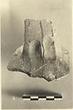
| Base of the band handle of a jug or pitcher.
Incised decoration on handle: double vertical line between short double vertical strokes; and two pairs of wavy horizontal lines on body, at level of handle ... 26 January 1937, 13, 16 February 1937 |
Domed askos. Low ring foot, broad plain-rimmed spout; strap handle concave in section; around lip a wheelrun groove, another partway down the spout and a pair around top of wall. Pinkish clay, gray at ... Context ca. 500-480 B.C. |
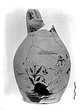
| Much missing, including nearly all of the trefoil mouth; restored in plaster. Ring foot and double rolled handle. The neck seems to have been glazed; on the shoulder below it a wavy line. On the body, ... 26 March 1938 |
|
|