|
|
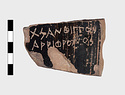
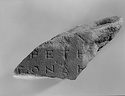
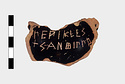
| From rim of large heavy black glazed amphora with squared rim. The top of the rim reserved.
Incised inside: Όστρακο οστρακοφορίας Ξανθίππου. Προέρχεται από το χείλος μεγάλου μελαμβαφούς αμφορέως. Finished ... 18 June 1935 ... Robinson (1951), p. 178 ... Hesperia 10 (1941), p. 3, fig. 3 ... Agora XIV, p. 51, pl. 38. |
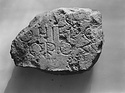
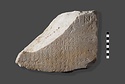
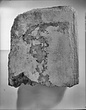
| Inscribed fragment.
Parts of top, both sides and back preserved; bottom broken off.
Boundary stone of the Nymphaeum.
Three lines of the inscription preserved.
Poros. Found in modern or late Turkish wall ... First half of 5th. century B.C ... Travlos (1971), fig. 425 ... Hesperia 10 (1941), p. 38, no. 3 ... Agora XIX, no. H 3, p. 22. |
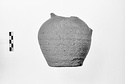
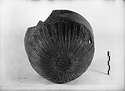
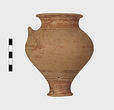
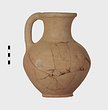
| Body preserved intact but handle missing and neck broken off at base. Flat bottom, globular, ribbed body. One strap handle attached below shoulder. Three incised grooves at base of slightly flaring neck ... 8-9 March 1939 |
| From a coarse unglazed pot.
Incised outside:
Very micaceous pinkish clay. Well, Roman context. Leica PD 764 ... 4 April 1936 ... Hesperia 21 (1952), p. 3, no. 7, fig. 2 ... Hesperia 10 (1941), p. 2 ... Agora XXV, no. 17, pp. 11-12, 33, fig. 2. |
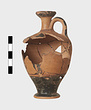
| Mended from many pieces; fragments of body and shoulder missing. Similar in shape, size and decoration to P 16587 (ΝΝ 1713). Purple: ground line, band at base of neck, two bands on lip.
Good black glaze, ... 25 April 1940 ... Hesperia 20 (1951), pl. 42 a-3 (Grave 12) ... Hesperia 10 (1941), p. 2, fig. 1 ... ABV, p. 461, no. 18. |
| Intact except for small chip from lip. Outside unglazed except for rim. Rim inside and omphalos glazed; fringe of short strokes around omphalos. On body inside, four grapevines with tendrils and white ... 25 April 1940 |
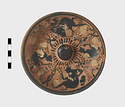
| Small fragments are missing from side wall. In the medallion, a rosette of 11 petals, from the medallion spring elongated petals with pointed tips, alternating with jewelled lines which terminate above ... 3-12 March 1934 ... Hesperia Suppl. 10 (1956), p. 105, under no. 108 ... AJA 45 (1941), p. 218, n. 69 ... Hesperia 3 (1934), no. |
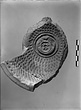
| Mended from two pieces; the profile complete. In the center, a gorgoneion; on the sides, leaf pattern.
Pinkish buff clay.
ADDENDA Medallion from same stamp as p 3089.
Cf. Hesperia Suppl. 10 (1956), p ... 2 March 1934 ... Hesperia Suppl. 10 (1956), p. 84, n. 4 ... AJA 45 (1941), p. 220, no. 1 (noted) ... Hesperia 3 (1934), p. 453, fig. 119. |
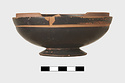
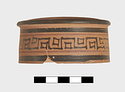
| Intact, save for chip from rim. High flaring ring foot and rounded body; reserved groove outside below rim; upstanding inner rim to hold lid. Black glaze all over except: bottom of bowl inside foot, resting ... 25 April 1940 |
| Inscribed fragments.
Monument to heroes of Phyle.
Top and right side preserved; other sides broken.
Fragment Ε 476, consists of five lines of the inscription.
Pentelic marble.
ADDENDA Belongs with I ... Early 4th. century B.C ... Hesperia 71 (2002), pp. 377-397, figs. 1-3 ... Hesperia 3 (1934), p. 287, no. 78 ... Hesperia 2 (1933), p. 151, no. 3. |
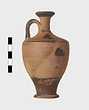
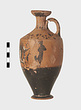
| Intact. Surface much worn and peeled. Shoulder lekythos with low foot and flaring mouth. Foot and lower body glazed; purple ground line. On body, crude nude figure, left, draped figure facing center to ... 25 April 1940 |
| A deeply concave mold for making the face and the side of the head (including ears) of a bearded male, about life size.
Right half broken away; original surface preserved at top, left edge and back.
The ... 25 April 1940 |
| Lid intact save for chip at edge. Straight wall and very slightly convex top, projecting a little beyond the wall and grooved near the edge. On top, a bird with spread wings, no incision; black glaze on ... 25 April 1940 |
| Nearly complete. Missing one handle; badly chipped at rim and body; paint flaking.
Piriform body, low neck, wide mouth with flaring rim. Two small horizontal handles on shoulder; break for attachment ... Mycenaean LHIIIA2 |
| Complete save for chip from handle and many flakes from surface. Shoulder lekythos with low spreading foot and echinus mouth. Top of foot and lower body glazed, also mouth and handle. On front of body, ... 25 April 1940 |
| Inscribed fragments.
List of names by tribes and demes.
Fragments ΘΘ 104 and ΘΘ 124 (a) four joining fragments.
Inscribed face only preserved; parts of two columns.
Fragments ΘΘ 121a, ΘΘ 121b, ΘΘ 124b, ... 4th. century B.C ... Hesperia Suppl. 14 (1975), p. 79 ... Hesperia 35 (1966), pp. 149, 219, pl. 43a, fig. 3 ... Hesperia 10 (1941), p. 46. |
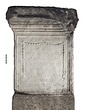
| Large inscribed base of grave monument.
Dimensions preserved complete, though at the bottom the projecting base-moulding has been broken away, and the under surface is preserved only near the middle of ... 113-136 A.D. |
| Complete. Mended from numerous fragments; largely chipped along breaks from impact on belly; patches of incrustations on one side, one on belly and one at rim.
Globular body. Tall, wide neck with rounded ... Mycenaean LHIIIB |
| Inscribed fragments.
Year of Hegesios.
ΚΚ 788 (a) inscribed face only preserved; much broken.
Seven lines of the inscription preserved; stoichedon.
Spacing (five lines including) 0.079m.
ΚΚ 1182a (b) ... 324/3 B.C. |
| About one-third of a black-glaze skyphos base with reserved band on exterior above foot. Flaring ring foot; space inside foot reserved. Excellent glaze, slightly worn on the resting surface.
Incised on ... 24 May 1940 ... Museum Guide (2014), p. 134, fig. 75 ... AntW 37 (2006), p. 51, fig. 10. (Camp) ... Hesperia 10 (1941), p. 3, fig. 2. |
|
|