|
|
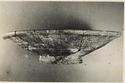
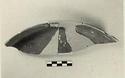
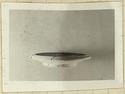
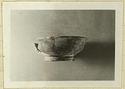
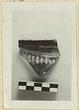
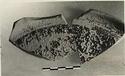
| A deep plate, or shallow bowl; mended from many pieces. Rather high ring foot; rounded rim.
Pinkish brown clay; poor glaze, most of which has peeled off. Well, in north cistern arm. Leica, 4-334 PD 346 ... 3 March 1934 ... Hesperia 3 (1934), no. E 1. |
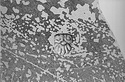
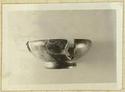
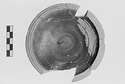
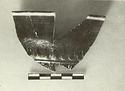
| About one-third of the plate preserved. On the floor, within a triple circle of shallow rouletting, four stamped palmettes.
Thin and very metallic glaze. Cistern. Leica, 4-322 PD 345, PD 346 ... 1932 ... Hesperia 3 (1934), no. C 1, p. 347. |
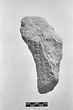
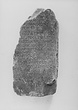
| Fragment of inscription.
Small bit of inscribed surface preserved; otherwise broken or chipped all round.
Pentelic marble. Found in Byzantine context, at bottom, in the southwest corner of the Market Square ... Late 5th. century B.C ... Hesperia 3 (1934), p. 1 ... Agora XVI, no. 26, p. 35, pl. 3. |
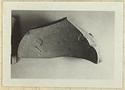
| Mended from three fragments; about three-quarters of the ring base preserved but none of the sides or rim of the dish, which shows a very faint upward curve toward the edges of the fragment. At the center, ... 4 April 1933 ... Hesperia 3 (1934), no. A 1, p. 316, fig. 2. |
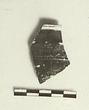
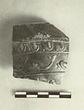
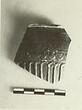
| Rim fragment with double spirals combined with leaves in upper zone. Below, goats rampant with krater between. Cistern. Leica, 99-20-1(2,3,4,5) PD 315 ... 1932 |
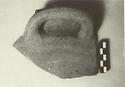
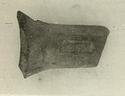
| Arched, rising, broken at curve, neck not preserved.
Typical clay; red core very distinct.
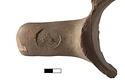
Impression nearly worn away; traces of rose and one or two letters. Rdg: rather lrg lets(VG)*
Date: DB says ... 29 March 1932 |
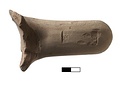
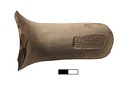
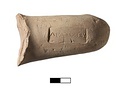
| From straight rim.
Fine pink clay, light buff slip.
Stamped. Dim: L 0.069, Hrim 0.05, Th 0.024* On top of drain. HEON (HE and ON lig, prhps inv) Leica ... 10 March 1932 |
| Rising; angular.
Typical clay.
Impression badly set; letters worn away; traces of rose. Finished letters
rose
(in O) Leica ... 15 March 1932 |
| Resembles rising less angular Rhodian type; fragmentary; worn all around.
Light red clay; yellow near surface; cream slip
Impression resembles Rhodian in shape; broken away at right; twice stamped; letters ... 23 July 1931 |
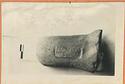
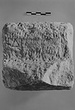
| Fragment from inscribed block.
The inscribed surface shows a slight horizontal curve.
Parts of twenty-two lines of the inscription preserved; non-stoichedon.
Pentelic marble. Pre-excavation. Found in the ... 1933 |
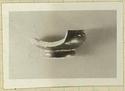
| Parts of lip and floor remain. Restored in plaster. The plate was broken in antiquity and mended with lead clamps of which one remains. The inner flange is dovetailed at either end and carefully inlaid ... 3-12 March 1934 ... Hesperia 3 (1934), no. ... Agora XXXII, no. 3, fig. 1. |
| Flat, curved shape; similar to Knidian but small.
Coarse greyish-red clay, micaceous.
Impression so carelessly made and so worn as to be almost illegible. Ἐπὶ Θε
[---] 427 Leica ... 16 July 1931 |
| Small, thick, nearly cylindrical.
Medium fine, red clay; slightly micaceous; pinkish-buff slip.
Impression broken away left of two letters. [---]ΤΑ 427 Leica ... 16 July 1931 |
| Broad, curved, level.
Medium coarse red clay, greyish at core; slightly micaceous; pinkish buff slip.
Monogram; lower part flaked away. Rdg: poss =Th=; animal dev?*
Par: par w/ attribute not found(VG)* ... 17 July 1931 |
| Small, thick, start of curve.
Medium fine clay, yellowish brick red clay; considerable traces of dark red paint.
Shallow, worn impression; small suggesting seal; content seems to be pictorial. Human ... 1931 |
| Broad, arched.
Rather coarse clay; cream surface, red just beneath; distinct gray core.
Indistinct impression from wear. Dim: W 0.037* Μενιπ( (Ν retr) Leica ... Late Hellenistic |
| Mended from two fragments; complete save for minor fractures.
Buff clay. Thin black glaze on the inside; the outside, and the rim with two grooves, unglazed. Well. Leica, 4-310 PD 347 ... 21 March 1933 |
| Neck preserved nearly complete; handles broken away below curve.
Stamp on outside of heavy rim [H. (letter) 0.022m.]:
Coarse red clay. Lighter at surface. Fill over south end of drain 1. Leica, 4-55, ... 17 May 1932 |
| Rim fragment. Gently flaring lip with plain rim.
Gritty, yellow clay. Covered with thin brown glaze on the inside only. Pithos. Leica PD 350 ... 1932 |
| Mended from two fragments preserving the complete circle of the base and part of the rim. Low heavy ring base; incurving rim.
Pink clay; the glaze thin, discolored and worn. Well. Leica ... 20-21 March 1933 |
| Fragments of rim and body missing. Low ring base; incurving rim.
Pink clay; good black glaze, metallic in places. Well. Leica ... 20-21 March 1933 |
| Restored in plaster. False base ring set off from the side wall by a shallow groove. On the inside, about 0.01m. below the lip the glaze has been scratched from the bottom of a shallow groove.
Thin black ... 1932 |
| Only the middle of the floor preserved, which rested on a false base ring formed by the downward continuation of the side walls. Around the outside are shallow corrugations run on the wheel. On the floor, ... 1932 |
| The neck preserved to its original height over one-half of its circumference. Gently concave in profile. Around its middle runs a garland of ivy leavs c arefully rendered in thinned clay. Just under the ... 1932 |
| Mended from seven pieces; parts of rim and sides still missing. Small flat bottom; bulging sides narrowing toward the neck; small flaring lip; single vertical ribbon handle.
Light reddish buff clay ... 17 March 1932 |
| Rather more than half preserved. A roughly made disc, nearly flat; the bottom left rough from the wheel.
Buff clay and slip. Well. Leica, 4-312 ... 21 March 1933 |
| Only a fragment of the bottom remains. High thin base ring; almost flat floor. Vertical side wall.
On the bottom within the base ring, incised in the dry clay:
Buff, slightly micaceous clay, covered ... 3-12 March 1934 |
| Mouth, handle, and parts of the side wall broken away. Restored in plaster. Heavy base ring, broad shoulder; slender neck with wheel-run grooves around its lower part; strap handle.
Buff clay, covered ... 3-12 March 1934 |
| Mended from many pieces. Missing about one-third of the rim and parts of the body. A shallow open bowl with low ring base and outward flaring lip.
Buff clay. Thin dull black glaze, reddish in places ... 18 March 1933 |
| Fragments of lip and body missing. Around center of interior, a double circle of rouletting.
Pink clay. Thin glaze, worn in places. Bottom of ring base and junction of body and base reserved. Well. Leica, ... 20-21 March 1933 |
| A single fragment preserving about half the base and a quarter of the rim.
Pink clay. Good black glaze, chipped on body and much worn beneath base and on lip. Well. Leica ... 20-21 March 1933 |
| Fragments of lip and body missing. Shape similar to P 2867 but base higher and smaller. Ridged rim.
Buff clay; thin black glaze on the interior; otherwise unglazed. Well. Leica, 90-12-9, 90-13-29, 90-35-11 ... 20-21 March 1933 |
| Fragment from the base of a saucer similar to P 2857. Outcurved lip.
On the floor is a circle of rouletting enclosing a number of free standing stamped palmettes of which two remain.
The black glaze ... 1933 |
| A garland of pointed pendents rendered in thinned clay suspended between the handles. On the neck, above, a horizontal line in white paint. Several more small fragments of this ware, two of them showing ... 1933 |
| Rim fragment, slightly convex at top.
Coarse buff clay covered with thin brown glaze on the inside and the top of the rim.
Cf. Agora XXXIII, no. 255. Well. Leica PD 350 ... 1933 |
| Part of the handle and rim are preserved.
Rim flat on top and bound by a shallow groove on either side.
Cf. Agora XXXIII, nos. 250, 280. Well. Leica PD 350 ... 1933 |
| Fragment of rim, gently convex on top.
Buff clay covered with brown glaze inside and out.
Cf. Agora XXXIII, no. 255. Well. Leica PD 350 ... 1933 |
| One handle and part of rim preserved. Rim almost flat on top. Heavy loop handle projecting well beyond the edge of the rim.
Buff clay covered with flaky brown glaze on the inside and on the top of the ... 1933 |
| Fragment of rim, sharply downturned.
Greenish yellow clay, unglazed. Well. Upper fill. Leica PD 350 ... 1933 |
| Fragment of rim, broadly flaring. Handle pinched into rim.
Greenish yellow clay, unglazed. Well. Upper fill. Leica PD 350 ... 1933 |
| Two joining fragments from rim.
Upper zone shows areca flowers. Pithos. Leica PD 331 ... 1932 |
| Small fragment from rim.
Double spiral in upper zone. Pithos. Leica PD 331 ... 1932 |
| Rim fragment. The lip of this imported Megarian bowl is incurved.
On the outer wall there remain parts of three zones divided by raised lines; the uppermost is occupied by a band of egg-and-dart; the ... 1932 |
| Rim fragment.
Egg-and-dart pattern in upper zone. Pithos. Leica PD 331 ... 1932 |
| Mended from several fragments; most of one side missing. High ring foot; out-turned rim.
Wide hatched band around center, inside, enclosing four very small palmettes.
Attic clay. Silvery-gray glaze, ... 22 April 1932 |
| Small fragment.
Rabbit's head shows on the side. Pithos. Leica PD 331 ... 1932 |
| Small fragment.
Ribs and dots. Pithos. Leica PD 331 ... 1932 |
| The handle and a little of the mouth only remain. Globular body; low neck with flaring lip; short strap handle.
Gritty, buff clay, fired yellow on the outside. Pithos. Leica, 4-333 ... 1932 |
| Rim fragment.
Rim flat on top but bent sharply down toward the outside.
Gritty, buff clay covered on the inside with thin brown glaze and spattered on the outside with the same.
Cf. Agora XXXIII, no ... 1932 |
| One handle, and part of wall and rim preserved. Lip slightly offset; rim sharply profiled; heavy horizontal handle set close to rim.
Gritty buff clay, covered with red glaze on the inside only. Pithos ... 1932 |
| The lip flares and was fitted with a ledge to receive a lid.
Decorated on the outside with horizontal rows of dots applied "en barbotine".
Coarse clay fired gray and red. Very thin fabric. Pithos. Leica, ... 1932 |
| Full dimension preserved; corners and edges somewhat broken. Front and back surfaces smooth, sides and top less so.
The lower part, to a height of ca. 0.20m. is wider and thicker than the top, and is left ... 1933 |
| Inscribed fragment of columnar grave monument.
Only the inscribed surface preserved.
Near top, traces of convex moulding, broken away.
White marble. Found at a late Roman level, in the pronaos of the temple ... 4 February 1932 |
| Angular type; part of rim preserved.
Red stain near neck.
Rectangular impression, shallow above and below; rose. Dip: red stain near neck*
Par: Nilsson 1909, 343, 1* Finished Middle Stoa Building Field; ... 6 March 1933 |
| High rising.
Fine clay, reddish-buff with light red core; cream slip, traces of red paint.
Careless impression for Rhodian. Dte: 1/2 3c BC (VG v.62)*Dip: traces of red paint* Finished Lowest stratum ... First half of 3rd century B.C. |
| Broad handle with short upper part.
Fairly fine micaceous clay, light reddish-buff.
Impression from same die as SS 304; chipped to right, but no letters missing. Par: same die as SS 00304* Terrace test ... 20 May 1933 |
| Rim fragment. Deep bowl. Horizontal rim, with two holes pierced for suspension.
Dull brown glaze.
Cf. Hesperia 3 (1934), no. C 6 (P 28076, deposit F 16:8).
Cf. Hesperia Suppl. 25 (1992), p. 6, n ... (18 June 1987) ... Dull brown glaze.
Cf. Hesperia 3 (1934), no. C 6 (P 28076, deposit F 16:8).
Cf. Hesperia Suppl. 25 (1992), p. 6, n. 19 ... Central area of Propylon, layer 3b of martyr, north of pillaging trench of Greek room 1. |
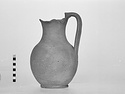
| The trefoil lip missing except at the back near the handle; otherwise complete save for a small hole in the bottom. Handle triangular in section with a rib down the middle. Low ring base.
Clay with bits ... 4 April 1933 ... Hesperia 3 (1934), no. ... Agora XXXIII, no. 1, fig. 1, pl. 1. |
| Rising; neck not preserved.
Fine clay; resddish-buff, redder at core; cream slip; surface pitted.
Left end of the impression broken away with part of one letter; worn.
Cf. SS 31. Par: SS 00031*
Dte: ... First half of 3rd century B.C. |
| Thick, rising, broken at curve; somewhat twisted.
Similar clay to typical Rhodian.
Impression much chipped round right end; worn in middle. Finished Σωκράτευ̣ς burning torch Leica ... 9 March 1932 |
| Arched; rising.
Typical clay; red core, large.
Impression rather careless for Rhodian. Finished Ἐπ' Ἰερέως
Ξενοφάν
του Leica ... 11 March 1932 |
| Level curved, broad; short top.
Coarse greyish-red clay; slightly micaceous; traces of red slip (?).
Large, untidy impression; nearly obliterated; probably incomplete at top. Ἐ̣π̣ὶ̣ Φ̣[ιλτά]
του π̣ρ̣[υορά] ... 16 July 1931 |
| Small fragment, meets the neck very obliquely; otherwise typical.
Medium coarse clay, greyish-red, yellow in surface breaks.
Impression broken away at right, incomplete and damaged above. [ Ἐπὶ Ἀγαθοκ] ... 15 July 1931 |
| Stocky handle lump beneath.
Coarse light reddish-buff clay; little or no slip.
Impression incomplete above and below, worn across the middle and damaged by chips.
Cf. Dumont (1872), pp. 192, 299-300 ... 26 April 1933 |
| Typical angular; junction with neck not preserved.
Typical clay.
Right end of the impression broken away. Shallow; worn. Retrograde. Finished Dump. Σωκράτευς (retr) burning torch (inv) Leica ... 17 March 1932 |
| Shape resembles typical Knidian; broken at curve.
Dark reddish-yellow clay; greyish at core; thin slip.
Small impression shallow; letters nearly worn away; trident right. Msc: prob from jar dated in ... 4 April 1932 |
| Lower part of small stele.
Well preserved surface at left edge; other surfaces worn.
Small dowel hole in center of curving top with bit of iron in place; projecting base.
White marble.
ADDENDA Small inscribed ... 1 June 1931 |
| Broad, widening at the neck; very small fragment preserving only start of handle.
Red clay, medium coarse; traces of light slip.
Only left end of the impression preserved, incomplete above, set close ... 28 April 1932 |
| Large fragment with part of rim. Angular, rising.
Typical clay.
Impression set carelessly and close to neck. Only a few letters legible. Finished [Σ]οσ[ι]κλε̣[υς]?
rose
(in O) Leica ... 10 March 1932 |
| Broken before curve; typical.
Distinctly micaceous; otherwise typical with remains of light slip.
Impression neat but shallow and worn. Below surface. Πολι bouk- ούχου
Ἀ̣σ̣τ̣ρ̣ ranion αγάλου
(Ρ retr) ... 17 March 1932 |
| Broken away before curve; could resemble Knidian.
Very coarse brick red clay; grey at core; slightly micaceous.
Outer half(?) of impression broken away; set at uneven depth; no letters; upper part of ... 15 June 1931 |
| Rising, angular.
Typical clay.
Impression much worn in the middle. Finished Ἀγαθοκλεῦς Leica ... 1 March 1932 |
| Rather small but in other respects resembles Knidian.
Clay russet to gray, with traces of probable slip.
Impression incomplete above and below, and very faint and shallow, but unmistakeably another from ... 10 February 1933 |
| Rising, rather broad.
Typical clay; breaks discilored.
Nearly half of circumference of the impression chipped away. Finished Cistern. [Ξεν]οτίμου?
rose
(in O framed) Leica ... 15 March 1932 |
| Chips missing from rim; otherwise complete low ring base. The glaze is light red to buff, thin, dull and much flaked.
Clay pinkish buff. Well. Leica ... 4 April 1933 |
| Small lagynos handle, broad; slightly rising; curves far from body; broken at curve.
Medium fine, light red clay; cream slip, thick on top.
Shallow impression; chipped at left end. Rdg: originally read ... 29 February 1932 |
| Neck largely preserved, repaired out of many pieces; handle broken across middle of stamp. Less angular shape than typical Rhodian.
Fairly fine clay, yellowish, with small light red core; cream slip ... 25 July 1931 |
| Typical shape.
Fine clay, light red at core, yellowish near surface; cream slip.
Single impression; half of edge incomplete or worn away. [ Ἐπὶ Ἁρμο]σίλα Θεσμοφορί(ου) vac
rose
(framed ... 16 July 1931 |
| Small fragment; shape probably typical.
Fine clay, light red at core, yellowish near surface; cream slip.
Impression broken at left edge; neat; worn.
Cf. SS 31. Par: see on SS 00031* Finished Παυσανία ... 22 July 1931 |
| Rising, angular.
Typical clay; traces of red paint.
Impression slightly incomplete above; damaged in the middle. Dip: traces of red paint* Finished Ἐπὶ Θέσ̣τορος
Ἀρτα̣μ̣ιτίου Leica ... 7 March 1932 |
| Appears to be typical, arched. Fragment preserves a good deal of ahndle but not in section with the neck.
Typical clay.
Very faint impression; letters round most of circumference worn away. Finished ... 9 March 1932 |
| Typical, junction with neck not preserved.
Typical clay.
Right end of the impression broken away; worn down middle. Par: bet ex BSA H69(VG)* Ἐπὶ Εὐφράν̣[ορ]
ος Εὐβουλί
δα Κνί al-
διον tar
(Σ lunate) ... 11 March 1932 |
| High rising, thick.
Fairly fine clay; reddish-buff with small red core; traces of cream slip, surface being reddish and pitted where slip is missing.
Impression shallow set, much damaged; circular stamp ... 1 March 1932 |
| Handle formed of two small thick ones, side by side; it rises from its attachment point and curves down close to neck.
Fairly fine clay with many small micaceous particles; light red with cream slip ... 1 March 1932 |
| Level, broad, start of right angle curve.
Coarse clay; grey at core.
Impression incomplete below; much worn. Publ: a worse ex than TD 6862 (VG)* Lowest red stratum. Ἐπὶ Ξενο[κλ]έ
ο[υς Ἀ]θα[ν]οκ
ρί[του ... 1 March 1932 |
| Small flat carefully made handle, completely preserved; index finger pressed in at base.
Fine clay, light red, greyish at core; thin cream slip. Dim: W 0.035* Παρίων 389 Leica ... 14 July 1931 |
| Typical angular shape.
Fine, light yellowish-red clay; cream slip much damaged.
Nearly obliterated impression. Par: Nilsson 1909 nr 46, 16 seals, 2 spaced like this*
Stp: incomplete below and to the ... 16 July 1931 |
| Typical. Handle rising.
Fine yellowish clay, with small light red core; pinkish cream slip.
Impression doubled; worn. Stp: doubled* Finished Δαμοκράτε[υς]
rose
(framed in O) 438 Leica ... 17 July 1931 |
| Typical.
Fine clay, light red at core; yellowish near surface; cream slip.
Single impression, much worn. Par: Nilsson 1909, nr 146; many in Pridik 1917 collect,
none from Pergamon-till recently(VG)* ... 17 July 1931 |
| Less angular shape than typical Rhodian.
Fine clay, yellowish, with small light red core; cream slip.
Letters in very slight relief. Par: Nilsson 1909 nr 263* Finished Ἐπὶ Καλλικράτευς
Ἀγριανίου 463 ... 20 July 1931 |
| A single fragment preserving most of the body. Missing the stem, fragments of the rim and the horizontal projection about the middle of the body, together with the two handles or lugs. At one of the breaks ... 20-21 March 1933 ... Hesperia 48 (1979), p. 217, XIII:1 ... Hesperia 3 (1934), no. |
| Curved, flat.
Coarse red clay, grey at core; micaceous; traces of light slip.
Impression incomplete at bottom; much worn. Upper part of Hellenistic deposit. Θ̣ρ̣άσων̣
bar
ἐπ̣ὶ̣ Α̣ΜΛΙ
(Ν retr, Ε,Σ ... Hellenistic |
| Level at attachment; thick, nearly cylindrical.
Coarse red clay, slightly micaceous, traces of light slip.
Impression oval and delicate, without letters; may be from engraved gem; Sphinx with tall pointed ... 15 July 1931 |
| Broken at curve. Appears to be typical Knidian.
Clay typical Knidian.
Impression slightly incomplete. Dim: W 0.043* Μεν(
Πρ( Κ(νίδιον?) Leica ... 12 March 1932 |
| Part of lip and floor remain. Gently concave floor, surrounded by high rim, thinning toward the top.
Fine buff clay, covered with red glaze, much flaked.
Pergamene Ware. Cistern. Leica PD 1171-167 ... 3-12 March 1934 ... Hesperia 3 (1934), no. ... Agora XXXII, no. 2, fig. 1. |
| Slightly less angular than typical.
Fine clay, light red at core, yellowish near surface; cream slip.
Impression chipped at the bottom; slightly doubled. Stp: sl doubled* Finished Παυσανία 413 Leica ... 15 July 1931 |
| One fragment from base and one from side remain.
Covered on the outside with white paint on which floral(?) designs were painted in red.
Gritty red clay. Pithos. Leica, 4-333 ... 1932 |
| Rising; angular.
Buff clay, red at cote; traces of cream slip. Surface including breaks blackened; much damaged.
Doubled impression, flaked off left end. Stp: doubled*Dte: 3/4 3c BC (VG v.62)* Lowest ... Third quarter of 3rd century B.C. |
| Inscribed columnar grave monument.
Lowest, 0.25m., raised rough surface. Center top, rough socket; depth about 0.04m.
Below moulded band, inscribed.
Hymettian marble. Found in the wall of the modern house ... 1931 |
| Fusiform shape. Traces of two white bands, one above and one below the point of greatest circumference.
Pinkish orange clay covered with a dark gray wash, somewhat worn off.
Cf. Agora XXXIII, no. 504 ... 4 April 1933 |
|
|