|
|
| Similar to angular Rhodian; twisted.
Fairly fine reddish-buff clay; cream slip.
Impression incomplete above; large letters. Finished [ Ἱεροκλεῦς]
ΙΑ Leica ... 10 March 1987 ... Hesperia 3 (1934), no. 65. |
| From the top of the lid. P 3373 (Γ 459), from the shoulder, also belongs. Convex top; vertical lower wall; broad rim projecting from shoulder. Around the top a wreath of wheat. Stems and leaves in white ... 3-12 March 1934 ... Hesperia 3 (1934), no. E 65. |
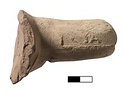
Lip fragment with heavy horizontal handle which is pressed close to the rim.
Red wash inside. Cistern. Leica PD 350 ... 1932 ... Hesperia 3 (1934), no. C 65. |
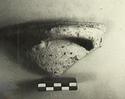
Rim fragment.
Rim flat on top but bent sharply down toward the outside.
Gritty, buff clay covered on the inside with thin brown glaze and spattered on the outside with the same.
Cf. Agora XXXIII, no ... 1932 ... Hesperia 3 (1934), no. D 65. |
Fusiform shape. Traces of two white bands, one above and one below the point of greatest circumference.
Pinkish orange clay covered with a dark gray wash, somewhat worn off.
Cf. Agora XXXIII, no. 504 ... 4 April 1933 ... Hesperia 3 (1934), no. A 65, p. 326. |
Resembles rising less angular Rhodian type; fragmentary; worn all around.
Light red clay; yellow near surface; cream slip
Impression resembles Rhodian in shape; broken away at right; twice stamped; letters ... 23 July 1931 |
Shoulder fragment. P 3368 (Γ 454), from the top, also belongs. Convex top; vertical lower wall; broad rim projecting from shoulder. Around the top a wreath of wheat. Stems and leaves in white paint, heads ... 3-12 March 1934 ... Hesperia 60 (1991), no. 116 ... Hesperia 3 (1934), no. E 65. |
Inscribed columnar grave monument.
Complete, except for a small break at one side of the top; and including the rough lower part set into the ground.
Hymettian marble. Found in a drain, east of the Metroon ... 16 July 1931 |
| Handle rectangular in section.
Very coarse brick red clay, micaceous.
Stamped with forty-four small crosses. Msc: filed under Stps for Ornament(VG)* 44 crosses Leica, 4-65 ... 14 March 1932 |
Inscribed fragment.
Back surface preserved, rough picked; and possibly a bit of the top; other edges broken.
Pentelic marble. Pre-excavation. Found in the modern wall of the house 636/19, over the west ... 4th. century B.C ... Hesperia Suppl. 9 (1951), p. 25, pl. 7 ... Hesperia 3 (1934), p. 65, no. 58. |
| Upper right corner of large inscribed base; grave monument.
Top uneven but smooth. Moulding at upper edge broken away.
Letters shallow cut.
Part of six lines of the inscription preserved.
Pentelic marble ... Second half of 4th. century B.C ... Hesperia 3 (1934), p. 65, no. 28. |
| Fragment from an inscribed stele.
Broken all round.
Parts of eight lines of the inscription preserved.
Hymettian marble.
ADDENDA I 929, I 990, I 2259, I 2301 and I 7479 belong and join with each other ... Mid 3rd. century B.C. |
| Rising, angular.
Fairly fine, reddish-yellow clay; cream slip; surface including breaks speckled with black; traces of burning(?).
Left end of the imp;ression wanting due to surface breaks; shallow and ... 4 April 1932 |
Typical, junction with neck not preserved.
Typical clay.
Right end of the impression broken away; worn down middle. Par: bet ex BSA H69(VG)* Ἐπὶ Εὐφράν̣[ορ]
ος Εὐβουλί
δα Κνί al-
διον tar
(Σ lunate) ... 11 March 1932 |
Typical shape; somewhat descending.
Coarse red clay; yellow at surface; light slip.
Small impression, nearly square; letters shallow. Well. Δ(ρ)άκο(ντος)
Νικα(
Κνι(
(retr) Leica ... 26 April 1932 |
Curve fragment of typical handle.
Fresh impression from fairly neat clay die; framed rectan gle; retrograde. Stp: clay die*
Study: die 3, SS 01032 die like ABC 3* Trench ΣΤ; Byzantine intrusion. Δράκο ... 23 March 1933 |
Level, broad, ribbed; broken at curve.
Coarse clay; red; traces of light slip.
Frame rectangle, impression set somewhat obliquely; worn. Δράκοντος
Κνίδιον
(Σ lunate, framed) Leica ... 1 March 1932 |
Broad, ribbed, descending.
Coarse reddish-brown clay, brighter at edges; cream slip.
Slightly incomplete impression on upper left part. Boustrophedon beginning upper right corner. Δράκο (retr)
ντος Μ ... 1 March 1932 |
| Broad, level; curves like Knidian.
Coarse red clay, smnall grey core; slightly micaceous.
Impression set obliquely; incomplete above, right. Ἐπὶ Θε̣δ̣ό̣το(υ)
Δράκοντος
(Ν retr, Ε,Σ lunate) Leica, 94-10-17 ... 16 February 1932 |
Slim handle.
Coarse red clay; slip thick on top.
Impression broken away at left.
Same die as SS 210; restored from that. Par: same die as SS 00210*
Cxt: listed w/ MSBF (VG)* Middle Stoa Building Field, ... 13 June 1933 |
Typical Knidian shape.
Typical Knidian clay.
Impression incomplete above, incomplete and dam,aged to right. Careful delicate letters, with apices and broken-barred "alpha".
Same die as SS 263, better ... 3 March 1933 |
Typical handle.
Coarse, rather yellowish-red clay.
Impression a framed rectangle. Much worn. Par: same die as SS 00192; Dumont 1871, p236 nr 35* Sandy deposit with late Hellenistic and early Roman pottery ... 22 March 1933 |
Broad; broken before curve.
Coarse red clay, rather micaceous; traces of light slip.
Right end of the imprtession broken away; left end incomplete above and below; large letters. Cxt: Cistern system ... Late 3rd century B.C.-2nd century B.C.(?). |
Mended with missing pieces restored in plaster and painted. Much of the glaze misfired. Surface very pitted. H. 0.28; diam. 0.168. H. A. Thompson, Hesperia 3, 1934, p. 334, fig. 14 and p. 428, fig. 114 ... Third quarter of the 4th century B.C. |
Neck of Knidian amphora with tops of handles preserved. The neck is contracted just below the riolled rim. A little further down, a sort of rough handle ridge at different levels on the two sides. The ... 4 March 1933 |
| Intact. Slightly flattened base, round body.
Coarse clay with mica and white inclusions. Slight traces of fire.
Cf. Agora XII, no. 1934, 525-500 B.C. Well. 1929 96-16-23, 96-16-24, 88-697 DA 13535 ... 6 July 1995 |
| Fragments from an honorary stele.
The larger fragment a, Ι (iota) 37, preserves the top and back surfaces. Along the upper edge a moulding has been chiseled away.
Inscribed below moulding. Below, two wreaths, ... 146-130 B.C ... Hesperia 29 (1960), p. 56, no. 81, pl. 17 ... Hesperia 4 (1935), p. 81, no. 38 ... Hesperia 3 (1934), p. 69, no. 65. |
Broad; ribbed; arched; broken at curve.
Coarse clay; red near surface; grey. Surface blackened.
Impression twisted; doubled; set near neck. Stp: doubled* Cistern. Ἐπὶ Ἱππάρχου
Δ̣[ιονυ]σ̣ί̣ο̣υ̣
Ἐπιφάνευς ... 12 March 1932 |
| Fragment from an inscribed base (?).
Broken all round; the rough picked top appears not to be original.
Dedication.
Parts of two lines of the inscription preserved.
Hymettian marble. Found in the wall ... 10 February 1933 ... Hesperia 15 (1946), p. 234, no. 65 ... Hesperia 3 (1934), p. 71, no. 67. |
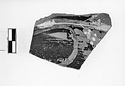
Rim fragment from kantharos(?).
Filling dots with black band below zigzags; purple band below that. Glazed inside.
The applied purple seems to indicate that this sherd is not to be dated before the middle ... 18 May 1932 |
| Mended from many pieces. About a quarter of the rim and several fragments of the sides and bottom missing. Restored in plaster. High walled bowl with broad, flaring rim and two loop handles; false foot ... 17 March 1932 ... Hesperia 27 (1958), p. 230, n. 97 ... Hesperia 3 (1934), no. ... Agora XXXIII, no. 610, fig. 77, pl. 65. |
| Flat bottom; low convex lower body, curving to a slightly concave almost vertical upper body with slightly flaring lip. One vertical strap handle, from lip to point of greatest circumference. On the body, ... 25 April 1934 ... JdI 74 (1959), p. 65, noted ... Hesperia Suppl. 2 (1939), no. XXV 3, p. 102, fig. 72. |
About half of the lower part of the mold is preserved with groups of lines radiating from the center, and a grapevine pattern between. The center consists of a simple rosette surrounded by concentric grooves ... 13 March 1933 |
| Intact except for mended chip on foot. Torus ring foot (flaring); largest diameter below midpoint of body. Torus mouth. Two lines of fugitive added red at base of handles; two incised lines at juncture ... 6 July 1995 |
| Identical with P 1104. Much mended; fragments from the walls, the base, and the top of one handle restored in plaster. Here the upper parts of the heads of the horse and the first woman are better preserved, ... 1 June 1932 ... Hesperia 3 (1934), p. 334, no. ... Agora XXX, no. 65, pl. 14. |
| Brittle white clay; light green glaze darker in places; fired yellowish-brown where lines or dots have been incised. A triple affair, the outer part of which has an elaborate cut out pattern; its lowest ... 5 February 1934 |
| Inscribed fragments.
Confiscated property of Alcibiades.
"POLETAI" record.
Fragment ΣΤ 604 from upper right corner of inscribed block.
Full thickness of block preserved, but large flakes broken from surface ... (ΣΤ 604) 11 May 1932
a) (Κ 1350) 16 July 1947
b) (Κ 22) 22 January 1934
c) (ΘΘ 5) 18 December 1936
c) (ΙΙ 242b) March 1938
d) (ΘΘ 30) 30 December 1936
d) (ΘΘ 44) 17 January 1937
d) )ΙΙ 133) 7-8 March 1938 ... |
| One piece amphora. Mended from many pieces. Complete save for scattered small gaps in the body and chips from the base. The surface is severely weathered especially on one side.
On either side, a sphinx ... August-September 1932 ... Hesperia 75 (2006), p. 15, n. 48 ... Hesperia 13 (1944), p. 39, no. 2 ... Hesperia 7 (1938), pp. 365 (n. 3), 367 ff., no. 1, figs. 1-4. |
|
|