|
|
Flaring ring foot. Reserved: underside with glazed band, two circles and dot. Two light grooves on lower part of wall. Glaze mottled red and black ... Ca. 420 B.C. |
Moulded foot, concave beneath, with grooved resting sur- face. Scraped line at junction of two mouldings on lower part of foot.
For other pieces from this same period, see P 2404 G-H 10-11 Hesperia, VI, ... 325-310 B.C ... For other pieces from this same period, see P 2404 G-H 10-11 Hesperia, VI, 1937, p. 165, fig. 98 a and P 572 H 16:3 Hesperia, III, 1934, p. 345, fig. 26, B 46. |
Ring foot. Plain rim. Totally glazed. Graffito on underside: see Fig. 22.
Published from contemporary deposits: P 7217 F-G 9-10 Hesperia, VI, 1937, p. 154, fig. 89 b; P 10560 B 15:1, XVIII, 1949, p. 330, ... 425-400 B.C ... Published from contemporary deposits: P 7217 F-G 9-10 Hesperia, VI, 1937, p. 154, fig. 89 b; P 10560 B 15:1, XVIII, 1949, p. 330, 73; P 19297 B 18:4, XX, 1951, pl. 50 c (Pyre 3-4), slightly later. |
Ring foot. Rim flat on top. Reserved: resting surface and underside with glazed band, circle and central dot.
From the same deposit P 2310 Hesperia, IV, 1935, p. 476, fig. 1, 37, Pots and Pans, fig. 25, ... 450-425 B.C ... From the same deposit P 2310 Hesperia, IV, 1935, p. 476, fig. 1, 37, Pots and Pans, fig. 25, with reserved handle-panel; P 2317 Hesperia, ibid., fig. 1, 44, all black; P 2311-4 ibid., p. 507, 38-41. Cf. also P 7217 F-G 9-10 Hesperia, VI, 1937, p. 154, fig. 89 b. |
Foot, most of floor and start of wall.
Flaring ring foot; lower part of wall concave, a groove at its junction with the upper wall. Reserved: underside with glazed circle, band, circle and dot. Decoration ... Ca. 425 B.C ... P 5924 F-G 9-10 Hesperia, VI, 1937, p. 155, fig. 90 d; and 491. |
| Part of infundibulum broken away.
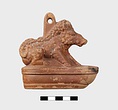
A wild boar couchant, rests on a high base. A pierced suspension lug rises from his shoulders; in his back is the filling hole.
Pale yellow clay covered with dull red ... 200-250 A.D ... Hesperia 7 (1938), p. 356, fig. 45 ... ILN (11 September 1937), p. 431, fig. 10 ... Agora VI, no. 1096, p. 82, pl. 31. |
Common 5th century type. Others from the Agora are P 2362 R 13:4 Hesperia, IV, 1935, p. 515, fig. 27, 82; J.H.S., LXXXII, 1962, pl. V, 3, right; P 11015 B 15:1 Hesperia, XVIII, 1949, pp. 335-6, 99; P 21695 ... Context ca. 460-440 B.C ... Others from the Agora are P 2362 R 13:4 Hesperia, IV, 1935, p. 515, fig. 27, 82; J.H.S., LXXXII, 1962, pl. V, 3, right; P 11015 B 15:1 Hesperia, XVIII, 1949, pp. 335-6, 99; P 21695 O 7:10 Pots and Pans, fig. 44, right. From Corinth, C-34-941: Hesperia, VI, 1937, p. 305, fig. 36, 212.
|
Toe, both handles and frag- ments of wall missing.
Stamped decoration: ovules, linked palmettes pointing upwards, linked palmettes pointing downwards, meander, linked palmettes pointing downwards.
For ... Ca. 420 B.C ... P 8096 F-G 9-10 Hesperia, VI, 1937, p. 155, fig. 90 g; this may be a lekythos. |
Fragmentary upper part.
One-piece neck and shoulder with a broad flange below the vertical rim. No trace of handles. Cooking ware.
Elaborate rims are uncommon in Attic hand-finished cooking-ware pots; ... Context ca. 425-400 B.C. |
One handle missing, restored.
Moulded foot; a ridge around lower part of wall. Com- pletely glazed. Decoration inside: circle of ovules, zone of palmettes, two circles of ovules, zone of linked palmettes ... Ca. 430 B.C ... P 2294 R 13:4 Hesperia, IV, 1935, p. 488, fig. 10, 17 and p. 502, fig. 20, 17 and P 23280 O 16:1-2 have the same pat- tern and stamp as 534 and the same treatment of foot and underside. P 8094 F-G 9-10 Hesperia, VI, 1937, p. 155, fig. 90 e, has the same underside and a slightly less elaborate pattern. |
Flaring ring foot. Concave lower part of wall, a groove at its junction with the upper part. Reserved: underside with glazed band, two circles and dot. Decoration inside: palmette cross on a circle.
The ... Ca. 400 B.C ... The following published examples of the 5th century can be compared for both underside and pattern: P 5484 I-J 18:1 Hesperia, IV, 1935, p. 488, fig. 10, 110; P 8091 F-G 9-10 Hesperia, VI, 1937, p. 155, fig. 90 f; P 9446 M 20:3-L Hesperia, XVIII, 1949, pls. 94 and 95, 161; P 10977 B 15:1 ibid., pl. 93, 77; P 13232 H 5-6 (c) ibid., pl. 94, 157 and p. 319, fig. 1, 157. The palmette cross on a circle appears quite early, on P 2296 R 13:4 Hesperia, IV, 1935, p. 502, fig. 20, 14 and p. 504, fig. 21, 14. |
| Two fragments, the smaller from the base; much missing from side and bottom. Glaze mottled black and red.
Three additional fragments, including a second nozzle, unite the two first found, and give a large ... Late in 3rd. quarter of 5th. century-375 B.C. |
|
|