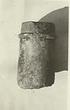
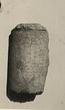
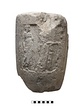
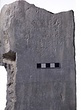
[Agora Object] I 1479: Grave Monument

Columnar grave monument. Broken at the bottom. Inscribed. Pentelic marble. Found in modern wall, south of the central part of the Middle Stoa. Leica ... 28 February 1934

[Agora Object] I 588: Grave Monument Fragment

Fragment of columnar grave monument. Broken at the top just above the ring, and at the back and bottom. The left end of six lines of the inscription preserved. Hymettian marble. Cf. I 568. Found in a ... 18 March 1933

icon

[Agora Object] I 2819: Grave Monument

Inscribed columnar grave monument; loutrophoros or lekythos (?). The full diameter is preserved. The present top and bottom both rough picked, and in the latter a hole has been cut. The top may be original, ... Before 350 B.C.

icon

[Agora Object] I 13: Base Fragment

Fragment of statue base with dedication. Moulded base; broken on top, back and partly at bottom; right edge and side preserved; cutting in left side; left side damaged, but inscription fully preserved ... 4th. century B.C.

icon

[Agora Object] I 1582: Prytany Decree Fragment

Inscribed fragment. Two joining fragments; broken all around. Eight lines of the inscription preserved. Hymettian marble. Found in late context, over the South Porch of the New Bouleuterion. Leica, II-35 ... Ca. 180-155 B.C.

icon

[Agora Object] I 3298: Record Fragment

Inscribed fragment. Broken away at the bottom. The right side, top and back smooth dressed, the left side rough picked with smooth bevelled edges. Treasure record. Pentelic marble. Cf. Hesperia 2 (1933), ... Late 5th. century B.C.

icon

[Agora Object] I 243: Marble Fragment

Inscribed fragment. Part of rough finished left side, and of picked back, preserved. Left side meets face at less than right angle. Inscribed surface much worn. Traces of eight lines of the inscription ... Late 2nd. century B.C.

icon

[Agora Object] I 178: Prytany Decree Fragment

Fragment from left side of inscribed monument. Left side fine-picked. Lower part of back, a surface converging toward front is roughly corrugated, perhaps from tool used to split for reuse. Possibly a ... Ca. 140 B.C.