|
|
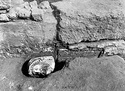
"Iron Pit" beneath house 634/20 and in the upper part of a well. Coins:
22 April 1958 #1-#3 (illegible)
23 April 1958 #1
25 April 1958 #1 (illegible) ... 1st C. B.C ... "Iron Pit" beneath house 634/20 and in the upper part of a well. |
Bits of broken molds and iron waste; no objects catalogued ... 4th-3rd c. B.C. |
Slag pit in front of South Stoa II. The filling consisted ... of a very miscellaneous lot of stone and marble. ... In among the stones was a loose filling of ash and charcoal and iron slag ... (nbpp. 6510, ... Second half 1st c. A.D ... Slag pit in front of South Stoa II. ... In among the stones was a loose filling of ash and charcoal and iron slag ... (nbpp. 6510, 6512). |
"Foundry Pit": N-S Cut on 50m. line (area of Stoa, Layer VII, with slag). A foundry pit in the courtyard of a small metalworking establishment outside the Agora to the northwest.
Both the courtyard and ... Ca. 375-350 B.C ... "Foundry Pit": N-S Cut on 50m. line (area of Stoa, Layer VII, with slag). A foundry pit in the courtyard of a small metalworking establishment outside the Agora to the northwest.
Both the courtyard and the pit preserved many traces of iron-working including slag, ash and charcoal, along with a considerable amount of pottery, figured, plain glazed and coarse, all fragmentary but constituting a homogeneous deposit, most of it rather earlier than the most developed material from Olynthos.
|
Early Roman pit at P/3-6/6,7
Layer 4a in Room 6 of Greek House δ, area P/2,3-6/6,8.
Pit in NW corner of Room 6 bounded by walls of Room to North and West, cut into preexisting layers to east, cutoff by ... 17 May 1971 ... Early Roman pit at P/3-6/6,7
Layer 4a in Room 6 of Greek House δ, area P/2,3-6/6,8.
Pit in NW corner of Room 6 bounded by walls of Room to North and West, cut into preexisting layers to east, cutoff by Byzantine pithos to South. ... Loose earth, red and black earth (especially black toward bottom); tiles, bones, carbon, glass, unidentifiable bronze pieces, very large iron nails with round heads, small iron nails, iron staples, plaster, some pieces of vitrified pottery.
|
| Herm head deliberately buried in a pit with coins of the 2nd half of the 4th c. Head found at an elevation of 51.907. Bottom of the pit at 51.637 m. Coins:
27 June 1972 #199-#205
Bits of bronze, iron ... 2nd half 4th c. B.C ... Herm head deliberately buried in a pit with coins of the 2nd half of the 4th c. ... Bottom of the pit at 51.637 m ... Coins:
27 June 1972 #199-#205
Bits of bronze, iron slag and bones. |
| Rodney S. Young ... Grave 8 in notebook. Bones discarded. Fragments of an iron pin found on the chest and a fragment of a Protogeometric krater base found beside the body were not inventoried.
JP
Unlined roughly rectangular ... LH III/EPG (date uncertain) ... Fragments of an iron pin found on the chest and a fragment of a Protogeometric krater base found beside the body were not inventoried.
... On the chest of the deceased the excavator noted remains of an iron pin, and at the right side of the skeleton a :conical foot" from an open vase. There was no evidence of any surviving cover slabs. the plain earth fill of the tomb pit yielded no sherds. |
Within the precinct of the Hephaisteion, about 10m. north of the north stylobate of the temple.
Flask-shaped pit (W. (bottom) 3.14 x 2.73m) probably originally intended as a cistern; used for dumping ... Ca. 375-310 B.C.-Byzantine ... Flask-shaped pit (W. (bottom) 3.14 x 2.73m) probably originally intended as a cistern; used for dumping waste from a metal furnace. A substantial mass of iron slag found at the bottom along with a thick waste of bricks, charcoal and sand and a quantity of pottery. |
| Rodney S. Young ... Grave 19 (In some records as Grave VIII). No remains, no burned matter or traces of burning.
JP
A small cutting with a single offering. The pit may have been for a simple child/infant inhumation, with ... Early Protogeometric ... JP
A small cutting with a single offering. The pit may have been for a simple child/infant inhumation, with the human remains totally dissolve or disintegrated. ... The floor of the pit comprised unhewn fieldstones packed closely together. The pit yielded no evidence of human remains, but a few small sherds were noted, one classified "Geometric" (not inventoried), suggested that this too, may have been a robbed Early Iron Age grave. |
| Laura Gawlinski ... Bronze foundry north of bridge on Piraeus street, east of Great Drain.
Keyhole-shaped bronze casting pit, cut into bedrock.
2016: Continuation of the excavation of a rectangular pit with foundry debris, ... Late 6th-early 5th c. B.C.
(Late Archaic/ Early Classical) ... Keyhole-shaped bronze casting pit, cut into bedrock.
2016: Continuation of the excavation of a rectangular pit with foundry debris, first excavated in 1949. Earlier material published by Mattusch, Hesp. 46 (1977): 374.
Pit cut into bedrock at west and north; fill continues beneath later wall (“Wall A”) at east. ... No evidence that casting took place in the pit itself.
No catalogued finds in 2016. |
| Eugene Vanderpool ... Rectangular pit, oriented east-west, cut party into filling of Early Protogeometric pit-well (I 18:4), to a preserved depth of about 0.30m. A late Byzantine wall founded below the floor of the grave destroyed ... Middle Geometric I ... Rectangular pit, oriented east-west, cut party into filling of Early Protogeometric pit-well (I 18:4), to a preserved depth of about 0.30m. ... In what survived of the west end of the tomb pit was found the well-preserved lower half of the skeleton, oriented east-west, cranium originally to the east. ... The tomb pit had a preserved length of about 1m and a width of ca. 0.80m. |
| Marcie Handler ... Cist grave for two infants. The grave was cut into a sterile rocky layer on its southern and western sides, and a sterile fill layer on its northern and eastern sides. No obvious grave marker was present, ... Early Iron Age |
|
|