|
|
| Extract from notebook ΠΘ XIX, pp. 3644-3646. Well at 105/ΝΗ (report on sorting of pottery, July 19, 1951 - H.S. Robinson).
"Not a useful well" HSR.
Well dug to 1.50m., vi/9/36; dug from 1.50m. to bottom ... Early Roman; use fillings of 2nd. c. B.C. and 1st. and 4th. c. A.D.; dumped filling of late 4th. c. (HSR)
Fill I: 2nd. c. B.C.
Fill II-V: to second half of 4th. c. A.D.
Fill VI: mixed to Byzantine ... Early Roman; use fillings of 2nd. c. ... A.D.; dumped filling of late 4th. c. (HSR)
Fill I: 2nd. c. ... A.D.
Fill VI: mixed to Byzantine. |
North of Eleusinion: Fill in Room 3 of Roman Building. 614 sherds (6 miniature shapes, 20 intrusive sherds).
Objects : terracottas; loom weights; spindle whorls; disks; handmade tray; lamps.
Early ware ... First half of 6th c. B.C.-Mixed Fill to ca. 480 B.C ... North of Eleusinion: Fill in Room 3 of Roman Building ... Objects : terracottas; loom weights; spindle whorls; disks; handmade tray; lamps.
Early ware : Gray Minyan; Mycenaean; Protogeometric-Late Geometric; imitation Corinthian.
... B.C. intrusions; much Mycenaean and Middle Helladic; 4th c. B.C; Roman; Byzantine; Turkish. |
| Deposit of terracottas, molds and pottery in a shallow pit sloping downward from north to south. This deposit was located beneath a layer of fill under a Late Roman plaster floor (Lots ΒΕ 2093-2095). The ... 1st c. A.D ... This deposit was located beneath a layer of fill under a Late Roman plaster floor (Lots ΒΕ 2093-2095). The deposit was cut at its south end by the Byzantine/Late Roman disturbance excavated in Lots ΒΕ 2087-2088, which explains the presence of terracottas in those contexts. ... Lot ΒΕ 2096-Lot ΒΕ 2102 Early Roman coarse: 6 tins with one sack of fine wares; terracotta figurines and mould fragments. |
Cistern at the southeast foot of Kolonos Agoraios.
Nbp. 2369: Two chamber cisterns, 88/ΛΔ and 100/ΚΘ, united by a long straight passage running almost due N-S. A draw shaft at 95/ΚΘ is set just off the ... Late 2nd-early 1st c. B.C.-86 B.C. |
| James Artz Pirisino Daniele Kylindreas Miltiades ... Excavation in Room 3 of ΒΘ West revealed 5 ceramic vessels in a row against the eastern face of Wall 12. 3 complete vessels (ΒΘ 122, 124, and 125) were catalogued, along with the base of a plain glazed ... 9th-11th c. A.D ... The primary types of glazed Byzantine pottery found in the fill included green and brown painted ware, plain glaze ware, Constantinople white ware, and monochrome glaze.
... In addition to the 3 vessels, a roof cover tile was mended from the tile debris in the same area, and 10 coins were found within the fill directly above and around the surface, mostly Anonymous Byzantine Folles datable to 1070-1075 A.D.
... A plaster layer was exposed and removed over the course of several baskets in the southern half of the eastern portion at an average elevation of 53.883m, and ceramic material from these layers date from the late 11th-early 13th century AD. |
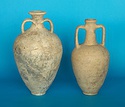
| Marcie Handler ... A deposit of six amphorae and one micaceous water jar was excavated between 20 June and 6 July 2005 in the area north of Wall K. The neck and one handle of one of the amphorae (BZ 1213) had been poking ... Ca. 1st c. A.D ... We removed two layers of fill in the area around this amphora, the first of which (lot 1540) was highly contaminated and contained material dating from the Late Geometric through the Byzantine periods. The second layer of fill (lot 1541) excavated around the amphora dated to the early Roman period (c. 1st century A.D.), and after we removed this layer of fill we revealed the outlines of five more amphorae and one micaceous water jar. ... NOTE: This deposit was first excavated 1-2 August 2001 as a "Late Roman layer with complete vessels" (elev. 53.040-53.370 masl, J/17,18-1/6,8). |
| Use filling of middle of 1st to late 6th c. (Roman Group M); dumped filling of 9th and 10th c. Down to a depth of about 21.00m. the fill of the well contained very few objects, the latest of them being ... 1st-6th c. A.D ... Use filling of middle of 1st to late 6th c. (Roman Group M); dumped filling of 9th and 10th c. Down to a depth of about 21.00m. the fill of the well contained very few objects, the latest of them being of the early Byzantine period (10th c. ... At 21.00m. there was a sudden change and very late Roman objects began to appear in great numbers.
|
|
|