|
|
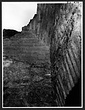
Water channel in north part of section. Pottery late 2nd.-1st. c. B.C. Coins:
14 March 1936 #8 ... Late 2nd.-1st. c. B.C ... Water channel in north part of section. Pottery late 2nd.-1st. c. B.C. |
Water channel in north part of section, giving access to water system. Channel Mouth 1. Six stamped amphora handles; two-thirds of bowls long-petal ... Late 2nd century-Early 1st c. B.C. |
| Well at 52/Ι, on the lower northeast slopes of the Areopagus. It was cut down and re-used in the late Roman period, in connection with the water channel. Use fill of 1st to early 2nd c.
Dump fill 5th to ... Early to Late Roman ... It was cut down and re-used in the late Roman period, in connection with the water channel. |
| Rodney S. Young ... Grave 7 in notebook (E.L. Smithson: Grave XXI: PG). Bones discarded. Disturbed and damaged cremation (originally trench-and-hole), the east end cut away, probably contained the burial urn.
JP
It consisted ... Late Protogeometric |
| Laura Gawlinski ... Bronze foundry north of bridge on Piraeus street, east of Great Drain.
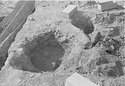
Keyhole-shaped bronze casting pit, cut into bedrock.
2016: Continuation of the excavation of a rectangular pit with foundry debris, ... Late 6th-early 5th c. B.C.
(Late Archaic/ Early Classical) |
| Shallow pit below layer I in Stoa Shop VI (Pyre)
Diameter 0.90; D. 0.15m Under shop VI of the Stoa of Attalos Pottery, ash, burning and packing of small stones in pit in stratum. The pyre was covered by ... Ca. 350 or 325 B.C. ? ... Layer II in turn covered a cobbled surface flush with a water channel. Two other pits with ash were found, but without pottery. The pyre must date at least as late as layer II, and probably not too much later. |
Well shaft cut through a cistern channel which was then packed with three amphorae (P 3123, P 3125, P 4201) of 1st or at latest early 2nd c. A.D. (These three amphorae could be considered with F 15:2) ... 3rd-4th c. A.D ... Well shaft cut through a cistern channel which was then packed with three amphorae (P 3123, P 3125, P 4201) of 1st or at latest early 2nd c. ... At 5.50 a group of fallen wall tiles arched over shaft which was empty to below 8.00 (at water level).
Lower fill 9.10-9.60m, 4th c. ... It seems more likely that tiles were robbed in late 4th c., one 1st c. amphora of packing fell in and then a 4th c. dump was dropped in, capped by tile fragments; later a 5th c. dump on top.
|
|
|