|
|
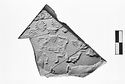
Part of base and side wall.
Medallion: probably a small rosette, surrounded by 5 rows of fronds and by a row of flying birds.
Wall: there remain Eros with torch and a large flying bird. East Stoa, northeast ... 12 June 1934 ... Mould for Megarian Bowls |
Base and part of wall.
Medallion: broken away; surrounded by triangular groups of fronds.
Wall: legs of a large figure moving left.
Wheel marks are fresh both inside and outside suggest that this is an ... 30 July 1937 ... Mould for Megarian Bowls |
| Clay: bright buff, hard and firm, retaining traces of oil on its inner surface. Another non-joining fragment added in 1934? East Stoa, from the filling behind the terrace wall, (Trench ι, north part, above ... October 1932 ... Mould for Megarian Bowls |
Fragment from rim.
Rim gone: a close set line of fronds, tips down above a line of double spirals from which depend at intervals small palmettes. East Stoa, northeast corner, beneath firm white floor ... 12 June 1934 ... Mould for Megarian Bowls |
Fragment from rim.
Rim zone: band of egg and dart above a guilloche.
On the wall there remains an arec flower. East Stoa, east end, layer II, beneath firm white floor ... 21 June 1934 ... Mould for Megarian Bowls |
Fragment from rim.
Rim zone: a line of double spirals above a line of ovules with double outline.
Wall: the remains a running bird within a dotted semicircle. WT 309.
Wall Trench T, disturbed filling south ... 28 August 1937 ... Mould for Megarian Bowls |
Clay: buff; fine, containing minute grains of mica. East Stoa; from the uppermost filling of the southern part (trench ι, south part) ... October 1932 ... Mould for Megarian Bowls |
Wall fragment, broken all around.
Rim zone: along its lower edge a line of ovules.
Wall: there remain a flying bird and part of a grape cluster? East Stoa, east end, Layer II, beneath firm white floor ... 16 June 1934 ... Mould for Megarian Bowls |
Clay: buff, yellow on the inner surface; fine and hard. East Stoa; clearing to the north of the terrace wall ... October 1932 ... Mould for Megarian Bowls |
Clay: buff, fine. Another non-joining fragment added later. East Stoa; clearing to the north of the terrace wall ... October 1932 ... Mould for Megarian Bowls |
Clay: buff, creamy of the inner surface; fine and hard. East Stoa; clearing the course of the terrace wall ... 1931 ... Mould for Megarian Bowls |
Two joining fragments from rim.
Rim zone comprises a line of palmettes above double spirals, above a beaded line, above egg and dart.
Wall: there remains the tips of lotus leaves with arec flowers between ... 16 June 1934 ... Mould for Megarian Bowls |
Two joining fragments from rim.
No rim zone.
On wall tall fronds alternated with lotus leaves, on lower wall are tips of lotus leaves from a calyx around base ? To east of east end of East Stoa, down to ... 16 June 1934 ... Mould for Megarian Bowls |
Wall fragment broken all around.
On wall there remains a broad leaf with jeweled mid rib; a daisy and other indeterminate space fillers between. WT 160.
Wall trench Q, Layer II, content of early III century ... Mould for Megarian Bowls |
Wall fragment broken all around.
On wall there remains part of a lotus leaf of a tendril. Northeast corner of East Stoa, beneath level of firm white strosis, where strosis was disturbed ... 15 June 1934 ... Mould for Megarian Bowls |
Wall fragment broken all around.
Rim zone: two double spirals remain.
Wall: tip of a large front with jeweled mid rib and tip of a smaller frond. Northeast corner of East Stoa, Layer II, beneath firm white ... 19 June 1934 ... Mould for Megarian Bowls |
Wall fragment retaining part of base ring.
Wall: covered by overlapping broad lotus (?) leaves.
On inner surface are fresh traces of graver. Southeast corner of East Stoa, from deepest red filling ... 12 June 1934 ... Mould for Megarian Bowls |
Non-joining fragments, one from base and two from wall.
Wall so far as preserved is covered by overlapping short fronds. East end of East Stoa, Layer II, beneath strosis ... 16 June 1934 ... Mould for Megarian Bowls |
Clay: red, buff on outer surface, fine and hard. Small non-joining wall fragment added later. East Stoa; from the upper filling of the south part of the area (trench ι , 8 m. from its south end) ... October 1932 ... Mould for Megarian Bowls |
Non joining fragments; one from rim, one from wall.
Rim zone: guilloche with one plain ridge above and two below.
Wall: covered with nodules as of a fine cone. East end of East Stoa; original red filling ... 29 June 1934 ... Mould for Megarian Bowls |
Wall fragment broken all around.
Wall: covered with nodules as of a fine cone. WT 270.
Wall Trench K, Layer III, content of early II century. 1264 ... 30 July 1937 ... Mould for Megarian Bowls |
Clay: buff inside; yellow outside; fine.
Medallion: head of Athena in Attic helmet surrounded by two rows of small fronds. East Stoa; filling behind the terrace wall ... 1931 ... Mould for Megarian Bowls |
Base and start of wall remains.
Medallion: a gorgoneion, very faint.
Wall: as preserved, covered by short, overlapping fronds.
Surface much rubbed. WT 269.
Wall Trench S2; red earth and debris to bedrock ... 23 July 1937 ... Mould for Megarian Bowls |
Clay: buff, fine, hard, retaining traces of oil on its inner surface. East Stoa; clearing north of the terrace wall ... October 1932 ... Mould for Megarian Bowls |
Clay: fine, buff, very slightly micaceous
The base is complete and retains a fragment of the side wall. On the base a ten leaved rosette surrounded by two raised lines. The lower side walls covered by ... 1931 ... Mould for Megarian Bowls |
Clay: buff, fine but showing some air holes; a little firm mica. Assembly Place, from the filling of Period III ... October 1932 ... Mould for Megarian Bowls |
Two rim fragments.
Rim zone: two plain ridges above, a band of double spirals below, between them palmettes, rosettes, standing birds and the tips of lotus leaves. East end of East Stoa, Layer II, beneath ... 5 July 1934 ... Mould for Megarian Bowls |
Rim fragment.
Rim zone: alternating sequence of rosettes and schematic plants rising from a line of double spirals above a band of egg and dart which is bounded above by two plain ridges, below by one ... 16 June 1934 ... Mould for Megarian Bowls |
Rim fragment.
Rime zone: alternating sequence of rosettes and fronds rising from a line of double spirals above a band of egg and dart which in bounded above and below by a plain ridge. East end Of East ... 14 June 1934 ... Mould for Megarian Bowls |
Rim fragment.
Rim zone: small fronds rising from a line of double spirals above a band of simple guilloche. WT 268.
Wall Trench δ5, surface earth. 1590 ... 24 August 1937 ... Mould for Megarian Bowls |
Rim fragment.
Rim zone: small fronds rising from a line of double spirals above a band of guilloche; two plain ridges between spirals and guilloche. East end of East Stoa, original red filling along south ... 26 June 1934 ... Mould for Megarian Bowls |
Clay: dull buff containing very firm grains of grit and mica. East Stoa; from the uppermost filling of the southern part (trench ι, south part) ... October 1932 ... Mould for Megarian Bowls |
Clay: pale yellow, fine, soft.
Rim zone: band of inverted palmettes below, the tip of a small frond and of something else of the right. Trench Θ, north half ... October 1932 ... Mould for Megarian Bowls |
Clay: yellow-green, containing very fine air holes. Trench Θ, northern half ... October 1932 ... Mould for Megarian Bowls |
Clay: fine, buff.
One quadrant of base and part of side wall remains.
Medallion of base probably plain, surrounded by two raised lines from which radiate narrow channels punctuated by dots and separated ... 1931 ... Mould for Megarian Bowls |
Two joining fragments, preserving part of base and wall.
Wall: long petals with jeweled lines between. Northeast corner of East Stoa, beneath firm white strosis ... 12 June 1934 ... Mould for Megarian Bowls |
Clay: Buff, fine. Assembly Place, surface ... 1931 ... Mould for Megarian Bowls |
Clay: bright buff inside, dull on surface, fine; containing minute grains of mica. Trench Θ, north half ... October 1932 ... Mould for Megarian Bowls |
Clay: Buff, fired to yellow on outer surface, fine. Another fragment, also from the rim, has been found to join with this. East Stoa, from the late filling along the north face of the city wall (Trench ... October 1932 ... Mould for Megarian Bowls |
Three rim fragments, non-joining.
Long petals alternating with jeweled lines which end above in small fronds; above the petals are two plain ridges. East end of East Stoa, original red filling along south ... 29 June 1934 ... Mould for Megarian Bowls |
|
|