|
|
| Lower half preserved. General type, as far as preserved, as P 24316 (ΣΑ 2526): This is the characteristic general type for the large proportion of the lekythoi from this group. Bell mouth with variations ... May-June 1954 ... Paralip., p. 182 (not mention in published version). |
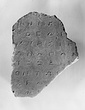
| Inscribed fragment.
Broken all around, save on left side which is smooth picked.
Decree in praise of a sacred embassy, a board of theoroi.
Part of eight lines of the inscription preserved, with one letter ... Early 3rd. century B.C ... ADDENDA A possible restoration can be made with mention of the herakleia and of sacrifices to Herakles. |
Shoulder fragment with thin, brown wash on inside near bottom. Max. dim. 0.043. Choes and Anthesteria, p. 80, cat. no. 170, fig. 287.
Youth (filleted head, much of torso, start of left arm, right hand) ... Ca. 425-400 B.C ... See also the brief mention by Beck, Album, p. 47 and by Rühfel, Kinderleben, p. 55. |
Wall fragment. Max. dim. 0.12. Schwarz, Triptolemos, p. 37, cat. no. V 49, pl. 8:14; Hayashi, Triptolemosbildes, p. 136, cat. no. 37, pl. 5:1 (wrongly called a calyx-krater); Langridge, "Eucharides Painter," ... Ca. 490-480 B.C ... The earliest preserved mention of Triptolemos' throne with the snakes is a fragment of Sophokles' tragedy, Triptolemos, which was probably first performed in 468 B.C. |
Bowl fragment. Max. dim. 0.032; est. diam. of tondo 0.14. H. A. Thompson, Hesperia 28, 1959, pl. 22:a, c.
I, around tondo, stopped-maeander pattern with cross-squares. A, nude man or youth (from the waist ... Ca. 490-480 B.C ... Kurtz (p. 70) in a brief mention of 1419 notes: "Dyfri Williams has recently assigned it [ 1419 ] to the Foundry Painter." |
Mended from many fragments with the missing pieces restored in plaster and painted, notably much of the wall under each handle and much of Side B. Ring on neck. Neck glazed on inside. Glaze abraded here ... Ca. 410 B.C ... Corbett saw that the drawing on 22 resembled that of the Talos Painter, but he concluded from the treatment of the hair and drapery that it is by another, less talented artist, a conclusion that seems correct, although one should mention specific similarities that draw 22 closer to the Talos Painter than to his contemporaries. |
Mended from many fragments, with missing pieces restored in plaster and painted, notable among them the left horizontal handle and part of the wall below it. Glaze fired greenish around left handle; abraded ... Ca. 430 B.C ... Perhaps one should also mention Brunswick 220, which is near the Hector Painter, on which a woman holds the end of a fillet in her mouth while she ties the rest of it around her head (ARV2 1037, 3; Matheson, p. 380, cat. no. |
|
|