|
|
The grid area is covered by 'modern bothros' nbp. 375 ... 1 June 1932 |
Lower fill may be original. Part of North side cut away by modern bothros wall. Fragments of Pilgrim Jug of Grey Ware, related to Turkish Grey Ware? ... 12th or 13th c. A.D. |
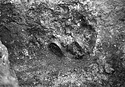
Pottery Deposit at 57/ΙΔ (also 57/ΙΣΤ and 63-66/Κ-ΚΕ). Contents of pit range from Mycenaean to Turkish; apparently the dump of a modern antiquities dealer ... Modern Context ... Contents of pit range from Mycenaean to Turkish; apparently the dump of a modern antiquities dealer. |
| Laura Gawlinski ... Bronze foundry north of bridge on Piraeus street, east of Great Drain.
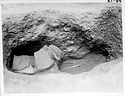
Keyhole-shaped bronze casting pit, cut into bedrock.
2016: Continuation of the excavation of a rectangular pit with foundry debris, ... Late 6th-early 5th c. B.C.
(Late Archaic/ Early Classical) ... Keyhole-shaped bronze casting pit, cut into bedrock.
2016: Continuation of the excavation of a rectangular pit with foundry debris, first excavated in 1949. ... Pit is 2.58m long (N-S), at least 1.35m wide; 0.66m at narrow north end; 1.36m deep. ... No evidence that casting took place in the pit itself.
No catalogued finds in 2016. |
| Rodney S. Young ... Grave 10 in notebook. No remains. Probably grave of a woman.
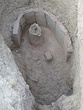
Only a small portion of the inhumation pit was preserved at the northeast edge of pit A, a large oval cutting of modern date dug for the construction ... Middle Geometric II ... Only a small portion of the inhumation pit was preserved at the northeast edge of pit A, a large oval cutting of modern date dug for the construction of a circular wall at its center, later used as a cess- pit. As preserved, the grave pit measured 0.48m wide; the remainder of the grave had been destroyed by the diggers of the later pit. |
Michael Laughy ... Debris pit, located in Room 2 of ΒΘ East. Pit measures ca. 2.30 by 1.70m., and nearly a meter deep. The pottery from the pit dates ca. 10th-12th c. A.D. The fill of the pit consisted of soft, black charcoal ... 10th-12th c. A.D ... Debris pit, located in Room 2 of ΒΘ East. Pit measures ca. 2.30 by 1.70m., and nearly a meter deep. The pottery from the pit dates ca. 10th-12th c. |
| Rodney S. Young ... Grave 8 in notebook. Bones discarded. Fragments of an iron pin found on the chest and a fragment of a Protogeometric krater base found beside the body were not inventoried.
JP
Unlined roughly rectangular ... LH III/EPG (date uncertain) ... JP
Unlined roughly rectangular pit cut into bedrock, measuring 1.71m long and 0.50m wide. the modern surface of what was known in the early 1930s as Plateia Theseiou sloped down toward the west; the bottom of the tomb at the east end was at a depth of 0.31m from the surface, and only 0.17m at the west end. the tomb was oriented east-west, with the head of the deceased toward the west. the skeleton, in part disturbed, was found on its back, arms by the side of the body. ... There was no evidence of any surviving cover slabs. the plain earth fill of the tomb pit yielded no sherds. |
| Eugene Vanderpool ... Grave (E.L. Smithson: Grave II: SM).
Unlined trench, roughly the size of the deceased, cut into bedrock to a depth of just over 1.50m. Oriented north-south, the tomb pit measured 1.69m in length (length ... Late Mycenaean/Submycenaean-Earliest Protogeometric ... Oriented north-south, the tomb pit measured 1.69m in length (length of the skeleton in situ, 1.65m), and had a width, as excavated, of 0.40-0.58m. the west side was slightly undercut, and a small part of the east side was cut buy the cellar wall of a modern house, but only the very edge of the tomb at an upper level was touched, whereas the contents of the grave were untouched. ... Within the tomb pit, the body of a middle-aged 45-49 years at death was placed in an extended position, on her back, head to the south. The body of the deceased was roughly the size of the tomb pit, and the head, turned toward the west, facing west-northwest, lay right up against the cutting of the tomb pit. |
| Rodney S. Young ... Grave 9 (E.L. Smithson: Grave XVIII: PG). Bones discarded.
JP
Roughly circular pit, about 0.59m in diameter, cut into soft bedrock to a depth of 0.42m. Tomb encountered only about 0.12-0.15m below the ... Protogeometric ... JP
Roughly circular pit, about 0.59m in diameter, cut into soft bedrock to a depth of 0.42m. Tomb encountered only about 0.12-0.15m below the modern surface of Plateia Theseiou. |
| Brian Martens ... Located in the southern section of Room I, now bound by the scarp of Wall U at the north,, the scarp of Wall L at the east,, and a modern pit at the south. At its now low elevations, excavated in the 2015 ... Third quarter of 5th c. B.C ... Located in the southern section of Room I, now bound by the scarp of Wall U at the north,, the scarp of Wall L at the east,, and a modern pit at the south. |
Rodney S. Young ... Grave 1 in notebook. Slightly disturbed by the digging of Pit A.
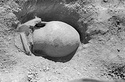
A large oil jar/amphora lay on its side with a flat stone stopping its mouth. The three small vases offered at the burial were found, together ... Ca. 600 B.C ... Slightly disturbed by the digging of Pit A.
A large oil jar/amphora lay on its side with a flat stone stopping its mouth. ... A bit of plaster A 443 probably a modern intrusion (RSY). |
Well at 15/ΙΕ = Pocket in side of Turkish Pit at 15/ΙΔ.
Shallow well on the lower slopes of the Acropolis, east of the Panathenaic Way, in the area later occupied by the Archaic Building.
Located 3.5m ... 700-675 B.C. with intrusions ... Well at 15/ΙΕ = Pocket in side of Turkish Pit at 15/ΙΔ.
Shallow well on the lower slopes of the Acropolis, east of the Panathenaic Way, in the area later occupied by the Archaic Building.
Located 3.5m north of the Archaic peribolos wall, in a spot later covered by the Temple of Triptolemos. The pit was disturbed by two Ottoman pits on the east and north sides and by the wall of a modern cellar sunk through part of it |
|
|