|
|
| Black glaze over all. From graves on S.E. slope of Hill of the Muses, just south of city wall, just above Mouseion St., brought in by former workman. Leica ... 21 May 1946 ... From graves on S.E. slope of Hill of the Muses, just south of city wall, just above Mouseion St., brought in by former workman. |
Fragment of rim and wall. Reserved band on inside of rim; another, 0.055 below rim. Glaze fired red on outside. P.H. 0.099; max. dim. 0.183; est. diam. at rim 0.38.
Apollo and the Muses(?). Apollo (wreathed ... Early 4th century B.C ... Apollo and the Muses(?). Apollo (wreathed head) stands to right, facing a Muse (head with earring and necklace, shoulders). ... White: wreath; flesh of Muses. Dilute glaze (mostly gone): jewelry; drawing on white; loose locks of right Muse's hair.
|
Wall fragment with start of rim. Max. dim. 0.048.
Woman (most of head, a bit of her himation) to left. Above, egg pattern with dots. Preliminary sketch. Dilute glaze: muscle of neck.
Some resemblance ... Ca. 470 B.C ... Some resemblance to the Muses on the calyx-krater in Schwerin, 706 = 1261, by the Villa Giulia Painter (ARV2 618, 6; Addenda 270), but I am not sure the hand is the same. |
| Broken at right. Top, bottom and left sides irregularly preserved. Back originally rough-picked but smoothed from reuse. Original relief ground chipped away on edges, particularly at top.
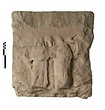
Preserved are ... 25 August 1977 ... The male figure is slightly larger than the females - perhaps he is Apollo and the women Muses or Nymphs. The surface is very battered.
|
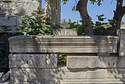
| Inscribed lintel block.
The left end is embedded in cement, but the dimensions appear to be fully preserved; a few large chips missing from the top, and the junction with the door posts broken away at ... 20 May 1933 ... Dedication to Athena Polias and the Emperor Trajan and the city of Athens by the priest of the Philosophical Muses, Titus Flavius Pantainos: the outer porticoes, the peristyle, the library with its books, and the entire establishment.
|
Two non-joining fragments, a preserving the shoulder, as well as the very low speira base. Fragment a is mended from many fragments, with the missing pieces restored in plaster and painted. Streaky, grainy ... Ca. 425-420 B.C ... Queyrel, BCH 108, 1984, pp. 126--127, fig. 5:a--c (fragment a); LIMC VI, 1992, p. 669, no. 104, pl. 399, s.v. Muses.
Apollo and Marsyas. ... Then come two more Muses (head, shoulders, raised right arm of one, her left foot) standing frontally, head turned toward her companion (part of torso missing). |
Three non-joining wall fragments. Dull, hard glaze on inside. Max. dim. a) 0.091, b) 0.075, c) 0.071. L. Talcott, Hesperia 8, 1939, pp. 268--269, figs. 1, 2 (the fragments have been relettered since this ... Ca. 470-460 B.C ... Gebhardt, in The Muses at Work: Arts, Crafts and Professions in Ancient Greece and Rome, C. |
|
|