|
|
| Pit (6x10) in the valley between the Areopagus and the Hill of the Nymphs. Large cutting in bedrock with 540 ostraka, mainly of the late eighties of the 5th. c. B. C. Much pottery, principally of the early ... Ca. 500-450 B.C. |
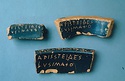
Ostrakon deposit, sand fill in a shallow channel in bedrock at the bottom of the Great Drain in the valley between the Areopagus and the Hill of Nymphs.
This group of ostraka may well come from a single ... Ca. 490-480 B.C ... Ostrakon deposit, sand fill in a shallow channel in bedrock at the bottom of the Great Drain in the valley between the Areopagus and the Hill of Nymphs.
|
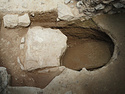
| Marcie Handler ... This deposit is a Mycenaean cist grave with two cover slabs, a type of burial described by Immerwahr in Agora XIII (pp. 103-104). Cist graves appear side by side with chamber tombs in the Mycenaean cemeteries ... LHIIB-LHIIIA:1 ... The fill on top of poros slab (Lot ΒΖ 2135) included pottery dating mostly to the late 8th c. ... B.C. and an Ostrakon of Xanthippos (ΒΖ 1983), providing a terminus post quem of 484 B.C for the fill that collapsed on top of the slab. The upper fill covering the boulder on the west end of the cutting (Lots ΒΖ 2128 and 2130) dated to ca. 500 B.C., and the fill lying directly on top of the boulder (Lot ΒΖ 2131) dated to the late 8th c. |
|
|