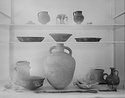
[Agora Deposit] O 13-14:1: Destruction Fill in Octagonal Room of Gymnasium and Rooms to North, including basement Room F

Destruction fill in octagonal room of Gymnasium and Rooms to North; also basement room F of late Roman Gymnasium ... Late Roman

icon

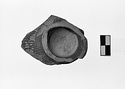
[Agora Object] P 19430: Moldmade Bowl Fragment

One fragment preserves center of floor and much of the high flaring foot. Moulded rosette surrounded by a ring of beads on underside within foot. The beginnings of the outside wall show petals. Megarian ... March 1948

icon

[Agora Report Page] 1971 Ω, s. 1

Ω 1971 End of Season Report. Roman House H. Ω 1971. Room 3A and Tunnel: Early Fountain House. Well. Courtyard. Room 5. Room 6: Bath. Other Rooms. History and Function. Function and Identification. Early ... 1971 Ω Q 21:5 Q 21:4 P 20:3 P 21:4 ... Other Rooms

icon

[Agora Deposit] B 17:1: Strosis

Herulian Debris in a house on the lower slopes of the Hill of the Nymphs: House P = South House; Room 2 = Dining Room; Room 3 = Kitchen; Room 18; Room 23; Room 24. Coins: 9 August 1947 #1-#37, #47-#49 ... Mid 3rd c. A.D.

[Agora Deposit] G 19-20:1: House A, destruction debris

House A destruction debris over floors. All floors (rooms 1-7) dug in 1939. Re-examination of House A in 1967 (nbpp. 648 ff.). Coins: 27 February 1939 #5-#9 7 March 1939: #1 9 March 1939 #4-#6 11 March ... First half 3rd. c. A.D.

[Agora Deposit] Q-R 13-14:1: Herulian Debris

Herulian debris over the Library of Pantainos. (Within this area the "Sculptor's Workshop", Iota, "Stoa" Room 1 has a group number of its own for the destruction fill R 14:2) (Note also that the "Bone ...

icon

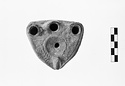
[Agora Object] L 5467: Three Nozzle Lamp

Intact. Disc plain; on rim herringbone. Top of lamp triangular with the three nozzles in a straight line across base of triangle. Unglazed. Very coarse flaky red clay. Cf. L 5479. Cf. Agora XXXIV, p ... 20 August 1965 ... ADDENDA Fragments of ca. 20 other lamps in container ... Basement rooms of Late Roman Gymnasium, on floor of north-south corridor, Room F.

[Agora Publication] Corinth V: The Roman Villa

Shear, Theodore Leslie ... American School of Classical Studies at Athens ... Excavated in 1925, the Roman villa at Corinth is famous for its well-preserved mosaics, showing goat herdsmen and other pastoral themes. Of rectangular design, they are curtailed or supplemented to fit ... 1930 ... Excavated in 1925, the Roman villa at Corinth is famous for its well-preserved mosaics, showing goat herdsmen and other pastoral themes. Of rectangular design, they are curtailed or supplemented to fit into irregularly-shaped rooms, leading to the author's suggestion that these were Late Hellenistic creations reused in a Roman context.

icon

[Agora Object] A 1645: Wall Crown with Molding: Painted

One end broken away; edges chipped. Anathyrosis on preserved end. Overhanging cornice on both sides; transition to resting surface on one side plain vertical, on the other cavetto and vertical. Considerable ... 25 May 1950 ... Overhanging cornice on both sides; transition to resting surface on one side plain vertical, on the other cavetto and vertical. ... East of Stoa Rooms 17-16, on bedrock.

icon

[Agora Report] 2009 Excavations

Preliminary Report on the 2009 Excavation Season ... John McK. Camp II ... Excavations were conducted in four sections: Γ, ΒΘ, ΒΗ and ΒΖ. In Section Γ, the investigation of the Classical buildings south of the Tholos continued with the aim to find out if they were civil, commercial ... 8 Jun-31 Jul 2009 ... Various other features were found, such as pithoi and pits. ... The rubble walls dividing the stoa into rooms were also removed. These rooms were built in the 5th and 6th centuries, and were probably used as shops.

icon

[Agora Notebook Page] ΟΟ-10-6 (pp. 1802-1803)

Summaries. Northwest Room. Poros Building. Roman Houses at South. House C; Rooms 1, 2, 4, 5. House C'; Rooms 3, 6, 7, 8, 9, 10. House D'. House B. Bath; =Building A. East Wall Line; Poros Building. Poros ... ΟΟ-10 1802, 1803 ... 1949 ... House C; Rooms 1, 2, 4, 5 ... House C'; Rooms 3, 6, 7, 8, 9, 10 ... Other 4th B.C. above Poros Building

icon

[Agora Deposit] B 19:6: Pyre in House N, Room 4

Pyre in House N, room 4 (RSY=Pyre 7), in the industrial area west of the Areopagus. Pottery, mall pieces of calcined bone, log, wood cinders, and charcoal in diamond-shaped pit in floor sequence. The pyre ... Late 4th-early 3rd c. B.C ... Layer 4 ran over the foundation of the wall between rooms 5 and 6; a layer of decayed mudbrick covered layer 4. ... It is possible that this is a double pyre of some sort, with two different groups of people combining their offerings, or an instance of two pyres deposited one on top of the other with a very short interval of time between them.

[Agora Webpage] AgoraPicBk 16 2003: Southwest Area

http://agathe.gr/guide/southwest_area.html

Southwest Area - Industry and Houses Leaving the area of the boundary stone, one can head southwest up a valley leading toward the Pnyx, meeting place of the Athenian assembly. Here are the complex remains ... The Poros Building at the top (north) has been tentatively identified as the State Prison. The other walls and wells represent private houses dating from the 5th century B.C. to the Byzantine period. One larger structure, the so-called Poros Building, has a long corridor flanked by square rooms, with a courtyard at the rear (Fig. 28).

icon

[Agora Report] 2007 Excavations

Preliminary Report on the 2007 Excavation Season ... John McK. Camp II ... Excavation continued this year in the sections ΒΖ, ΒΗ and Γ. In Section ΒΖ South, two areas were investigated: the north-south road and the areas west of the road. In the road, hard-packed gravel surfaces ... 13 Jun-3 Aug 2007 ... It seems to have been a building of at least six rooms/shops set side-by-side along the street. ... Excavation in other fills went down to late 8th and early 7th centuries B.C. ... In Section BH, the last of the 10th/11th century walls and other Byzantine installations were cleared and excavation continued into late Roman fills.

[Agora Webpage] Birth of Democracy: The Popular Courts

http://agathe.gr/democracy/the_popular_courts.html

The Popular Courts The popular courts, with juries of no fewer than 201 jurors and as many as 2,500, heard a variety of cases. The courts also had an important constitutional role in wielding ultimate ... One such building has been found at the northeast corner of the Agora square. Other public buildings are also known to have been used for court sessions. ... Bronze ballots and a ballot box were found in a complex of rooms constructed in the late 5th and 4th centuries B.C. and identified on the basis of these finds as lawcourts. ... Names of litigants and, possibly, other relevant persons follow.

[Agora Webpage] AgoraPicBk 4 2004: Judiciary and Lawcourts

http://agathe.gr/democracy/judiciary_and_lawcourts.html

Judiciary and Lawcourts The lawcourts of Athens, a city notorious throughout Greece for the litigiousness of her citizens, were both numerous and large. Several of these lawcourts were in the immediate ... In one of the small rooms of this predecessor was found a curious container (24): two up-ended water channel tiles fixed in the floor. ... The hub of the ballot indicated the verdict (solid for acquittal, hollow for condemnation), so that each juror, holding one ballot in each hand with the thumb and forefinger covering and concealing the ends of the hub, could deposit the one which represented his vote in the official receptacle and put the other in the discard bin. 24. ... One of the speechwriters, Isokrates, makes his client speak as follows: “Now about the other men he has plotted against, and the suits he has brought and the charges he has made, and the men with whom he has conspired and those against whom he has sworn falsely, not twice the amount of water would be sufficient to describe all these.”