|
|
Wall fragment from near handle with a conical protuberance (mastos[?]). Max. dim. 0.091.
Palmette (ends of fronds).
For a similar protuberance, but as a pair, see the bell-krater, New York, M.M.A. 07.286.81 ... Probably third quarter of the 5th century B.C ... For a similar protuberance, but as a pair, see the bell-krater, New York, M.M.A. 07.286.81 by the Achilles Painter (ARV2 991, 61; Paralip. 437, 61; Addenda 311). |
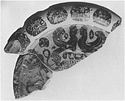
| Two joining fragments give somewhat less than half. Floor: a pair of sphinxes facing, flanked by others. Rim: incised rosettes, two suspension holes. Reverse: part of a large sphinx which fills all the ... End. 2nd. qtr. 6th. c. |
Wall fragment. Max. dim. 0.075.
Wedding scene. At the left is the bride (mostly preserved from shoulders to knees), dressed in a himation, being led by the groom (right arm, his hand clasping her left ... Ca. 430-420 B.C ... For the composition of the pair, cf. Amsterdam inv. 3495 by the Sabouroff Painter (ARV2 841, 76); Toronto 929.22.3 = 635 by Polygnotos (ARV2 1031, 51; Addenda 317; Matheson, Polygnotos, p. 358, cat. no. P 56, pl. 56); once London Market by the Naples Painter (ARV2 1099, 46 bis), which seems closest to 100; Erlangen 301 near the Naples Painter (ARV2 1102, 3); two by the Washing Painter: Vienna 2027 (ARV2 1127, 11; Addenda 332) and Houston 37.12 (ARV2 1127, 13; Addenda 332; Reeder, Pandora, pp. 163--165, cat. no. 23). |
Floor fragment with start of stem. Glaze somewhat pitted on underside. Max. dim. 0.059.
I, youth or man (torso, part of legs) kneeling to right. In front of him, start of another figure, probably a woman ... Ca. 450 B.C ... Red: inscription.
The pair is probably having intercourse. Cf. the Triptolemos Painter: Tarquinia (ARV2 367, 93; Addenda 223). |
|
|