|
|
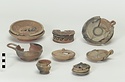
| Contents of Pithos Y; probably belonging to sacrificial pyre III.
In northern corner of courtyard. Characteristic pyre pottery in fill of one of two pithoi set into the floor of the courtyard as part ... 400-350 B.C ... Characteristic pyre pottery in fill of one of two pithoi set into the floor of the courtyard as part of 4th c. reconstruction (phase 3). |
Well 12: Archaic.
It lies on a rocky ledge about thirty meters north of the Klepsydra, just east of the Panathenaic street. In spite of its depth, it produced little pottery and its contents were of slight ... 6th c. B.C.? ... In the well were not merely the usual quantities of domestic wares, pithoi, tubs and the like, of broken up terracotta rooftiles and crude brick; there was also a number of building stones: three large blocks of poros from some archaic structure, and many small carefully dressed blocks of Acropolis limestone from a polygonal wall or walls. |
Disturbed "Votive Deposit" at 27-28/ΙΖ-ΙΗ
Reddish fill in five circular cutting in bedrock, considered by the excavators to have been one deposit. Fill was disturbed in later periods, probably by construction ... 7th c. B.C, with intrusions ... Fill was disturbed in later periods, probably by construction of pithoi. Deposit was found 4-5m east of Rocky Outcrop. |
Well 19: Latest Mycenaean. Near Klepsydra. Diameter mouth 1.25-1.35m., narrowing about a third of the way down and becoming rectangular, 0.90-1.0 to a side. Muddy at m; water collecting rapidly at 8.m ... Late Mycenaean ... Above, two dumped strata of domestic debris, storage pithoi, architectural fragments, quantities of stones from walls (in upper), grindstones; commonest and latest pottery post-fountain.
|
| A cave-in not long after the digging of this shaft destroyed its possible usefulness as a well and thereafter it was used as a dump. Two principle periods of such use were noted, and within these several ... Ca. 575-480 B.C ... This was sorted all together, and regrouped by "Kind', lettered under these numbers, as follows (6 tins).
a) Large black glaze amphora; other large pots.
b) Wine jars; black glaze.
c) Cooking ware.
d), e), f) Roof tiles, pithoi, tubs.
Nos 324-327: were kept out so as to make up the joins which they contained, p. 1340.
|
| Eugene Vanderpool ... Grave (E.L. Smithson: Grave II: SM).
Unlined trench, roughly the size of the deceased, cut into bedrock to a depth of just over 1.50m. Oriented north-south, the tomb pit measured 1.69m in length (length ... Late Mycenaean/Submycenaean-Earliest Protogeometric ... A roughly rectangular stone slab rested on the ledges above the head of the deceased, while fragments of a pithos (or pithoi), also resting on the ledges, covered the deceased down to the thighs. |
Mycenaean Deposit (Gully) in front of NE Stoa (corrected from P 7:1).
It consisted of a series of irregular pits, some gradually linked up with one another to form what seemed a natural gully. The largest ... Mycenaean IIIA-B ... The gully itself ran in a southwesterly direction and yielded about twenty small painted sherds, fragmentary cooking pots, unglazed kylix stems, fragments from pithoi and other coarse pots, as well as part of a stone grinder and many animal bones.
|
|
|