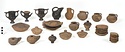
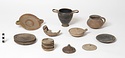
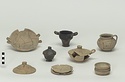
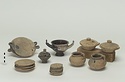
|
|
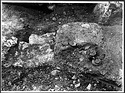
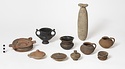
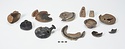
| Pyre in House N, room 4 (RSY=Pyre 7), in the industrial area west of the Areopagus.
Pottery, mall pieces of calcined bone, log, wood cinders, and charcoal in diamond-shaped pit in floor sequence. The pyre ... Late 4th-early 3rd c. B.C ... Pyre in House N, room 4 (RSY=Pyre 7), in the industrial area west of the Areopagus.
... The pyre came to light just below the surface of layer 4, with the pit going down into layer 5, the floor associated with phase 3 of the house. ... The pyre seems to have been dug into layer 4, which was then patched and continued in use. |
| Pyre in Room 1, area west of street (RSY=Pyre 11).
Early in the third quarter of the 4th. c. B.C.
In courtyard. Artifacts, bone, and cinders in irregular pit in floor sequence. The pit had been dug into ... 350-330 B.C. |
| Pyre in Room 8 of Roman House H. Concentration of artifacts, bone, and flecks of carbon in stratum, no pit discerned. the pyre lay within a red fill apparently contemporary with it, but with some later ... 300-290 B.C. |
| Pyre in layer 8a in SW corner of Room 7 of Greek House δ.
Oval pyre; 0.60 (n-s)x 0.35 (e-w).
The pyre was covered by the surface of layer 8 and extended slightly into layer 9 below it. Small bone fragments, ... 325-300 B.C. |
| Pyre in House T, Room 1, Layer 5-6 (RSY=Pyre 3) in the industrial area west of the Areopagus.
First quarter 4th. c. B.C.
Artifacts, bone, and cinders in pit in floor sequence. The pyre was found in digging ... 400-375 B.C.(?) |
| Pyre in House D, Room 4 (RSY=Pyre 4) in the industrial area west of the Areopagus.
Notebook refers to House N.
Pottery belongs late in third quarter of the 4th. c. BC. Pyre burned near beginning of last ... 350-300 B.C ... Pyre in House D, Room 4 (RSY=Pyre 4) in the industrial area west of the Areopagus.
Notebook refers to House N.
Pottery belongs late in third quarter of the 4th. c. ... Hence the pyre may postdate the abandonment of the house considerably. |
| Pyre in layer "9d" in SW corner of Room 6 of Greek House δ. Ashes and fragments of small bones ... Ca. 225 B.C. |
| Pyre 1 in Central House, Room XI, strosis 3. Sacrificial pyre with characteristic small vases amid carbonized twigs and bone.
Near north side of courtyard. This pit was cut slightly into strosis 3 (lot ... 1st quarter 4th c. B.C. |
| Pyre in House N, room 2, layer 5 (RSY=Pyre 8).
Near northern corner of room 6. Artifacts, bone, burnt logs, and cinders in square pit dug from level of layer 5, through layers 5 and 6; thin clay floor ... 325-300 B.C ... Pyre in House N, room 2, layer 5 (RSY=Pyre 8).
... Young identified layer 6 as the latest house floor and concluded that this pyre was buried after the abandonment of the house. ... The stratigraphic situation may therefore indicate a renovation rather than abandonment. The pyre lies well below the mudbrick layer of wall decay in this room. |
| Disturbed pyre dispersed in fill of Room 5, House D.
Pyre pots in very fragmentary condition were noticed by Barbara Tsakirgis in later analysis of pottery that had been excavated in 1938; no mention of ... 14 June 1938 ... Disturbed pyre dispersed in fill of Room 5, House D.
Pyre pots in very fragmentary condition were noticed by Barbara Tsakirgis in later analysis of pottery that had been excavated in 1938; no mention of them was made at the time of excavation.
The fill in which they were found lies partly over the continuation of the eastern wall of the house. |
Greek House J, under room 8 of Roman House H.
Typical though very fragmentary pyre pottery lay dispersed in a stratum over bedrock with pottery ranging from the 5th to the mid-3rd c.
In same general area ... Early 4th c. B.C.? ... Greek House J, under room 8 of Roman House H.
Typical though very fragmentary pyre pottery lay dispersed in a stratum over bedrock with pottery ranging from the 5th to the mid-3rd c.
In same general area as pyre Q 20:4, it must come from a different, earlier pyre. |
| Rubbish Pit . Pit cut through a house floor. In courtyard, beside door to room 3. Artifacts, bone and scattering of large cinders in roughly rectangular pit dug through floor bedding and covered by red, ... 325-300 B.C. |
|
|